New York

Sculptures Remix Modern Art and Native American Tradition

As part of our ongoing partnership with Beautiful/Decay, today we bring you an article about the work of Brooklyn-based Jeffery Gibson, who explores his Choctaw and Cherokee background in a solo exhibition at Shoshana Wayne Gallery through October 26. Author Danny Olda notes, “Gibson inserts himself and his heritage into art history: by […] smart mixing and remixing.” This article was originally published on September 11, 2013.

Jeffrey Gibson. Portal, 2013; elk hide over birch panel, graphite, acrylic and oil paint; 60 x 48 x 2 1/2 in.

Jeffrey Gibson. Portal, 2013; elk hide over birch panel, graphite, acrylic and oil paint; 60 x 48 x 2 1/2 in.

Artist Jeffrey Gibson blends art histories and cultures with seeming effortlessness. His work isn’t the pastiche of past decades, a witty pairing of disparate influences. Rather, Gibson’s work appears more to be rooted in contemporary remix culture. Portions of modern and contemporary art styles inhabit art pieces along traditional Native American artwork with an inclusiveness that’s refreshing. Interestingly, the gallery statement of his latest exhibit at Shoshana Wayne Gallery notes:

“This mash-up of visual and cultural references comes from the artist’s Choctaw and Cherokee heritage, moving frequently during his childhood—to Germany, Korea and the East Coast of the U.S. , and his early exposure to rave and club cultures of the 1980s and 1990s. Gibson cites that the sense of inclusiveness and acceptance, the celebratory melding of subcultures and an idealistic promise of unity all galvanized by the DJ’s power to literally move an audience to dance to his beat, continues to serve as a primary inspiration for his inter-disciplinary practice.”

Read the full article here.

Share

Elsewhere

Victoria Fu: Belle Captive at Emerson Dorsch

In a time when appropriation has become seamlessly integrated into contemporary art practice, it’s not easy to provide a precise definition for such an increasingly amorphous concept. Jan Verwoert offers a robust description, calling appropriation “an intense sense of an interruption of temporal continuity, a black out of historical time that mortifies culture and turns its tropes into inanimate figures, into a objectified, commodified visual material, ready to pick up and use” [emphasis mine][1]. This last segment of Verwoert’s phrasing is intriguingly applicable to Victoria Fu’s current exhibition Belle Captive at Emerson Dorsch, in Miami, in which her two videos rely on the appropriation of stock footage.

Victoria Fu. Belle Captive I, 2013; installation view, Belle Captive, 2013. Courtesy of Emerson Dorsch, Miami.

Victoria Fu. Belle Captive I, 2013; installation view, Belle Captive, 2013. Courtesy Emerson Dorsch, Miami

In the gallery’s main exhibition space, at one end of the open room, Belle Captive I (2013) is projected at a large scale onto and spilling beyond a temporary wall erected in the gallery. The other iteration, Belle Captive II (2013), appears at a much smaller scale on the gallery’s adjacent wall alongside sculptural cutouts of three blank portrait silhouettes—akin to Facebook placeholder images for those lacking profile pictures. Each video is about six minutes in length and continuously looped, and the videos follow a similar archetype consisting of montages of stock footage in the foreground and abstracted 16mm footage of sunsets in the background. Even though the clips are obscure, they certainly read as familiar: images of a young girl waving, a dog lapping up water, a lusciously red tomato, and men and women in suits holding blank signs could easily be inserted into any of the ubiquitous advertisements that pervade our daily existence. Fu’s usage of stock footage here removes these banal images from the commercial environments for which they were intended, similar to the actions of artists using appropriation strategies in the 1970s.

Read More »

Share

Toronto

Ruinophilia: Luke Painter’s Rebound at Le Gallery

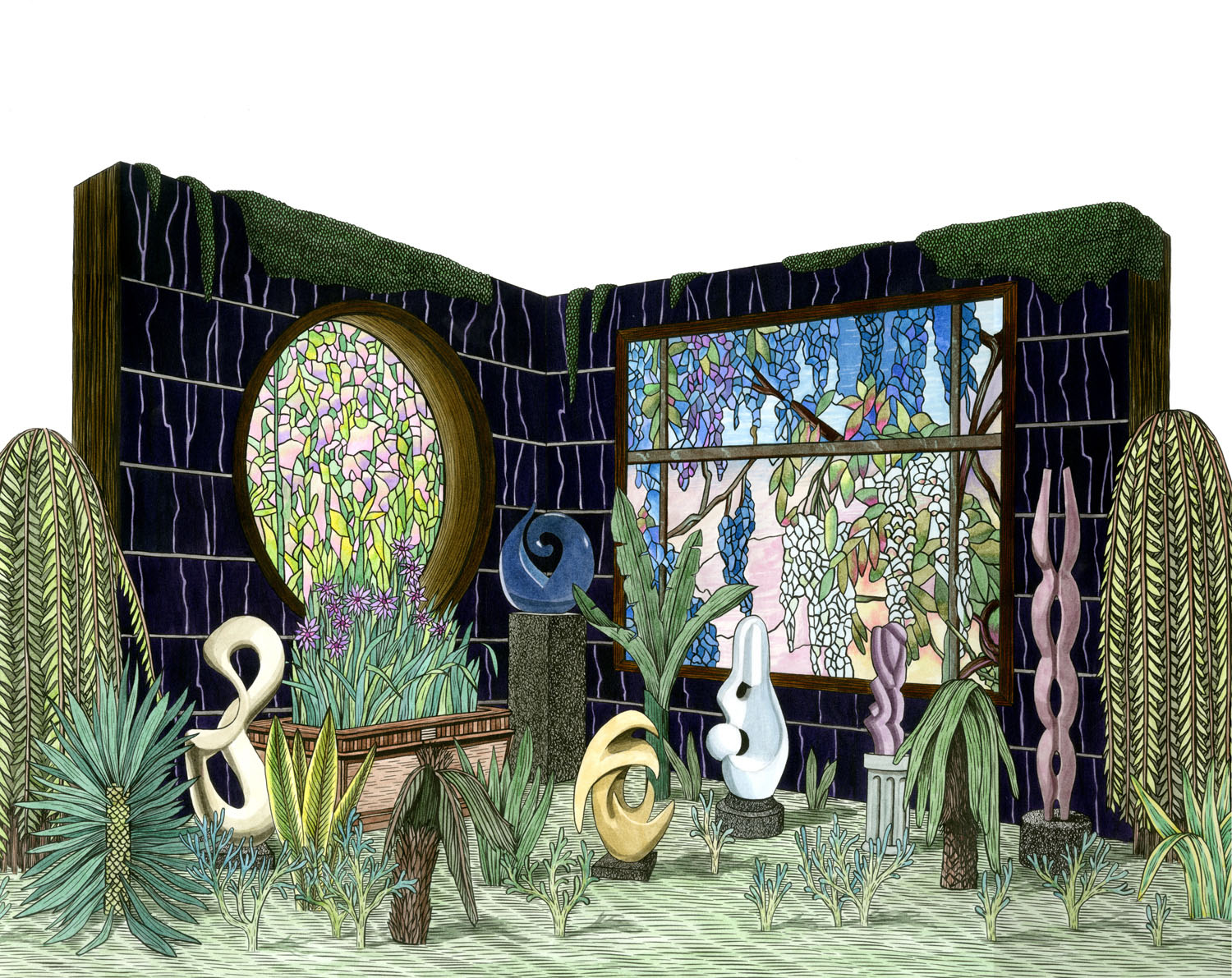
There’s something dark and morose underlying Luke Painter’s surreal, methodical drawings installed at Le Gallery on Toronto’s Dundas Street West. While the compositions and their titles are playful in their kitschy pop-cultural references, the flattened perspective field, broken architectural fragments, and dampened chromatic tones create a sense of uneasiness within the viewer.

Painter_modern_art_sculpture_garden

Luke Painter, Modern Art Sculpture Garden, ink on paper, 2013 17 1/2  x 21 in. Image courtesy the artist and Le Gallery

Painter is traditionally trained as a printmaker, though over the last number of years his practice has transitioned to focus on drawing and painting with a compulsive—at times almost neurotic—attention to detail. These compositions are rooted in a pastiche appropriation of historical patterns and architecture beginning with the Arts and Crafts movement. In Rebound, his current solo exhibition at Le Gallery, Painter turns to the 1980s, pinpointing revivalist trends in the decorative arts: Louis Comfort Tiffany, Art Nouveau, Memphis design, Art Deco, and neo-Gothic architecture.

Read More »

Share

Chicago

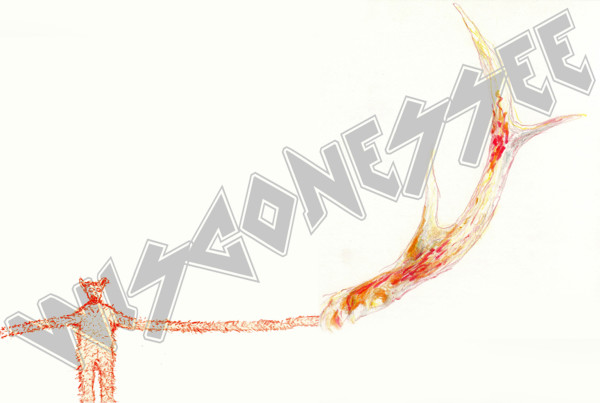
Avenging Ancestors, Failing Spectacularly: Wisconessee at Kasia Kay Projects

If you’re at all interested in seeing Wisconessee, Duncan R. Anderson and Daniel Bruttig’s semi-collaborative two man show at Kasia Kay Projects, I can tell you right now there’s a good chance you’ve already seen it. Typically, I’m not one to write a negative review for the sake of teeing off on artists who are just trying to get some work out there. But this show is typical of the broader cultural trend of favoring work that’s long on stylish cynicism, full of derivative posturing, and the worst kind of irony. It’s an established and mechanically rehearsed drift that is certainly worthy of comment.
wisconesseecardfront

Wisconessee simply can’t mask its own clichés. The exhibition checks off so many of the familiar tropes associated with hip urban bohemia the artists may as well have used a “Best of” collection from Juxtapoz as their creative blueprint. Barry McGee–style clusters of individually framed art pieces are faithfully reproduced in what has become practically a mandatory installation strategy. Half-man/half-animal composite creatures so dutifully inhabit the artists’ “personal mythologies” that Maurice Sendak’s estate should be collecting royalty checks. If shows like Wisconessee represent a common metaphorical language of childhood experience and Gen X/millennial angst, then that language is now a babble, tongue-tied and hoarse from exhaustive repetition. Unintentionally, the show is less a collection of works by two individuals and more like a taxonomy of popular signifiers of self-conscious alienation and the postures of marginality so common among young urban creative types. They quote The Smiths, for fuck’s sake!

The most glaring locus of these issues resides in the large groups of colored-pencil and marker drawings. When done effectively, a critical mass of pictures can speak to the concept of Internet-era image overload. Here, similar use of materials and the close arrangement of images are meant to blur distinctions between Anderson’s and Bruttig’s work. And yet certain individual themes begin to emerge through careful viewing.

Read More »

Share

New York

Charles Gaines and Sol LeWitt at Paula Cooper NYC

Two shows at Paula CooperSol LeWitt: Wall Drawing 564 and Charles Gaines: Notes on Social Justice—knowingly nod at each other from their respective spaces across West Twenty-First Street. Wall Drawing 564: Complex forms with color ink washes superimposed (1988) holds court in Cooper’s large, dramatic exhibition hall surrounded by roughly contemporaneous structures and works on paper, and the immersive drawing exhibits LeWitt’s sustained interest in the grid and the architecture of optics with colorful bravura. Across the way, less colorful but no less stunning, Charles Gaines: Notes on Social Justice presents a new series of systems-based drawings: musical scores with lyrics sourced from political manifestos that consider the relationship between reading, looking, and aesthetic experience. Although seemingly unrelated, Gaines and LeWitt are significant players in the life and afterlives of Conceptual art. As stated in LeWitt’s 1967 “Paragraphs on Conceptual Art,” “The idea becomes a machine that makes the art…It is usually free from the dependence on the skill of the artist as a craftsman.” [1] These shows illuminate how far one can push drawing—that original litmus test of artistic skill—away from traditional notions of authorship and the artist’s hand.

Sol LeWitt. Wall Drawing #564: Complex forms with color ink washes superimposed, 1988; installation view, Sol LeWitt, 2013. Courtesy of Paula Cooper Gallery, New York. Photo: Steven Probert.

Sol LeWitt. Wall Drawing #564: Complex forms with color ink washes superimposed, 1988; installation view, Sol LeWitt, 2013. Courtesy Paula Cooper Gallery, New York. Photo: Steven Probert

Both exhibitions show parts of these artists’ oeuvres that may be somewhat strange to viewers. Wall Drawing 564 is unlike LeWitt’s early wall drawings composed of orthogonal lines and his slick, hard-edged Pop-colored wall drawings. Executed by a highly skilled team, it is majestic in scale (it fills all three walls floor to ceiling) and color (ink wash applied with rags onto adjoining facets of large geometrical forms), invoking the architecturally bound, spiritual sublime of the Italian frescoes that so moved LeWitt when he lived in Spoleto, Italy, in the late 1970s. A stark, white structure, 12 x 12 x 1 TO 2 x 2 x 6 (1990) stands in an adjacent room as a reminder that the grid and its permutations undergird the architecture, optics, and aesthetics of everyday experience as well as LeWitt’s strictly conceptual investigations. When one is enveloped by the three walls of Wall Drawing 564, the grid governs which forms recede and which hover in its frames, just as it structures the shifting volumes and forms of 12 x 12 x 1 TO 2 x 2 x 6. Despite LeWitt’s well-known proclivity for the conceptual, Wall Drawing 564 does not eschew what he described as “perceptual,” or “meant for the sensation of the eye primarily.” [2]  Then again, as he noted in the same text, “it doesn’t really matter if the viewer understands the concepts of the artist by seeing the art.” Here we might rethink the traditional interpretation of LeWitt’s theory of Conceptual art—aesthetics may not matter, but seeing does.

Read More »

Share

Help Desk

Help Desk: Padding the Resume

Help Desk is an arts-advice column that demystifies practices for artists, writers, curators, collectors, patrons, and the general public. Submit your questions anonymously here. All submissions become the property of Daily Serving. Help Desk is co-sponsored by KQED.org.

Help Desk Leader

Artists are routinely asked to donate work toward the benefit of an organization. I have reached the point where I am just not sure how my participation ranks along with my overall exhibition history. Also, benefit shows vary greatly in scope and prestige. With some, artists are carefully selected, and others—well, we simply add to the giant pot in order to be able to help out in what little way we can. So what (if any) is a suitable way to list auctions, charitable donations, or benefit shows on one’s CV? Do they go in the “Select Group Exhibitions” category? Do they need an asterisk of some kind? Do they get their own section? Or do they stay out altogether? Furthermore, when panels or curators view résumés, do they view these things as positive qualities or simply as résumé padding?

The short answer is that there is not only one answer. There’s a bit of confusion about CVs and résumés, since the two terms are often interchangeably used. However, you might want to think about your CV as an all-encompassing master document that lists every show, residency, award—and yes, charity auction—that you’ve ever participated in. After all, CV is short for curriculum vitae, or “the course of one’s life,” and it’s a good idea to keep such a document for your future biographers so that they get the facts straight when they’re writing about your early years.

Oscar Tuazon. Sensory Spaces, 2013; installation view, Museum Boijmans Van Beuningen, Rotterdam. Courtesy of Museum Boijmans Van Beuningen. Photo: Studio Hans Wilschut.

Oscar Tuazon. Sensory Spaces, 2013; installation view, Museum Boijmans Van Beuningen, Rotterdam. Courtesy of Museum Boijmans Van Beuningen. Photo: Studio Hans Wilschut

Your résumé, on the other hand, is a document that usually has a prescribed length (“no more than two pages”) and should be tailored to the position for which you are applying. I checked in with Bert Green of Bert Green Fine Art in Chicago, and he also expressed this opinion:

“An artist’s exhibition résumé is intended to give as complete a picture as possible of how widely and well the artist’s work is exhibited and to demonstrate an involvement in and commitment to the art world. Some artists maintain two exhibition résumés, a comprehensive version with every single exhibition they have ever participated in and a shorter version that is used publicly, to save space and emphasize quality. Generally the comprehensive version is not shared, but it is a good idea to maintain one as a document for posterity.”

Read More »

Share

From the Archives

From the Archives: Diana Al-Hadid

Today in From the DS Archives, we bring you a review by Seth Curcio on the work of Diana Al-Hadid. Al-Hadid makes large-scale, mixed-media sculptures, and she currently has a solo exhibition at the Savannah College of Art and Design Museum in Savannah, Georgia. This article was originally published on November 19, 2007.

Diana-Al-Hadid-11-19-07 .jpg

Diana Al-Hadid. Record of a Mortal Universe, 2007; mixed media, 128 x 138 x 106 in.

Stepping into the Perry Rubenstein Gallery in New York City is a little like stumbling upon a musical shipwreck. Diana Al-Hadid has used plaster, fiberglass, wood, polystyrene, and cardboard to create a romantically ramshackled and dilapidated sculpture, Record of a Mortal Universe (2007), which is based on the phenomenon of a hero’s collapse. Sourcing religion, architecture, and physics, Al-Hadid’s pointed and varied references unfold within the work, from a grand staircase that leads to a decomposing Greek temple to an upside-down vaulted arch and melted pipe-organ pedals. A gramophone extends through a ring of decrepit temple columns and crumbling Gothic buttresses, making the sculpture seem as though it has appeared, tattered and torn, from the background of a painting by Hieronymus Bosch.

Read More »

Share