San Francisco

A Rose Has Bite

As part of our ongoing partnership with Art Practical—and to celebrate its new website—today we bring you an article that considers the exhibition A Rose Has No Teeth: Bruce Nauman in the 1960s. Written by Leigh Markopoulos and originally published on September 11, 2013, the article looks at Nauman’s exhibition, its legacy, and the questions it raises for the future. Markopoulos asks, “If we accept that Nauman is a great artist and that his time in the Bay Area influenced him, and if we allow that the exhibition supports this point of view, then why not use this understanding as a starting point for the further excavation of our local art histories?”

Bruce Nauman. From Hand to Mouth, 1967; wax over cloth; 28 x 10.13 x 4 in.

Bruce Nauman. From Hand to Mouth, 1967; wax over cloth; 28 x 10.13 x 4 in.

The exhibition as a medium for the presentation and consumption of art and the question, “What makes a great exhibition?” have increasingly come under examination in recent years. An exhibition is a fleeting and ephemeral construct, residing more in time and space than in material documentation. The title often reveals very little. The catalogue presents scholarship that illuminates the exhibition’s argument, as well as its content, but not its form or reception. Press coverage addresses the latter but is for the most part relatively brief, subjective, and, as will be shown, not always entirely accurate. The curator and the institution preside over the exhibition archives, which comprise research materials and organizational files as well as documentation of the installation. But the experience of actually standing among the works and the tenor of the conversations provoked by this experience have, for the most part, evanesced, even when the exhibition in question took place as recently as six years ago. All of which is to say that coming to grips with A Rose Has No Teeth: Bruce Nauman in the 1960s at the University of California Berkeley Art Museum (BAM/PFA), organized by the museum’s then senior curator Constance Lewallen in 2007, is no less fascinating and complex a task than that posed by reconstituting earlier exhibitions.

Read the full article here.

Share

Fan Mail

Fan Mail: PUTPUT

PUTPUT is the Swiss and Danish artist duo of Stefan Friedli and Ulrik Martin Larsen. Though they primarily work in photography, their medium seems secondary—it’s merely the most effective form for documenting their work. The duo re-imagines objects and captures eccentric still-life setups, photographs, and object re-imaginings that open up an entire world of potential visual and sculptural combinations.

PUTPUT. Fitting #2, 2013; inkjet print; dimensions variable; edition 1/5. Courtesy of the artist.

PUTPUT. Fitting #2, 2013; inkjet print; dimensions variable; edition 1/5. Courtesy the artist

The objects they create range from Fitting (2013), a series of chairs made from combined materials and objects (such as a chair with a house plant as a leg), to a series titled Objective Ambition (2012), which captures the shadowy ambitions and projections of unaltered ready-made objects. Their first book, self-published in an edition of 250, is titled Tribute to the Salami (2012).

PUTPUT. Tribute To The Salami, 2012; off set print; 16 pages; edition of 250. Courtesy of the artist.

PUTPUT. Tribute to the Salami, 2012; offset print; sixteen pages; edition of 250. Courtesy the artist

The duo identifies its work as “operating at the intersection where conceptual photography, styling, art, and design meet.” These juxtapositions, or aptly described meetings, raise interesting queries that their work seems to purposefully evade yet seems on the verge of answering: what is more important, the object(s) or the depiction of those object(s), i.e., the language itself or the communication of that language? Additionally, are the two effectively separable? These questions exemplify the key tensions in PUTPUT’s body of work. Furthermore, the duo’s work confounds and complicates both the ideas and expectations of collectors and an art market poised to commodify any object or medium.

Read More »

Share

New York

Pattern Recognition at MoCADA

Pattern Recognition, currently on view at Brooklyn’s Museum of Contemporary African Diasporan Arts, focuses primarily on the paradox of explaining abstract painting. Though designed as a straightforward, contemporary group show featuring new work from established artists, Pattern Recognition must be viewed within the context of a museum whose focus is on community dialogue and education.

(from left to right) Duhirwe Rushemeza, The Conscious Blind Arrival (Yellow, Blue and Red), 2013; thin-set mortar, concrete, acrylic house paint, wood and embedded rusted metal detritus; 21 x 21 x 6 in. Kimberly Becoat, Absence of Subjection, 2013; acrylic, sumi ink, sand, treated rice paper, constructed twine, stones, mesh wire on paper; 30 x 43 in. Rushern Baker IV, Untitled (Exploding Wall), 2012; inkjet and marker on paper; 8 x 11 in. Kimberly Becoat, Evolution, 2013; acrylic, stones, sand, treated canvas, found objects on canvas; 36 x 60 in. Courtesy of the artist and MoCADA. Photo: Hiroki Kobayashi.

(from left to right) Duhirwe Rushemeza, The Conscious Blind Arrival (Yellow, Blue and Red), 2013; thin-set mortar, concrete, acrylic house paint, wood and embedded rusted metal detritus; 21 x 21 x 6 in. Kimberly Becoat, Absence of Subjection, 2013; acrylic, sumi ink, sand, treated rice paper, constructed twine, stones, mesh wire on paper; 30 x 43 in. Rushern Baker IV, Untitled (Exploding Wall), 2012; acrylic, paper, ceramic tile adhesive and resin on canvas; 50 x 38 in. Kimberly Becoat, Evolution, 2013; acrylic, stones, sand, treated canvas, found objects on canvas; 36 x 60 in. Duhirwe Rushemeza, Brothers Gonna Work It Out (Green and White, burnt red and blue), 2013; thin-set mortar, concrete, acrylic house paint, wood and embedded rusted metal detritus; 48 x 48 x 5 in. Courtesy of the artist and MoCADA. Photo: Hiroki Kobayashi.

The hand of Dexter Wimberly, the independent curator behind the exhibition, is explicit throughout the display; he is present both in the descriptive and theoretical wall texts that flank each work and in the one-on-one video interviews that provide insight into each artist’s practice. His eagerness to provide extensive background, explanation, and context for the works is further evidenced by an assortment of affiliated programming, including a roster of teen workshops and community talks led by featured artists on techniques in abstract painting. MoCADA’s self-stated mission is to use visual art “as a point of departure,” producing exhibitions that challenge or spark community discussion and debate. The show, therefore, is concerned not merely with aesthetics but with using abstract art as a kind of cultural tool. Pattern Recognition, in its concentrated endeavor to make its artistic discipline accessible to the community, asks an important question: how might we “mobilize” abstract art? Read More »

Share

Elsewhere

Lick ’Em by Smiling: Jeremy Deller and Shary Boyle at the Venice Biennale

If the Venice Biennale is the United Nations of contemporary art, then the Giardini is its Security Council. The park’s stately pavilions belong to the (mostly European) nations that were best situated to claim them in the early- to mid-twentieth century. National pavilions are organized by state entities and can be counted on to present a government-sanctioned view of art, which tends toward the conceptually slick and politically safe. Within this controlled format, the British and Canadian pavilions at the most recent Venice Biennale offered some surprises with respect to both the form and the content of the works on view.

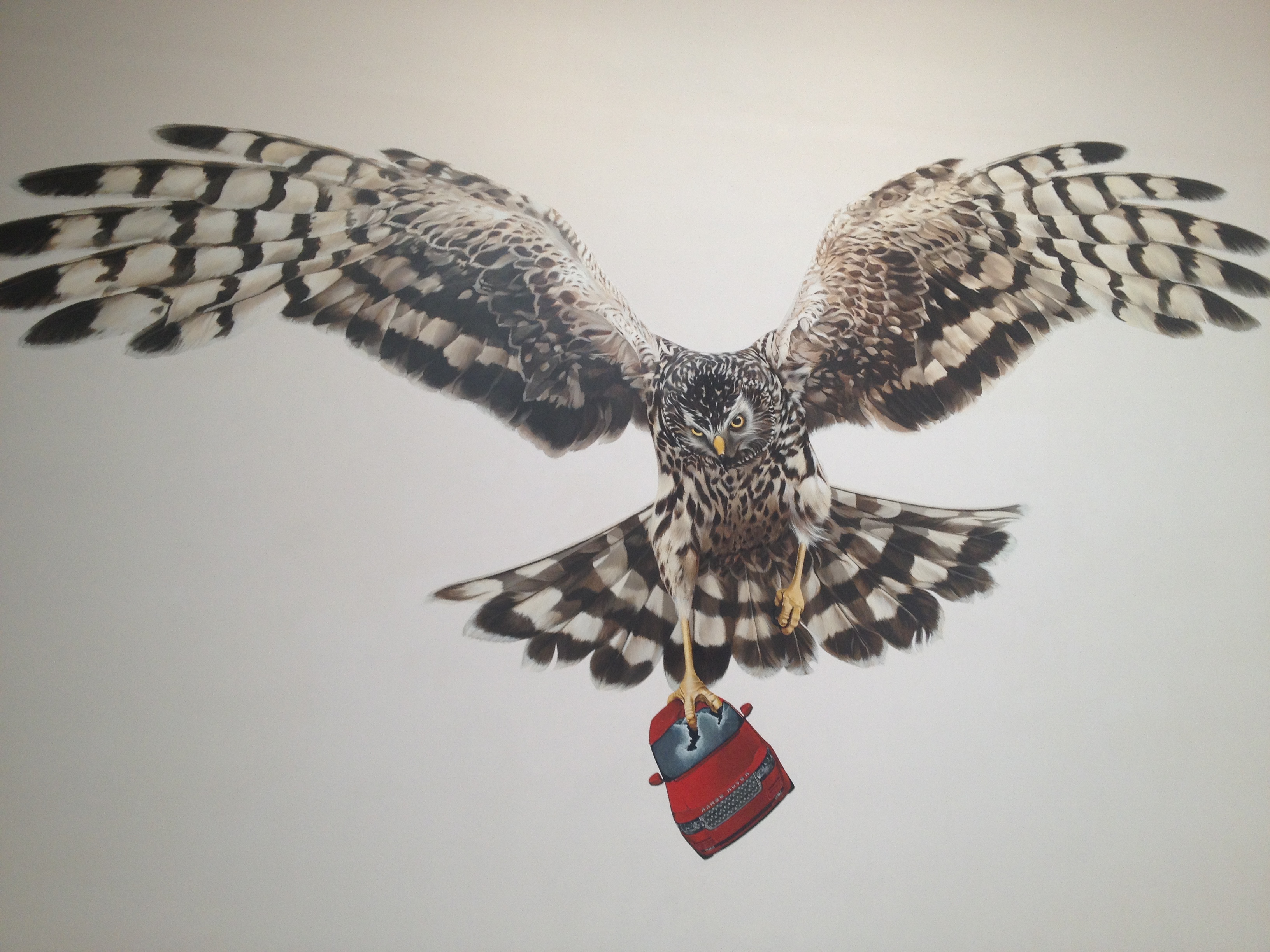
Jeremy Deller. A Good Day for Cyclists, British Pavilion 2013. Photo by the author.

Jeremy Deller. A Good Day for Cyclists, 2013. British Pavilion. Photo by the author.

Jeremy Deller at the British Pavilion brings a political approach to history in a series of installations that deal with working-class revolt against the symbols of affluence. A series of large wall murals add polemical humor to the copious photographs, documents, and drawings that Deller has collected—each space centered on a different act of protest. Upon entering, the viewer first encounters a mural of a massive owl in flight with a red Range Rover dangling from one of its claws. On the opposite wall, the banking town of St. Helier in Jersey is depicted in flames. These are mythological scenes in which Deller imagines the twin oppressed collectives of nature and the working class taking their revenge on those who have exploited them for so long.

Read More »

Share

London

Long Ago and Not True Anyway at Waterside Contemporary

In Long Ago and Not True Anyway at Waterside Contemporary, curator Pierre d’Alancaisez explores a kind of history that exists beyond the dry material of archives, records, and established national narratives. Instead, in this small London gallery nearly hidden around a corner among Islington’s high-density residential buildings, this exhibition’s artists and artworks blur the borders between uncertain subjective experience and the history it inhabits.

Long Ago and Not True Anyway, installation view, Waterside Contemporary. Slavs and Tatars, Self-Management Body, 2013; Silkscreen, cross-stitching, cotton; 6x28.5x5.45cm. Slavs and Tatars, Triangulation (Not Kalingrad Not Kerbala), 2011; Concrete, paint. Courtesy of Waterside Contemporary, London.

Long Ago and Not True Anyway, installation view, Waterside Contemporary. Slavs and Tatars, Self-Management Body, 2013; Silkscreen, cross-stitching, cotton; 6 x 28.5 x 5.5 cm. Slavs and Tatars, Triangulation (Not Kalingrad Not Kerbala), 2011; Concrete, paint. Courtesy Waterside Contemporary

Taking the exhibition’s thesis most directly, the collaborative group Slavs and Tatars claims a spurious (though not necessarily absurd) parallel between the Polish Solidarity movement Solidarność and the Islamic Revolution in Iran. This is history of the imagination, though it is not without purpose: the history of each movement is used as a means by which to understand the other, highlighting similarities where one may at first see culturally—and thus, perhaps, totally—separate events. In Self-Management Body (2013), a vaguely ominous statement of bureaucratic democracy appears silkscreened in both English and Polish across an Iranian pattern. Beside it, the low wedge-shaped sculpture Triangulation (Not Kaliningrad Not Kerbala) (2011) abstractly unites geography, through precise negation, by indicating a common point where the two cities are not. In both works, Slavs and Tatars composes work around cultural claims, drawing focus to the newly figured space between histories.

Read More »

Share

Hashtags

#Hashtags: Art as Response to Attacks on LGBT Rights in Russia on the Eve of the Sochi Olympics

#LGBTQ #Russia #SochiOlympics #civilrights

The upcoming 2014 Winter Olympics and Paraolympics in Sochi, Russia, have shined a light on a host of environmental, migrant, labor, and civil rights concerns in Russia. International observers and Russian organizations indicate that the situation for lesbian, gay, bisexual, and transgender (LGBT) people in Russia has recently deteriorated. An emergent “traditional values” ideology propagated by the state and church—that falsely posits homosexuality as being anti-Russian, a Western import, and dangerous to children—is leading to increased violence against LGBT people, penalty and fines for “homosexual propaganda,” hate speech in the media, and intimidation of LGBT activists by extremist organizations, soccer hooligans, and neo-Nazis.

Claude Cahun

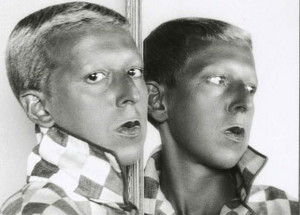
Claude Cahun. Self Portrait, c. 1928. Gelatin silver print. Musée des Beaux-Arts de Nantes. Image courtesy of Wikipedia

Against the backdrop of increasing, institutionalized homophobia in Russia, I looked for positive and realistic images of LGBT Russians. As a photography historian and film curator, I am aware of the potency of visual representation—the affirming power of self-representation in particular. My PhD dissertation on queer surrealist photographer and activist Claude Cahun argued for the power of photographic self-representation in both affirming and crafting identity in the face of rising fascism. The images I was seeing of LGBT Russians were either of frontline activists fighting for their right to public assembly or misrepresentations, painted in words, by the virulently homophobic invective of politicians, neo-Nazis, and Russian Orthodox Church leaders. American and British LGBT civil rights movements have been represented, documented, and dramatized in film (Milk), photographs (Catherine Opie), Conceptual art (Gilbert & George), political art and design (Gran Fury), and public assembly and protest (as documented in the exhibition AIDS in New York: The First Five Years). As LGBT Russians are fighting for the basic right to declare their very existence, as well as for the rights to assemble as a community and to raise children, this battle is playing out on the turf of visual imagery.

Read More »

Share

From the Archives

From the Archives: Interview with Lukasz Jastrubczak

Today in From the DS Archives we bring you an interview with Polish artist Lukasz Jastrubczak. Jastrubczak and his collaborator Małgorzata Mazur are currently exhibiting work in The Day Is Too Short at the Wrocław Contemporary Museum in Wrocław, Poland, through October 21, 2013. Jastrubczak also has work in Spojrzenia, the Deutsche Bank Foundation Award at the Zacheta National Gallery of Art in Warsaw, through November 17, 2013. The interview was conducted by Bean Gilsdorf while Jastrubczak was a resident at the Headlands Center for the Arts last year and was originally published on March 22, 2012.

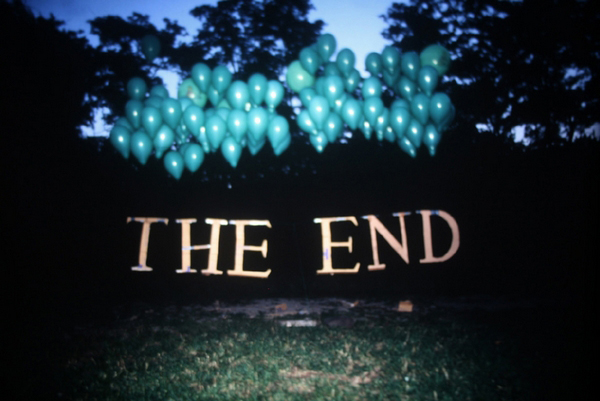
Lukasz Jastrubczak. The End, 2009; documentation of performance, photo: Małgorzata Mazur

Bean Gilsdorf: Let’s talk about your sense of cinema and some of the motifs that you’ve pulled from films. How do you find your material, and what attracts you to it?

Lukasz Jastrubczak: Most of my inspiration is connected directly to a specific idea in the movies. I try to take an idea from cinema and use it in a very minimal way, as simply as possible. I use materials like cardboard or fabric, because the works are props, as though I am taking the scenography from movies and putting it into reality. For example, The End (2009) was made with cardboard and helium balloons. I wanted to put the fictional sign into reality as simply as possible and re-create the final motion of the words on a movie screen. And Paramount Mountain [installed as part of the exhibition Mirage] is just the beginning of a movie, the logo. At least, that’s the inspiration, but then I also connect it with the tradition of abstract geometry, the shape of a triangle, and the color blue. It creates the idea of a distant mountain in aerial perspective.

BG: And you are also inspired by various artistic movements and ideas, right?

LJ: This work is all connected to Suprematism and Cubism in some way. Inspiration for Cubist Composition with a Jug (2011) didn’t come from the movies directly, but the idea works with Paramount Mountain. The concept is that in the gallery space you have a distant mountain, a blue triangle shape, and it’s the farthest 3D object for the viewer. But behind the mountain there is this fourth dimension, what the Cubists were looking for, and there’s a sculpture of a jug there. So formally and physically there are four jugs, but the title suggests that there is only one jug. It’s one sculpture in different points of view, dealing with different kinds of dimensions, which is analytical Cubism. The cubist composition becomes a four-dimensional object.

Read More »

Share