San Francisco

Trapped in the Wunderkammer at Kadist Art Foundation

What inspires artists? How do they create their work? Today we bring you a video from Kadist Art Foundation in San Francisco, documentation of one of seven recent presentations in which artists discuss inspirational objects and ephemera in their private collections. The basis for this project was artist Linda Geary‘s book Studio Visit, which, according to Kadist, “collects impressions from 100 in-studio conversations about art and life. An unexpected result of her informal visits, Geary discovered many artists have collected images and objects unlike their public practice, raising questions like: Do personal collections change the way we think about an artists work? Do artists lead multiple lives as cultural thinkers?” This video documents a presentation by artist Jordan Kantor, whose work was reviewed by Daily Serving in 2010

Videos of the other participating artists (David Huffman, Rebeca Bollinger, Andrew Masullo, Jim Melchert, Emily Prince, and Margaret Tedesco) can be found on Kadist’s Vimeo page. 


Share

Clarissa Bonet’s Somber Reconstructions Of The Urban Landscape

Today from our friends at Beautiful/Decay we bring you the photography of Clarissa Bonet. Author Victoria Casal-Data notes, “One of the most interesting elements in this body of work is [Bonet’s] ability to transfer what would seem to be a mundane act on the streets to a scene that speaks of the human psyche, and emotion in general.” This article was originally published on October 9, 2013.

Clarissa Bonet. City Space, n.d.; photograph, 24×30, edition of 6. Courtesy of the artist.

Clarissa Bonet. City Space, n.d.; photograph, 24×30, edition of 6. Courtesy of the artist.

Everyone has a different perception of the city, to some it might feel luxurious and culturally rich, to others it might appear to be dirty and smelly, and to many natives, including Chicago-based artist Clarissa Bonet, the city is this somber, anonymous, and emotionally charged space. Bonet’s acclaimed on-going series, City Space, captures her personal perception of the urban landscape and its relationship to the ones that inhabit it. “The Urban space is striking. Its tall and mysterious building, crowds of anonymous people, and endless seas of concrete constantly intrigue me,” the artist says.

Read the full article here.

Share

Fan Mail

Fan Mail: Darren Jones

Darren Jones works across a wide range of forms and subjects, often displaying an adroit sense of humor in his installations, sculptures, digital images, and text based artworks. However, Jones’s work is not only a series of well-pitched interventions and re-arrangements; there is a poetic and delicate seriousness that complicates much of what he makes.

Darren Jones. Deeper Understanding, 2008; Broken computer, additional and rearranged keyboard keys; 11 x 17 x 11 in. Courtesy the artist.

Darren Jones. Deeper Understanding, 2008; Broken computer, additional and rearranged keyboard keys; 11 x 17 x 11 in. Courtesy the artist.

Deeper Understanding (2008) turns his old broken laptop, stuck in the process of starting up, into a readymade sculpture. The keyboard of the haggard PC computer has been altered to read, “I know that you are feeling tired,” as though Jones is trying to communicate his appreciation for the now-broken computer’s lost memory and functionality. This ode to a personal computer, lost and gone, gives levity to an experience that can be quite trying and that many people have gone through at least once.

Read More »

Share

Toronto

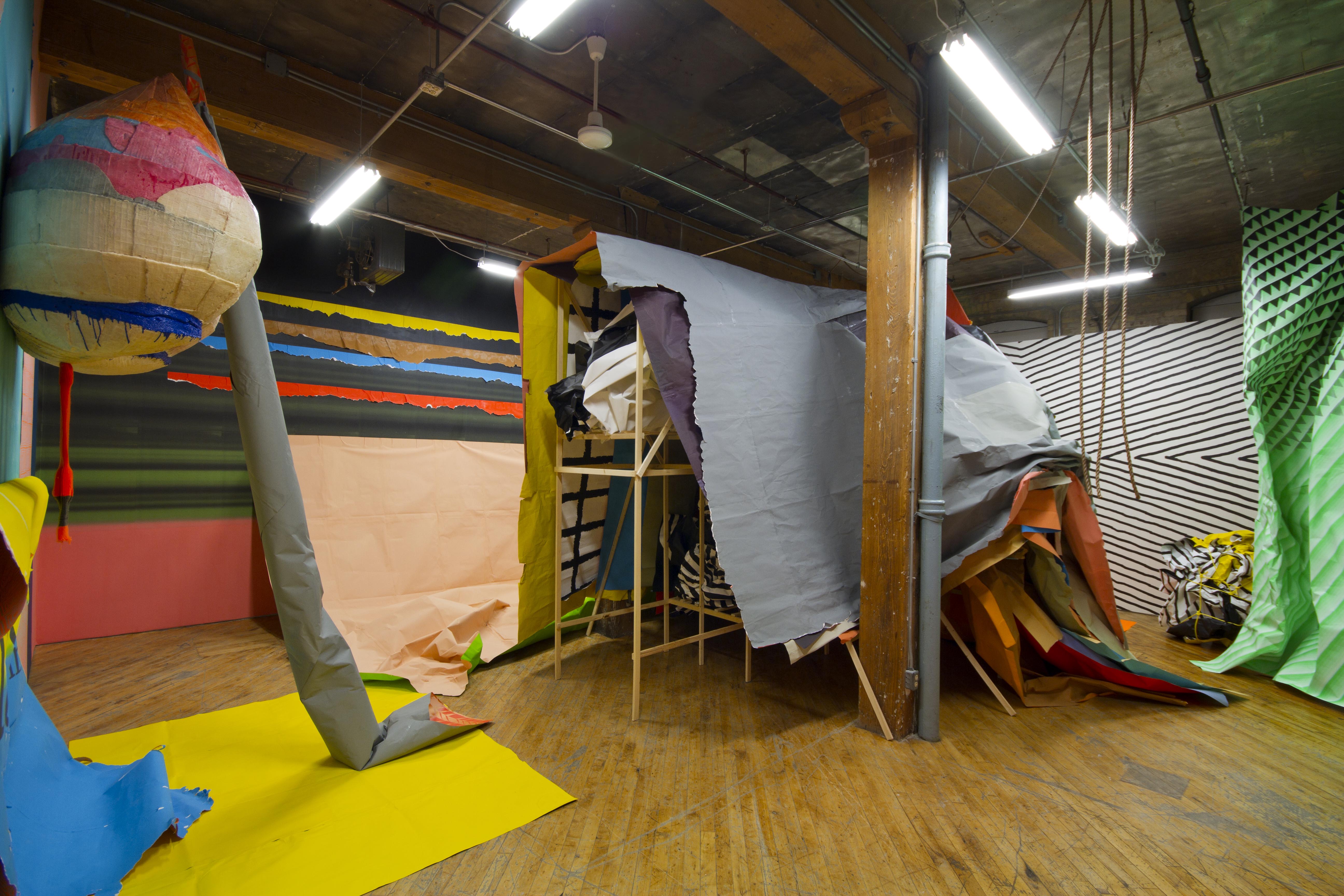
Séripop: Looming at YYZ

I first came across Montréal artist duo Séripop (Chloe Lum and Yannick Desranleau) a number of years ago when I was more embedded in the indie music scene here in Canada. In this sphere, the pair are known for their layered, DIY gig posters and refreshingly offbeat graphic design work. Despite their disregard for the formal rules of graphic design, Lum and Desranleau possess an intuitive approach to process that renders their work captivating.

IMG_9034(M)

Séripop (Yannick Desranleau and Chloe Lum), Looming, screen printed paper, polyurethane foam, wood, paper mâché, felt-backed vinyl, fabric, paint, pantyhoses, fiber glass insulation batts, cardboard, plaster, hooks, pulleys, rope, found objects, 2013. Photo: Allan Kosmajac.

The duo’s playful, instinctual style is on full display in Looming, their current site-responsive installation at YYZ Artists Outlet in Toronto. While Lum and Desranleau both briefly attended art school, they left to pursue other interests (primarily their noise band AIDSwolf), enabling them to develop an aesthetic unconstrained by the pretensions of academia. Their works still conceptually draw from contemporary art tropes such as architectural theory and Bruce Nauman’s process-based approach, but they never lose their sense of wonder and playfulness, allowing for an immediate, visceral reaction. In recent years, Séripop have managed to carve out a respectable niche for their practice both within Canada and abroad, yet, as they note in an interview accompanying their piece Hoarding Skin (2011), they’re still “in it for the shits and giggles.”

Read More »

Share

Elsewhere

Camille Henrot: Cities of Ys at the New Orleans Museum of Art

French video artist Camille Henrot creates parallels between the mythical and the contemporary. In her first solo exhibition in the United States at the New Orleans Museum of Art, she investigates the legendary city of Ys in France and the vanishing coastal area of southern Louisiana that is occupied by the ancestral Houma Indians. Coastal erosion, in real and mythical tales, is at the heart of this exhibit.

Camille Henrot. Cities of Ys, 2013 installation view. Courtesy of the Artist and Gallery Kamel Mennour

Camille Henrot. Cities of Ys, 2013; installation view. Courtesy of the Artist and Gallery Kamel Mennour

For over two years, the artist interviewed and researched the acculturation of the United Houma Nation. The exhibit is composed of sculpture, prints, and nine new videos mostly shot in Terrebonne Parish, the home of approximately 6,000 members of the Houma Nation.[1] The Houma have been in the process of seeking federal recognition as an American Indian tribe since 1979, when they first filed a letter of intent. That petition was rejected in 1994 and today the Houma are still waiting for recognition to be granted.

Henrot was born in Brittany, France, the home to the mythical city of Ys. According to legend, Ys was lost to the sea when the daughter of the king was tricked by the devil into opening the seawall, allowing the ocean to swallow the city whole. In southern Louisiana, over 2,000 square miles of marsh and swamp have become open water in the last seventy years.[2] This landscape took 6,000 years to build and with the help of oil companies and navigation canals, it has been quickly destroyed. In the next two decades, parts of the Houma Nation’s land will be completely submerged.

Read More »

Share

Hashtags

#Hashtags: Divide//Conquer: Artists Confront the Gentrification of Urban Space

#gentrification #displacement #race #class #technology #industry #neo-colonialism

Any conversation among artists these days is bound to turn to the question of gentrification—the process of urban renewal by private developers that ultimately displaces poor residents in favor of the upwardly mobile. Modernism in art has always accompanied displacement of poor citizens from city centers, from the time of the Impressionists when Georges-Eugène Haussmann refashioned Paris, to the remaking of Manhattan as a banker’s playground under committed arts philanthropist Michael Bloomberg. As the present-day wealth gap spreads and assets are increasingly concentrated in the hands of the wealthiest Americans, artists and activists find themselves on the front lines of a battle to preserve the characteristics of ethnic and bohemian neighborhoods nationwide from the homogenizing forces of corporate culture.

Activists engaged in political struggles defined along economic, racial, and sociological lines have an established part to play in defending against this onslaught, and a clear justification for their involvement in protest actions and legal challenges. Artists, on the other hand, have a more ambivalent relationship to these trends. They are often implicated as both the perpetrators and the victims of gentrification. Many believe that their role is not to speak out about social issues, but to communicate self-expression. They are experts in neither legal nor civic arenas. Given these truths, how and why should artists engage in the fight to save urban communities from eviction and displacement?

Mail Order Brides/M.O.B. (Jenifer Wofford, Reanne Estrada, Eliza Barrios). Manananggoogle, 2013. Multimedia installation including website and photographs. Commissioned by the San Jose Museum of Art with support from The James Irvine Foundation and MetLife Foundation.

Mail Order Brides/M.O.B. (Jenifer Wofford, Reanne Estrada, Eliza Barrios). Manananggoogle, 2013. Multimedia installation including website and photographs. Commissioned by the San Jose Museum of Art with support from The James Irvine Foundation and MetLife Foundation.

To understand why artists are compelled to participate in these struggles, first consider how gentrification occurs. An area subject to prolonged neglect is often the only affordable location for recent immigrants, the working poor, and other marginalized groups to reside. Their presence fosters further civic neglect, as these are groups with minimal political clout who remain invisible to many politicians and business leaders. Many artists of note have emerged from within these ostracized communities, informed by their vernacular traditions, and inspired to create positive images and messages to counter the symptoms of neglect. In recent history, these have included founders of graffiti art, mural art, performance art, and interventionist art movements that have transformed mainstream art discourse. Other artists move into these areas because they too have limited means, and find not only cheap rents but a sense of safety in community to guard against the hardships of urban poverty. Eventually, the energizing force of artistic creation helps to revive these atrophied regions despite the lack of civic or capital investment, at which point developers take notice and begin to snatch up the remaining inexpensive or abandoned properties. Those newly renovated properties are marketed to the professional class with the vibrant local culture as a major selling point. As upscale residents move in, the creators whose works helped create interest in these areas often find themselves priced out along with their less affluent neighbors.

Read More »

Share

Shotgun Reviews

Barbad Golshiri: Curriculum Mortis at Thomas Erben Gallery

Shotgun Reviews are an open forum where we invite the international art community to contribute timely, short-format responses to an exhibition or event. If you are interested in submitting a Shotgun Review, please click this link for more information. In this Shotgun Review, Bansie Vasvani reviews Barbad Golshiri’s Curriculum Mortis at Thomas Erben Gallery in New York City.

Barbad Golshiri. The Untitled Tomb, 2012; iron, soot, 53 x 24 in. Edition of 3. Photo: Andreas Vesterlund, courtesy the artist and Thomas Erben Gallery, New York.

Barbad Golshiri. The Untitled Tomb, 2012; iron, soot, 53 x 24 in. Edition of 3. Photo: Andreas Vesterlund, courtesy the artist and Thomas Erben Gallery, New York.

The question of martyrdom pervades Barbad Golshiri’s sculptural installation of tombstones in his solo exhibition Curriculum Mortis at Thomas Erben Gallery. Through his deeply conceptual yet enormously potent practice, Golshiri devises a way of outwitting the religious regime of his home country Iran with work that one can position in the relatively recent legacy that includes sculptor Parviz Tanavoli and Iranian modernism from the 1950s. Reminiscent of Carl Andre’s spare, horizontal sculpture Equivalent VIII (1966), Golshiri’s abstract, minimalist forms are a refreshing way of addressing oppression in his country.

In The Untitled Tomb (2012), a transportable metal lid with stenciled Arabic text on its surface serves as a temporary tombstone for a man who was not permitted to have one. Soot poured on the stencil marks the metaphorical site of the grave and the man’s epitaph that begins “Here Mim Kaf Aleph does not rest. He is dead…” Aleph’s ephemeral gravesite is visible so long as it is not blown away by the wind. If martyrdom is understood in light of the Islamic concept of jihad or holy struggle, Mim Kaf Aleph’s ongoing battle to be honored and acknowledged even after his death convolutes this belief.

Read More »

Share