Elsewhere

Fashion Photographer Treats Old Negatives With Chemicals To Create Surreal Distortion

From our friends at Beautiful/Decay, today we bring you a look at the chemically manipulated photographs of Rohn Meijer, whose work combines happy accidents with a trash-to-treasure approach to art making. Author  notes: ”Meijer claims that 90 percent of each batch he creates is trashed, but apparently he has a large arsenal of film that he doesn’t mind tossing, as they were most likely going to end up in the garbage anyway.” This article was originally published on  

High Society,

Rohn Meijer. High Society, n.d.; photograph from manipulated negative.

Dutch fashion photographer Rohn Meijer applies a chemical cocktail to old negatives in order to produce stunning effects of surreal color and distortion. This idea occurred to Meijer when he discovered some old negatives that were damaged by moisture. He then decided to concoct his own chemical-water treatment (the specifics of which he’d like kept secret) that would interact with the silver nitrate on the back of the negatives and enhance the effect of crystallization. Though he does like to treat entire negatives with the caustic bath, he will sometimes deliberately apply the cocktail to certain parts of the photograph in order to draw out or deepen the effect.

“What I’m looking for is the way that colors play out, sometimes a bleeding effect, other times more harsh effects,” he says. “It’s a different kind of developing I’m doing, it’s not done in a laboratory.”

Read the full article here.

Share

Fan Mail

Fan Mail: Senan Lee & Pansy Aung, a.k.a. Salt ’n’ Pepper Squid

Senan Lee and Pansy Aung make up the duo Salt’n’Pepper Squid, and they specialize in making innovative and often humorous advertising campaigns that range from magazine spreads to promotional videos. Their recent evolution from individual creative producers to collaborators—in June of this year—has inspired new ways of thinking that reach beyond the campaigns the duo are accustomed to making. In September, they came up with their first artistic collaboration, The Diving Bell (2013).

Senan Lee & Pansy Aung. The Diving Bell, 2013; Recycled cardboard; 80 x 80 x 80 cm. Courtesy the artists.

Senan Lee & Pansy Aung. The Diving Bell, 2013; recycled cardboard; 80 x 80 x 80 cm. Courtesy the Artists.

In the age of visual culture, the distinction between art and advertising can be a bit unclear, but is not without precedents. Many well-known designers, advertisers, and documentarians—Charles and Ray Eames, Norman Rockwell, and Werner Herzog, to name a few—work in overlapping spheres of production that all circle around the formation and implementation of utilitarian yet rarified ideas. Making these distinctions can be a bit like splitting hairs. The question is, to what ends do these projects aim? Senan and Pansy’s The Diving Bell implies that a key difference for them, in creating artwork vs. campaign work, is that The Diving Bell is a reflection and exploration of the very process of creating ideas: “For anyone who comes up with ideas on a daily basis, the act of putting on your own ‘Diving Bell’ is the time you use to discover, search, and generate [ideas].”

Read More »

Share

New York

Chris Burden: Extreme Measures at the New Museum

Chris Burden is one of the legendary giants of performance art. In his seminal body pieces from the early 1970s, he orchestrated a series of daredevil brutalities and tests of the body’s resilience. Burden has had a more prolonged career, however, as a large-scale installation artist who masterminds feats of engineering that seem divorced from the body: scaled-down replicas of major bridges, a giant scale that weighs Burden’s own Porsche against a meteorite, replicated cop uniforms too large to fit a human body. Both of these styles of work are currently on view in the New Museum’s Burden retrospective, Extreme Measures. The show tracks Burden’s transition from performance to installation—from a focus on the body’s resilience in the tension of an extreme moment, toward static objects severed from the experience of lived reality.

Chris Burden. The Big Wheel, 1979. Three-ton, eight-foot diameter, cast-iron flywheel powered by 1968 Benelli 250cc motorcycle; 112 x 175 x 143 in. Courtesy of The New Museum, New York. Photo: Benoit Pailley.

Chris Burden. The Big Wheel, 1979. Three-ton, eight-foot diameter, cast-iron flywheel powered by 1968 Benelli 250cc motorcycle; 112 x 175 x 143 in. Courtesy of The New Museum, New York. Photo: Benoit Pailley.

There has always been a strong element of science present in Burden’s work. His performance pieces test the limits of technology against the body. Burden’s installation work, on the other hand, is a series of projects in physics and engineering that test a man’s ability to re-create technology. I use the word “technology” to refer specifically to those 19th-century analog tools dominated by a socially masculine energy: concrete, electricity, fire, gunpowder. Burden’s work progresses from a measurement of the man-made against the man, toward a measurement of the social conscription of the masculine (that is, our idea of the “man”) against that which is man-made. Maleness, in Burden’s installations, is a questionable subject, fraught and fragile despite its posturing.

Read More »

Share

Singapore

If the World Changed: Singapore Biennale 2013

Premised on the obliquely hypothetical question “What if the world changed?”, the Singapore Biennale 2013 (SB2013) is presented as a deconstructed entity centered on allusive keywords—or “tags” in internetspeak—such as “histories,” “intervention,” and “materiality” in order to highlight the transmutative and the transformative qualities of the art produced in the region. With a collaborative team of 27 curators instead of an artistic director helming the show, If the World Changed presents the works of 82 artists and eschews the country pavilion-centric layout in favor of a more organic display of artworks that are hung according to interwoven ideas of words and images.

Kiri Dalena. Monument for a Present Future, 2013; installation view, single-channel video and mixed media installation (wood, clay and stone); dimensions variable. Courtesy of the Artist.

Kiri Dalena. Monument for a Present Future, 2013; installation view, single-channel video and mixed media installation (wood, clay, and stone); dimensions variable. Courtesy of the Artist.

On paper, at least, there’s much to get excited about after reading SB2013’s vague but stylishly crafted curatorial brief. Above all, there’s the anticipation that nascent ideas embedded within these keywords will become sites of exchange and experimentation, and it is within this framework that SB2013 attempts to operate, weaving strands of commonality (though tenuous at times), shared tensions, themes, and attitudes. As academia continues to mull over the definition of Asia as an incoherent, multivalent concept rather than a homogeneous physical, social, and cultural entity, SB2013’s vision appears to be almost a dramatic, metaphorical realization of this idea. Even though this vision consists of a nebulous collection of words that, on their own, are theoretical concepts and linguistic connectors to a wider dialogue on art and its shared values, the lack of a more precisely crafted statement also presents the discursive slippages in which the collaborative team of curators can operate more fluidly as they seek to represent the varied cultures and identities of the Southeast Asian nations. If the distilled purpose of Biennales is to display a hybrid variety of art forms produced by artists working in specific cultural contexts, If the World Changed certainly succeeds in reinforcing the rhetoric of the region’s socio-economic, aesthetic, and ideological complexities with what is at times a beguiling mix of artworks.

Read More »

Share

Perth

Andrew Nicholls: The Water Works at Turner Galleries

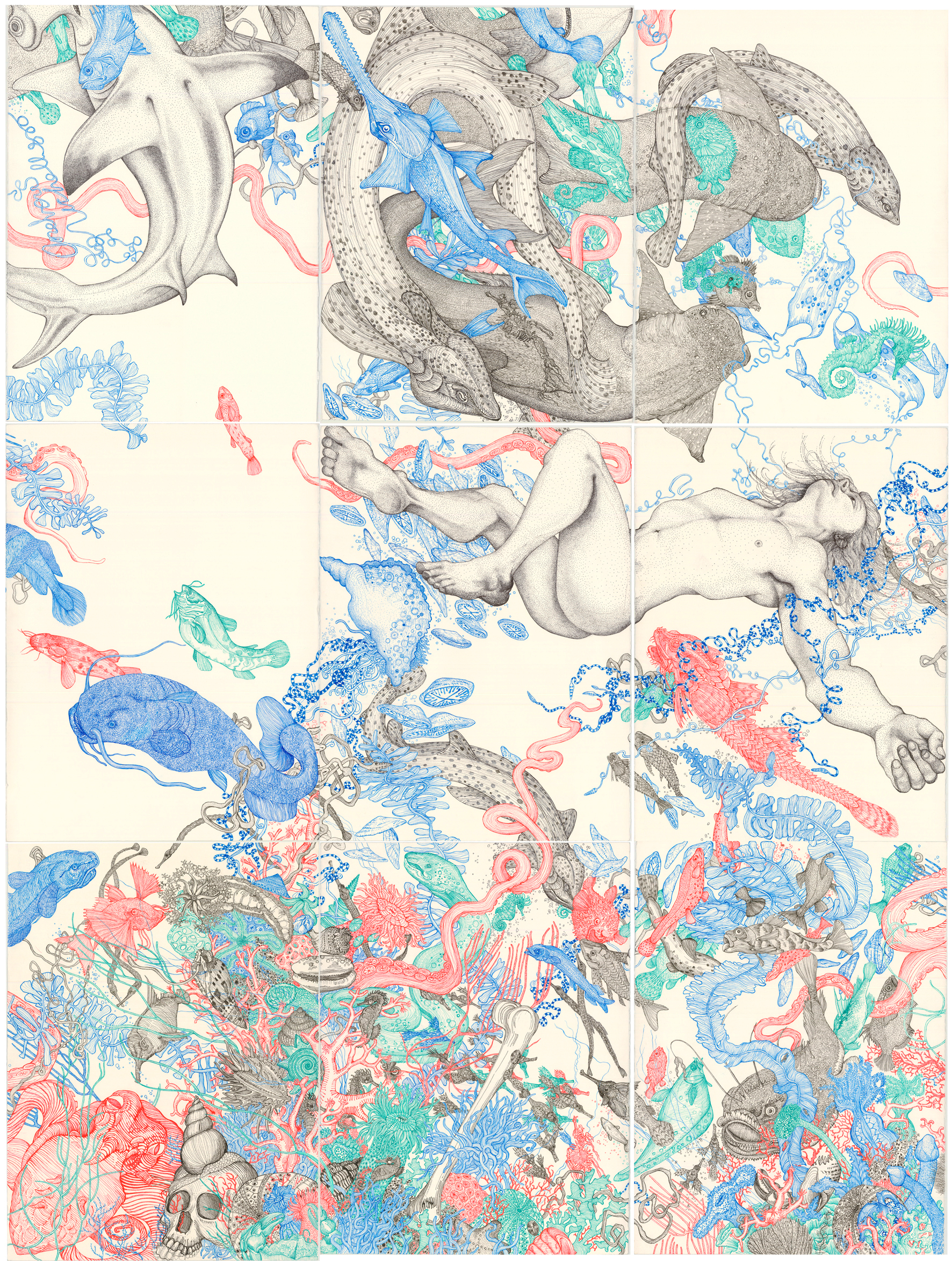
Australian artist Andrew Nicholls dredges the queasy aesthetics of sentiment for its submerged ideological content. In an ongoing thread of his practice, he locates the ideals and practices of British imperialism in the kitsch, seemingly innocuous world of 19th- and 20th-century ceramics, disrupting this historical narrative with traces of the otherness otherwise repressed in the imperial worldview. He subsumes his viewers in an unsteady undertow of horror and desire.

A coral room (put your hand over the side of the boat, and what do you feel?)
Andrew Nicholls. A Coral Room, 2008–09; archival ink pen on watercolor paper.

His latest exhibition The Water Works at Turner Galleries features a body of aquatic-themed drawings and sculptures in which the maritime environment serves as a spawning ground for all manner of fantastic inversions of the so-called natural order. With characteristically acerbic humor, Nicholls re-situates ancient depictions of the ocean as a site of monsters and wondrous perils in the context of mass-produced ceramics, eroticized male bodies, and mainstream Australia’s hysterical anxieties about invasion via its maritime borders. Amid ships on the verge of being wrecked and views of the glories of the deep, audience members clasp seashells to their ears only to hear water-themed excerpts from the artist’s music collection—the stylings of Destiny’s Child bursting this exquisite dream bubble.

Read More »

Share

Hashtags

#Hashtags: The State of Art: Bangladesh, Portugal, Greece, and Palestine at the Venice Biennale

#politics #statehood #borders #biennials #nationalism

The Venice Biennale is fundamentally shaped by its founders’ belief in statehood. Each nation-state secures its site, much like an embassy, and asserts its self-image through the choice of curators and artists. Four pavilions at the 2013 Biennale demonstrate how the notion of the nation-state is constructed and deconstructed in the face of contemporary global pressures. For Bangladesh, the pavilion is a platform to assert a distinct national identity and to distract from tensions prompted by multinational, neocolonial actors. For Portugal, the pavilion is an emissary transporting national essence across geographical borders. For Greece, the pavilion is a catharsis for anxieties about an unstable economic and political system. For Palestine, the pavilion is a non-site reflecting the nebulous identity of a stateless people. Art serves politics in each exhibition, whether representing patriotism, diplomacy, reckoning, or refusal.

Dhali Al Mamoon. Elimination, 2013. Installation. Bangladesh Pavilion, 55th Venice Biennale. Photo by the author.

Dhali Al Mamoon. Elimination, 2013. Installation. Bangladesh Pavilion, 55th Venice Biennale. Photo by the author.

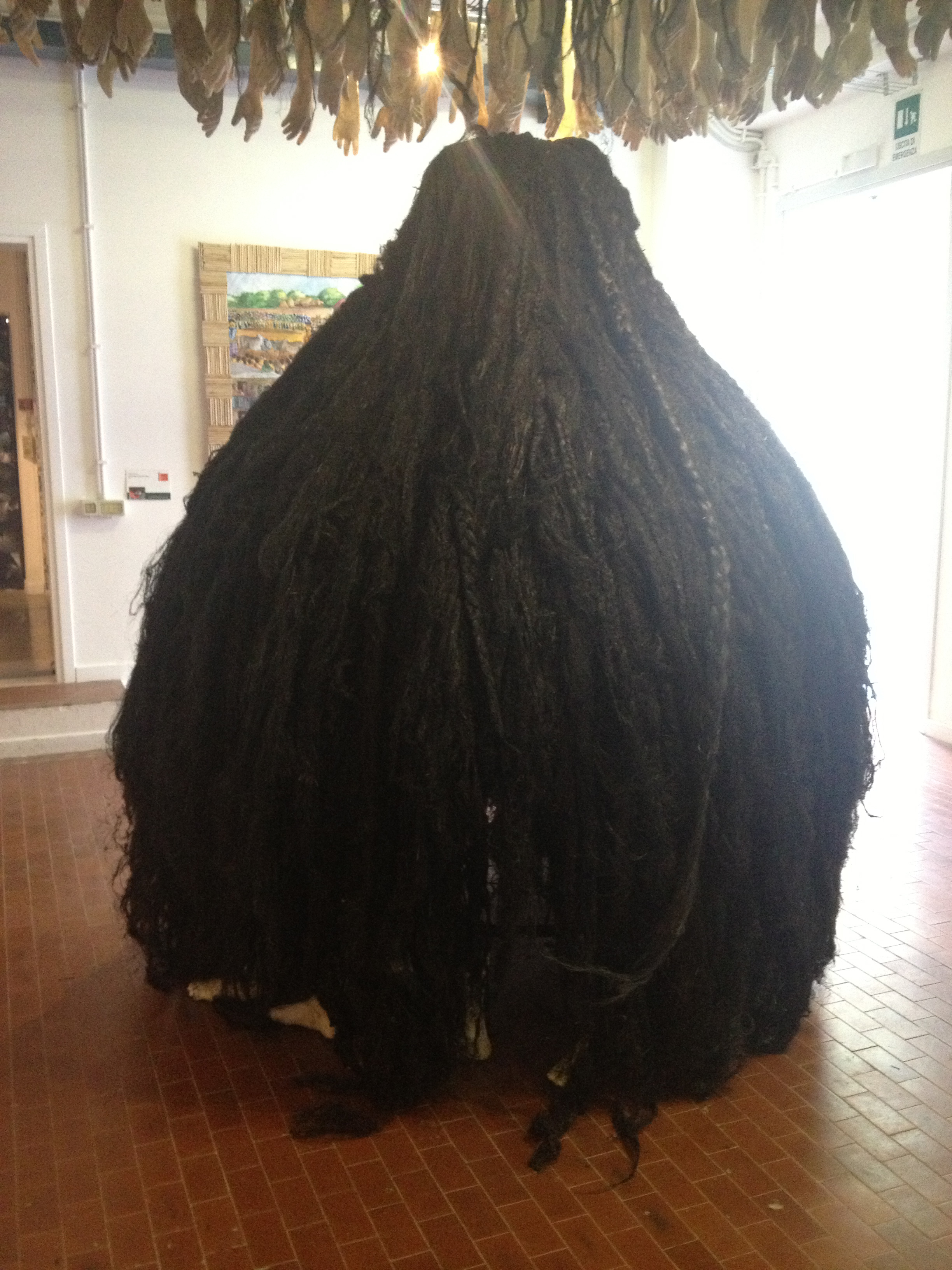
Bangladesh’s pavilion hosts a group show, Supernatural, that features eight Bangladeshi artists, two international artists, and a collaborative project by the Charupit Art School. The show is commissioned by Francesco Elisei, an Italian who is also responsible for the current and 2011 Costa Rica pavilions, and curated by another Italian, Fabio Anselmi, who curated the 2011 Syrian pavilion. The Bangladeshi artists Mokhlesur Rahman, Mahbub Zamal, A. K. M. Zahidul Mustafa, Ashok Karmaker, Lala Rukh Selim, Uttam Kumar Karmaker, Dhali Al Mamoon, and Yasmin Jahan Nupur are all members of a collective, the Chhakka Artists’ Group. They are joined by Gavin Rain of South Africa and Gianfranco Meggiato of Italy. The works are a broad mix of modernist painting and sculpture, multimedia works, installations, and folk art. Very little holds them together materially, stylistically, or thematically. Large-panel paintings by Mokhlesur Rahman sit adjacent to gleaming geometric abstractions in bronze by Gianfranco Meggiato. The paintings invoke the folk figures and rural landscapes of an idealized Bengali past, while the sculptures are quintessential mid-century European modernism of the sort that has come to be identified with corporate architecture. A mixed-media sculpture installation by Dhali Al Mamoon has a creepy vibe that doesn’t gel with the adjacent cheerful, naïve paintings from the Charupit School. Mamoon’s work is a mountain of matted black hair atop a circle of pale feet that poke out from beneath, with hands suspended from above. Ambiguous and menacing, it is among the show’s best works as it occupies a space that is neither nationalistic nor nostalgic.

Read More »

Share

From the Archives

From the Archives: You Killed Me First: The Cinema of Transgression at Kunst-Werke

After the Smithsonian’s G. Wayne Clough decided to remove David Wojnarowicz’s film A Fire in My Belly from the exhibition Hide/Seek: Difference and Desire in American Portraiture, Wojnarowicz became a household name and a cultural touchstone, to the point where Vanity Fair can now glibly claim, “Right-wing America will be begging for David Wojnarowicz…” and expect its readers to get the joke. In September, Clough announced that he will leave the Smithsonian at the end of the year, and though his name will likely disappear from our cultural consciousness, Wojnarowicz’s will remain. In this week’s From the Archives, we bring you a review of You Killed Me First, an exhibition of films that go beyond the boundaries of social norms. This article was written by Ali Fitzgerald and originally published on March 1, 2012.

Richard Kern. You Killed Me First, 1985; film still, courtesy of the artist.

You Killed Me First (1985), one of Richard Kern’s longer films starring David Wojnarowicz and Lung Leg, could be read as a clear teenage allegory of the Cinema of Transgression itself. A girl (Lung Leg) bristles at the religious directives of her parents, asserting her right to personhood outside demure hairstyles and turkey dinners, constructing voodoo dolls, and entertaining other manners of dark drawing in her dank emo den. When confronted with the humanity and hypocrisy of her tormentors, the young antihero vanquishes their belief systems (and bodies), asserting, “You killed me first!”

Nick Zedd, in his manifesto, describes the Cinema of Transgression’s proponents as “a new generation of filmmakers daring to rip out of the stifling straightjackets of film theory in a direct attack on every value system known to man.” You Killed Me First: The Cinema of Transgression at Kunst-Werke Berlin is the first exhibition devoted solely to the Cinema of Transgression. This allows viewers, for the first time ever, to see a remarkable amount of cinematic defiance in one place. Among the 19 films shown, there is an insistent interest in constructing purposeful rebellion during a time when Reagan-era family values were becoming a “revitalizing force” in America.

Read More »

Share