Boston

The Meta-Biennial: the 2013 deCordova Biennial

Today we bring you a review of the deCordova Biennial from our friends at Big Red & Shiny in Boston. Twenty-one artists and collaborative teams from the states of Connecticut, Massachusetts, Maine, New Hampshire, Rhode Island, and Vermont are featured in this six-month survey exhibition. Author John Pyper notes, “…the intention is to create a snapshot of the artists in New England and to feature emerging talent. This goal is a bear of a problem.” The article was originally published on October 25, 2013.

Installation view of The 2013 deCordova Biennial.  Photo: Clements Photography and Design.

Installation view of the 2013 deCordova Biennial. Photo: Clements Photography and Design.

Over the last few years I’ve developed sympathy for those who organize large, all-encompassing exhibits like biennials. If you hold on too tightly to a curatorial vision, you can create an autobiographical list of your favorite artists or styles. If you are too loose with a curatorial vision, you may accidentally create a Rorschach test allowing the public to complain about almost anything, including what others might deem a success.

The deCordova Biennial, now in its third iteration, is a paradox. It’s the type of show that you don’t remember the show, but you remember the work. Walking around it gives you a feeling that something is off, and I think reading the catalog reveals what is causing that feeling. The deCordova Biennial is not one thing. I have complete sympathy for this beast’s curator, but the exhibition doesn’t commit to any vision for art besides the idea that artists in New England are part of a wider network that includes artists outside of New England. The Biennial doesn’t become a Rorschach test because the labels weren’t good enough or for some other technical flaw. It was designed to be a Rorschach test.

Read the full article here.

Share

New York

Janet Cardiff: The Forty Part Motet at The Cloisters

Getting to the Janet Cardiff installation at The Cloisters was like a modern-day quest for some kind of Holy Grail, which in the end seemed appropriate. After my phone died at the 191st St. subway stop—leaving me with no guide through the unfamiliar paths of Fort Tryon Park—and after circling the labyrinthine rooms and hallways that make up The Cloister’s architecture, I finally found The Forty Part Motet, Cardiff’s sound installation.

Janet Cardiff. The Forty Part Motet, 2001; installation view, Fuentidueña Chapel at The Cloisters museum and gardens. Courtesy of The Metropolitan Museum of Art. Photo: Wilson Santiago.

Janet Cardiff. The Forty Part Motet, 2001; installation view, Fuentidueña Chapel at The Cloisters museum and gardens. Courtesy of The Metropolitan Museum of Art. Photo: Wilson Santiago.

For the 11-minute score, Cardiff reworked the Tudor-era composition Spem in Alium Nunquam Habui (In No Other Is My Hope) (1573) by Thomas Tallis. The piece, originally intended for recital in churches and cathedrals, logically suits the religious iconography of The Cloisters, while also mirroring the compound’s collaged nature. Constructed in reference to no singular structure, the Cloisters function as an ensemble of many historical precedents. In the Fuentidueña Chapel, Catalan frescos of the Virgin and Child as well as the Adoration of the Magi cover the walls, and a life-size wooden crucifix hangs at the foot of the 12-century apse. The installation of The Forty Part Motet bridges both centuries and geographic borders.

Read More »

Share

British British Polish Polish at the Centre for Contemporary Art Ujazdowski Castle

Now on view at the Centre for Contemporary Art Ujazdowski Castle in Warsaw, British British Polish Polish is a comprehensive—nearly overwhelming—exhibition with works by more than 60 artists occupying two floors. Though the individual pieces of the show are often thrilling, their overall placement leaves much to be desired. According to curators Marek Goździewski and Tom Morton, the exhibition is meant to reflect “the extraordinary parallel flowering of contemporary art in Britain and Poland […] conventionally identified with two much-contested ‘groups’: the Young British Artists, and the exponents of Polish Critical Art.” Yet the premise of the show and its layout don’t agree. To claim a “parallel flowering” is to invite a comparison, but analyzing the contemporaneous movements together is nearly impossible, given that artists are often grouped by nationality instead of by the conceptual or even material basis of their works.

Konrad Smolenski. Rysunek (Drawing), 2001; color video, sound, 3 min 30 sec.

Konrad Smolenski. Rysunek (Drawing), 2001; color video, sound; 3 min 30 sec.

Tracey Emin’s My Bed (1998) is set in a room with other works by Damien Hirst, Georgina Starr, and Paul Noble, but the concerns and gestures of the YBAs are so firmly established in art historical discourse that no surprises are created by placing them in proximity. Instead, a more fascinating context for the work could have been created by placing Norman Leto’s A Painting Damaged by Looking (2006)—a work made on an old mattress—nearby. This would have established a material connection between the two pieces, suggesting the transmission of influence across national borders and time periods, inviting a deeper comparison than can be made by placing contemporaneous and intranational works together. Likewise, putting Konrad Smolenski’s single-channel video Rysunek (Drawing) (2001) adjacent to these works would have amplified the connection to pain, fear, punishment, and the body. Over the course of 3 1/2 minutes, Smolenski whips himself on the chest with a short length of rope, “drawing” angry red welts on his torso as a voiceover intones, “I’m lazy… I’m not productive… I’m not systematic… I’ll never get a job…” However, by placing these works in spaces rigidly defined by nationality and time, the viewers never get to see the aggregate power of potential synergies.

Read More »

Share

New York

Sophie Calle: Absence at Paula Cooper Gallery

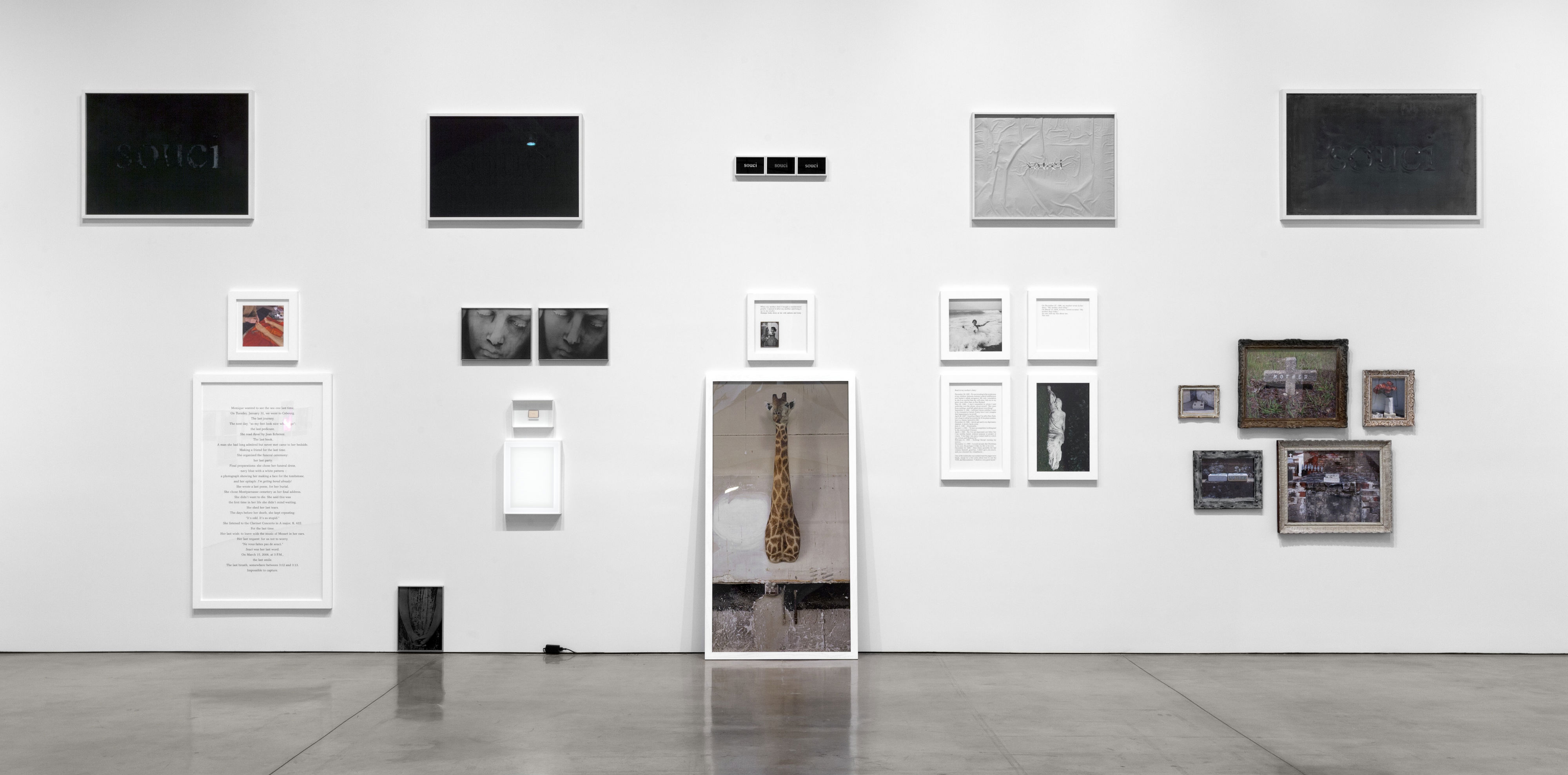
In 2005, Sophie Calle’s mother found out she had breast cancer. In 2006, as her mother lay dying, Calle set up a camera at her deathbed and recorded the entire process. “I wanted to be there, to hear the last word,” she told ARTINFO. “I didn’t know if she would have something to tell me at the last minute.”

© 2013 Sophie Calle / Artists Rights Society (ARS), New York / ADAGP, Paris. Courtesy of Sophie Calle and Paula Cooper Gallery, New York. Photo: Steven Probert

Sophie Calle. Absence, 2013; installation view, Paula Cooper Gallery, New York. Courtesy of Sophie Calle and Paula Cooper Gallery, New York. Photo: Steven Probert. © 2013 Sophie Calle / Artists Rights Society (ARS), New York / ADAGP, Paris.

She did. In Absence, Calle’s current show at Paula Cooper Gallery, her mother’s last word, “souci,” appears frequently, rendered in tall, imposing letters that loom above the other pieces.

The French word means “worry” and is often uttered within the phrase “Sans souci” or “Don’t worry.” But Calle fails to include the negative “don’t,” turning the show into an exploration on negatives, positives, and neutrals. Like much of Calle’s past work, Absence acts as a mystery novel that tirelessly searches for a missing person. In this case, that person is her mother.

Read More »

Share

London

From Wings to Fins: Morris Louis and Cyprien Gaillard at Sprüth Magers

Taking its name from a 2006 feature in National Geographic, Sprüth Magers’ latest London exhibition, From Wings to Fins, features the work of color-field painter Morris Louis and Cyprien Gaillard, a young French artist recently established within the international circuit. While Louis’ position is firmly mid-century, Cyprien Gaillard is a locus of tragic postmodernism. Drawn to modernism’s ideals, contradictions, and historical failures, Gaillard has risen on his ability to seek out and create tensions between stability and precarity, utopia and ruin, beauty and entropy, memory and amnesia. In the past, these tensions were variously converted into spectacles, as when Gaillard constructed a mountain of beer in Berlin or vandalized Robert Smithson’s Spiral Jetty (1970) with a fire extinguisher; intimate objects, such as the series of etchings the artist commissioned picturing dilapidated tower blocks among lush scenery; or meditations, notably in video works like Cities of Gold and Mirrors (2009). At the core is Gaillard’s fascination with the aging and crumbling edifices held up as inevitable sites of utopian failure within landscapes of historical violence.

gaillardmorris

Morris Louis. Beth Samach, 1958; installation view; Sprüth Magers London. Photo: Steve Ruiz.

In From Wings to Fins, these tensions are more subtle still, working between legacies embedded in objects. Culled from an unspecified collection, the two Morris Louis paintings, Beth Samach (1958) and Gamma (1960), play multiple roles: They are asked to represent the ideals and aspirations of a historical moment of great confidence and aspiration, and to model the falling motion of collapsing buildings in their blooming color drags. In the main space, the wide Beth Samach hangs before two vitrines in which National Geographic magazines are arranged, each with pages curved back in floral loops. Nearby, mounted to the gallery wall, a replica of an architectural security device mimics these radial shapes. The work is titled Fence (After Owen Luder) (2013) and, like the beautifully encased magazines, this archaeological original—discovered among the wreckage of Owen Luder’s Trinity Square car park in Gateshead—has undergone an artistic transmutation, now recast in bronze.

Read More »

Share

Help Desk

Help Desk: A Spark in the Dark

Help Desk is an arts-advice column that demystifies practices for artists, writers, curators, collectors, patrons, and the general public. Submit your questions anonymously here. All submissions become the property of Daily Serving. Help Desk is co-sponsored by KQED.org.

Help Desk Leader

I graduated from college about a year ago, and have been pursuing art passionately and persistently ever since. My work is well received, and I’ve participated in shows, but I’m used to being generally unnoticed. When it dawned on me that ardor does not equal opportunity, I came to another blindingly obvious realization—I know virtually nothing about building a career as an artist past this point. How do all of these young, contemporary artists that I admire get to where they are now? My whole life is art. I’ve never had more faith in anything, and can’t see myself doing anything else. My point is that I am unacceptably clueless about how to reach an audience in a way that I would like to. I’m aware that being an artist isn’t a walk in the park, but right now I’m stuck in a rut. What do I need to do to keep moving forward? I don’t want to lose my spark because I’m in the dark.

I wish I could give you a fun and non-cynical pep talk along the lines of: Just work hard and the magic will happen!, but you’ve already figured out that you can work your fingers to bloody nubs and still no one at Art Basel will know your name. Your question, though, is a good one. It’s the fundamental—perhaps axiological—query of the emerging artist living in the shadow of late-market capitalism: “I am passionate about art; how do I garner acclaim and money for my work?” And you’ll find any number of peppy answers if you poke around in art-career books, but my advice is that you keep these two things as far from each other as you can, because—and this is the really important part—you can only really control one of them.

Rezi van Lankveld.

Rezi van Lankveld. Agua, 2013; oil on canvas, 55 x 48 cm.

The point I’d like to make about control is central to your concern about how young contemporary artists got where they are now. These days, most young hotshots attended highfalutin MFA programs in New York or Los Angeles, where their work was seen by high-level gallerists and/or curators, some of whom were paid to take a look. Most of these artists had early market successes that were driven by a dealer who was willing to speculate on the value of their work. Many artists have been plucked from the deep, dark well of obscurity by a high-powered curator who put their work into a high-profile show at a major institution. When you weigh it in the balance, it turns out that these artists did not have much control over their careers beyond getting into top-notch schools and thereby having access to VIPs—someone else with money, influence, and power made it happen. I’m not trying to cast doubt on these artists’ relative talent or make pessimistic comparisons to the likelihood of you reaching your own goals, but it’s crucial that you understand that a rapid ascent to the dizzy heights of Artforum Mountain is not in the power of the artist alone.

That said, it is absolutely possible to meet people who believe in your work and who will help you move your career forward. You can start by building yourself a website with crisp, professional images that convey exactly what your work is, with accompanying texts that briefly explain what and how and why you do what you do. You can invite curators and gallerists and writers to your studio to chat about the work. You can submit images to online and print publications that showcase the work of emerging artists. Those art-career books will tell you in great detail how you can do all this. You can also look at some previous Help Desk columns here and here.

Read More »

Share

Shotgun Reviews

Citydance at Kadist Art Foundation

Shotgun Reviews are an open forum where we invite the international art community to contribute timely, short-format responses to an exhibition or event. If you are interested in submitting a Shotgun Review, please click this link for more information. In this Shotgun Review, Marion Cousin reviews Citydance at Kadist Art Foundation in San Francisco.

Francis Alÿs. Railings, 2004; still from film, 9 min 15 sec.

Francis Alÿs. Railings, 2004; still from film; 9:15.

The organizers chose not to reveal much beforehand; the only instruction was to meet at the Kadist Art Foundation at 7 sharp. Inspired by City Dance, Bay Area dancer and choreographer Anna Halprin’s 1977 performance that unfolded in over nine locations in San Francisco, Citydance featured nine videos projected around the Mission district on two occasions. Anne Lesley Selcer punctuated each video by reading one of her poems on the first night, and Stephanie Young did the same on the second night. For both evenings, the locations were as varied as the selected works and highlighted the juxtaposition of one city’s image onto another. For example, at the corner of 20th and Harrison Streets, Francis Alÿs’s Railings (2004) was projected on the bottom of a wall underneath the metal fence of John O’Connell High School; the video animated the space with the sounds of the artist dragging a stick across different railings in London.

Read More »

Share