San Francisco

Energy That is All Around at SFAI’s Walter and McBean Galleries

From our partner Art Practical, today we bring you a review of Energy That Is All Around, a group show of “Mission School” artists now on view at the Walter and McBean Galleries in San Francisco. Our #Hashtags editor Anu Vikram discussed this same show recently in her column The Trouble with the Mission School, and today we bring you another consideration of the work. Author Patricia Maloney notes, “As an ideology for San Francisco, the Mission School is still relevant even as its namesake neighborhood has radically transformed and derivative works have diminished the politics that informed the aesthetic choices of the original artists.”

Ruby Neri. Untitled, 1995; paint on paper; 34 x 22 inches. Courtesy of the artist

Ruby Neri. Untitled, 1995;
paint on paper; 34 x 22 inches. Courtesy of the artist

Curated by art historian Natasha Boas, Energy That Is All Around, on view at the San Francisco Art Institute (SFAI) Walter and McBean Galleries, highlights the studio production of Chris Johanson, Margaret Kilgallen, Alicia McCarthy, Barry McGee, and Ruby Neri, who, with the exception of Johanson, met as students at SFAI. Boas attempts to disintegrate the calcifying nostalgia that surrounds their work as hallmarks of the Mission School by emphasizing the overlapping formal concerns of their paintings, drawings, and sculptures. This framework shifts the focus away from how deeply integrated street art and subcultures, folk music, punk, outsider art, and typography were in their lives as well as their art. Instead, Boas foregrounds the enduring collaborations that began while the artists were students, as well as their concurrent, dynamic discoveries around line and color that occurred individually and collaboratively.

Alicia McCarthy and Ruby Neri are the standouts. A 1996 untitled (and rare) oil painting by McCarthy draws one in with its siren call of polychromatic, wavering lines woven into a hypnotic grid. Such Thing Countless Wondrs (1995), a group of nine works on paper by Neri, assembles a set of pictograms that seems to provide a lexicon for the rest of the show with its combination of animals, figures, and fonts. Also remarkable is the small group of Johanson’s mostly untitled acrylic-on-panel paintings from 1998. Dark sentiments about pain, failure, helplessness, and rage crowd the monochromatic works, in which figures are layered almost to the point of obliteration.

Read the full article here.

Share

From the Archives

From the Archives: Art Basel Miami Beach, In Stereo

Art Basel Miami Beach runs from December 5 to 8 this year, so now that we’re done with turkey and family, it’s time to crate up the artwork and enter the commercial fray. Today we bring you a look back at the 2012 fair, courtesy of gallerist and writer Catlin Moore, who gives you the insider’s scoop on the concerns that drive the curatorial decisions in many a dealer’s booth.

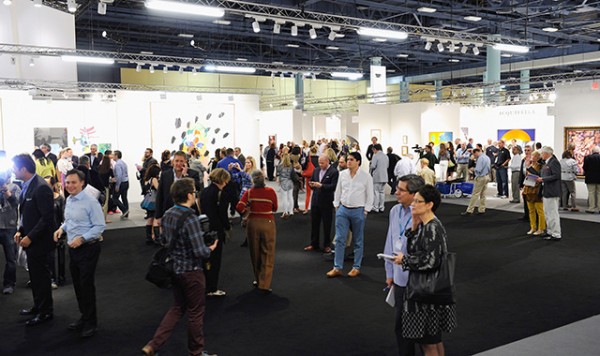
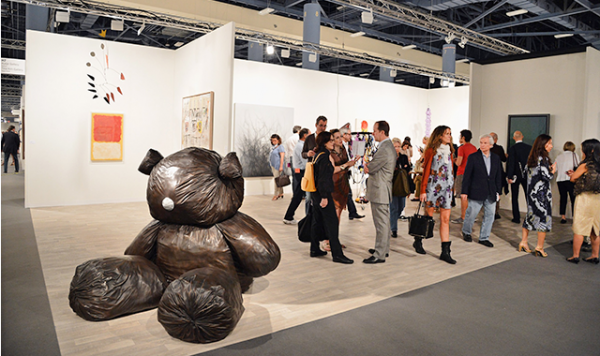
Photo by Mike Coppola/Getty Images for Art Basel Miami 2012.

Let’s begin with the facts. This year’s 12th annual installment of Art Basel Miami Beach featured 257 exhibitors (excluding publications, institutions, or bookstores). This means 257 booths spanning the floor of the approximately 500,000 square foot bottom floor of the Miami Beach Convention Center. If you walk all eight north-to-south aisles (one way), you will canvas a little over two miles of carpeted ground. This does not include the shorter east-to-west aisles (of which there are six), or offsite partnering venues (of which there are three). Add to the mix the record attendance numbers (50,000 visitors) over a short period of time (four days) at the pricey cost of participation ($35,000 on average), and you have a bona fide contemporary art circus. At $42 a ticket, the show better be worth the cost of admission.

Crowd view of Art Basel Miami Beach 2012. Photo by Andrew H. Walker / Getty Images.

Needless to say, the costs associated with exhibiting in one such fair are astronomical. Beyond the cost of the booth itself (which runs $52 per square foot in the fair’s main section), a gallerist must consider packing, shipping, flights, meals, staff hotel accommodations, promotional expenses, possible furniture rental, client entertaining, and the omnipresent “unanticipated expense.” Need an extra light bulb in the booth? That’ll be $150 each. Lunch for the staff of four? $96 a day. Needless to say, the pressure to (at a minimum) break even on the expenses of participating in the headlining mega-fair oftentimes results in high-ticket inventory from high-ticket artists, leaving little room for the mid-career, emerging, or unknown set. So when a gallerist decides to feature the atypical–potentially, unsaleable–artists of his/her program, it can often be considered a bold, magnanimous statement. Moreover, to hold the attention of a collector is challenging enough when sensory overload is a fated plague, but to also attempt to capture their focus through an unorthodox sensory faculty requires certain panache. Enter: sound and video art; the conceptual, disenfranchised cousins of Basel’s long-running triple feature, starring Koons, Murakami, and Warhol. This is not to say that presenting sound and video art at a venue like Art Basel Miami Beach is easily done, or even encouraged, by participating dealers. All signs typically point to “easily overlooked,” especially when competing with more commercially digestible works like the colossal Roy Lichtenstein in Gagosian’s booth, or the hustled parade of hip-hop moguls weaving through the masses. However, a select few of these ambitious projects managed to cut through the white noise of the fair’s inner murmur and conduct an alluring opus for the observant few.

Read More »

Share

San Francisco

City of Disappearances at CCA Wattis Institute of Contemporary Arts

Today we bring you a video walk-through of City of Disappearances, the current exhibition at the CCA Wattis Institute for Contemporary Arts. Curator Joseph del Pesco (half of the curatorial team, with Elizabeth Neilson) takes the viewer through the show, explaining the works on view and the ideas that brought them together. “Here we think about the echoes of the city, ” explains del Pesco, “the memories that are embedded in the architecture.”

Share

New York

Mike Kelley at MoMA PS1

Mike Kelley, now at MoMA PS1, is massive. The largest retrospective of the artist’s work to date, it is comprehensive perhaps to a fault, filling each of the exhibition space’s four floors to capacity and arguably beyond. The former school building’s multiple stairwells allow for various paths through the exhibition—a feature that is liberating if potentially disorienting—but the overall impression is one of totality; of a lifetime of practice gathered together and laid out for inspection. Even after several hours navigating the show with the aid of a floor plan, I’m not confident I saw everything, but in any case, I had had enough.

Mike Kelley. Day is Done, 2005; installation view, Mike Kelley, 2013. Courtesy of MoMA PS1. Photo: Matthew Septimus.

Mike Kelley. Day Is Done, 2005; installation view, 2013. Courtesy of MoMA PS1. Photo: Matthew Septimus.

This is to say that the show is taxing, partly because Kelley’s art is itself often stress-inducing, concerned as it is with giving stage to images of trauma and giving form to anxieties that society would otherwise repress—and doing it with a fierce impudence and black humor that has been aptly classified as punk. To be sure, this disdain for the polished and the decorous is what makes Kelley so outstanding as an artist, and Mike Kelley deserves praise for including so many of his hard-to-stage projects. Take, for instance, his quixotically ambitious Day Is Done video installation series, which sets out to stage twisted “repressed memories” purportedly lurking beneath 365 high-school yearbook photos of extracurricular activities. Here we encounter twenty-five of the thirty-two completed installments together in one rich, cacophonous gallery.

Where the exhibition comes up regrettably short, however, is in opportunities to actually reflect on the career, tragically ended by Kelley’s suicide last year, that is so thoroughly on display. To what do Kelley’s lacerating meditations amount? For someone not already long acquainted with the artist’s practice, this retrospective, profuse as it is with examples, provides precious few opportunities to formulate a response.

Read More »

Share

New York

Radical Presence: Black Performance in Contemporary Art at NYU’s Grey Art Gallery

How is Blackness performed?  Most African American contemporary artists will admit in confidence that they are often expected to perform their Blackness for the power players of the art mainstream, regardless of their choice of artistic medium. Artists working in two dimensions such as Kerry James Marshall, Kara Walker, and Wangechi Mutu have gained currency by creating work that makes the construction of black identity its subject. Sculptors such as Rodney McMillian and Kamau Amu Patton have garnered acclaim by merging the formalist concerns of minimalism with a black (and Black) material palette. Radical Presence: Black Performance in Contemporary Art at Grey Art Gallery is the first of a two-part exhibition originating at the Contemporary Arts Museum Houston [the second is at the Studio Museum of Harlem] that addresses the history of black performance art since the 1970s. Blackness is evidently performed in these works, but whether there is truly such a thing as black performance remains in question.

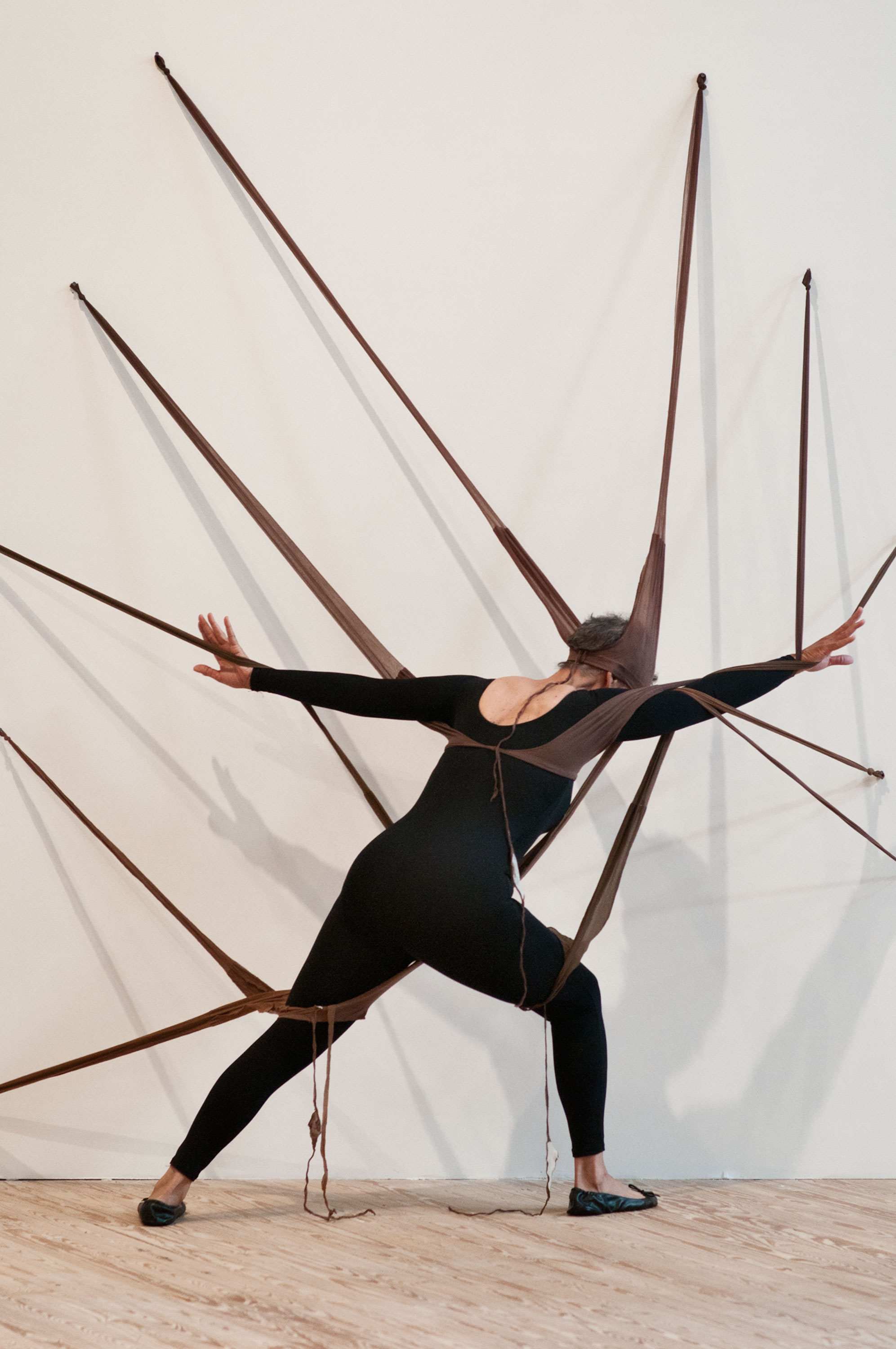
Maren Hassinger performing in Senga Nengudi’s RSVP (1975–77/2012) at Contemporary Arts Museum Houston, November 17, 2012. Courtesy the artists and Contemporary Arts  Museum Houston. Photo: Max Fields.

Maren Hassinger performing in Senga Nengudi’s RSVP (1975–77/2012) at Contemporary Arts Museum Houston, November 17, 2012. Courtesy of the Artists and Contemporary Arts Museum Houston. Photo: Max Fields.

Touchstones of the black performance history described by curator Valerie Cassel Oliver include Senga Nengudi’s RSVP (1975), a series of choreographed events she created in collaboration with fellow artist Maren Hassinger in which Hassinger’s body activates sculptures made from nylon stockings manufactured in “black” skin tones. Nengudi’s work operates as an African American Arte Povera in which mundane materials are invested with the experiences of common people, their abjectness an echo of disenfranchisement and poverty. Her medium, stockings, is a material that emulates the skin of black women while offering them an elusive promise of upward mobility and social acceptance. Her sculptures recall the work of Eva Hesse in their pendulous, organic abstract forms, acted upon by gravity so as to be in a constant state of tension. Nengudi rose to national prominence via 2012’s Now Dig This! Art and Black Los Angeles 1960-1980 at the UCLA Hammer Museum (which traveled to MoMA PS1). Here, her work is performed on scheduled dates by Hassinger and other dancers. Absent their bodies, as sculpture it is most effective when the viewer has the memory of her more ambitious installations in the earlier exhibition. Read More »

Share

Help Desk

Help Desk: MFA vs. Residency

Help Desk is an arts-advice column that demystifies practices for artists, writers, curators, collectors, patrons, and the general public. Submit your questions anonymously here. All submissions become the property of Daily Serving. Help Desk is co-sponsored by KQED.org.

Help Desk Leader

How valuable is an MFA these days and is it really worth the cost? I’ve spent the last two months researching schools and preparing applications for MFA programs in several different countries. (My partner’s job might require me to study abroad.) I would like the degree not because I am interested in teaching, but because I am interested in the intensity of a two-year program to cultivate solid research and focus on work amidst peers and access to faculty input. In some cases, however, the cost for international students is very high. I just took part in an artist residency that left me wondering: If I’m not that interested in teaching, is it really necessary to have the MFA, or could I have comparable experience with multiple residencies and save the money?

The answer to this question depends a lot on what kind of person you are. Do you like deadlines? Are you disciplined and self-motivated? If aliens were invading Earth in a month, would you voluntarily do hundreds of push-ups a day and build a tank out of junkyard cars in order to defeat them? Or are you like me, who would eat all the cookies I could put my hands on and then find a hole in which to quietly die? If your answer is the former, then perhaps you have the drive to create and execute an intense plan for self-education.

Pat O'Neill. Horizontal Boundaries, 2008; still from color film, sound, 23 mins.

Pat O’Neill. Horizontal Boundaries, 2008; still from color film, sound;
23 mins.

Here’s what the MFA is: two years of studio time interrupted by seminars, readings, papers, presentations, and bitch sessions with classmates over cheap drinks. It’s an artificial structure designed to cram as much as possible into your head in a very short time. Every day is intense, and even though it is a scaffolded ordeal, it is still much more self-directed than the typical undergraduate experience. In an MFA program, you have to create and think very deeply about creating at the same time, and this (plus all the hangovers you’ll suffer) is what makes it completely exhausting.

If you set out on your own, there are three main components to an MFA program that you’re going to have to try to replicate: studio time, coursework, and conversation. The first is easy if you’re at a series of residency programs, so let’s put this one aside.

Read More »

Share

Shotgun Reviews

Stacey Steers: Night Hunter at Catharine Clark Gallery

Shotgun Reviews are an open forum where we invite the international art community to contribute timely, short-format responses to an exhibition or event. If you are interested in submitting a Shotgun Review, please click this link for more information. In this Shotgun Review, M. Rebekah Otto reviews Stacey Steers’ Night Hunter at Catharine Clark Gallery in San Francisco.

Stacey Steers. Lillian on Bed with Eggs, 2011; Video clip of Night Hunter; Film 35mm to HD Stereo sound. 15:30. Courtesy of Catharine Clark Gallery.

Stacey Steers. Lillian on Bed with Eggs, 2011; video clip of Night Hunter; film 35mm to HD stereo sound; 15:30. Courtesy of Catharine Clark Gallery.

Experimental animator Stacey Steers currently has work on view in Night Hunter at Catharine Clark Gallery. The centerpiece of the exhibition is Night Hunter House (2011), an imposing, black Victorian dollhouse. Through small windows, the viewer may glimpse ten small rooms filled alternately with artifacts of domesticity (a single nylon drying on a rack) and eerie, surreal snakes with foreboding eggs. The rooms also contain small screens that show excerpts of the film Night Hunter (2011), a collaged video starring Lillian Gish, the proto-ingénue of silent films. Gish is by turns the heroine and the damsel of Night Hunter, a delicate film that juxtaposes the “real” filmed world of Gish with an animated one. The simplistic animation and collage techniques illuminate the textures of grainy black-and-white film, creating a world that is stranger and more complex than either medium alone. Gish becomes Alice in a darker wonderland.

Read More »

Share