San Francisco

Jonathan Runcio: Glass in the Garden at Romer Young

From our San Francisco Bay Area partner Art Practical, today we bring you a review of Glass in the Garden, Jonathan Runcio‘s current solo show at Romer Young Gallery. Author Danica Willard Sachs explains that Runcio’s work “dismantles the architecture of the city, peeling back the glossy finish to show the viewer the raw substrate.” This article was originally published on November 25, 2013.

Jonathan Runcio. Glass in the Garden, 2013; installation view. Courtesy of the Artist and Romer Young Gallery, San Francisco.

Jonathan Runcio. Glass in the Garden, 2013; installation view. Courtesy of the Artist and Romer Young Gallery, San Francisco.

In his latest exhibition, Jonathan Runcio gives the viewer fragmented artifacts from the urban landscape: cement, steel, enamel, and glass. Here, Runcio returns to many of the themes of his earlier work—in particular, an interest in exploring the materials of the urban environment. In Glass in the Garden, Runcio pairs these materials with images sourced from Arts & Architecture magazine’s pioneering mid-century experiments in residential home design: the Case Study Houses.

Standing aloof in one corner of the gallery, Runcio’s Cast-Off Lamp 02 (2013), a stark approximation of a streetlight with a slim brass post and exposed industrial bulb, anchors the exhibition firmly in the streetscape. Untitled (Message) (2013) features a sheet of tarnished brass screen printed with overlapping and ultimately unrecognizable images of the Case Study Houses. Crumpled and discarded on the floor like rubbish, the sculpture underscores the end of a certain kind of built landscape. The effect of the overall installation of the artist’s sculptures plays doubly: Runcio has either positioned viewers amid the wreckage of a post-apocalyptic landscape, or he has placed us in the formative stages of new construction.

Read More »

Share

Fan Mail

Fan Mail: Cody Arnall

Cody Arnall uses his unique vision to approach the mundane and utilitarian objects that surround him. By seeing the potential in these objects, Arnall transforms latent possibilities into new combinations that simultaneously approach a mysterious beauty and a perceivable yet unnamed functionality.

Cody Arnall. Untitled, 2009; shopping carts, steel, plastic mesh, zip ties; dimensions variable. Courtesy of the artist.

Cody Arnall. Untitled, 2009; shopping carts, steel, plastic mesh, zip ties; dimensions variable. Courtesy of the Artist.

Much of Arnall’s reconfiguring has to do with bringing a distinct “energy, force, and movement” (his words) to the everyday objects in his sculptures, which resemble the assemblage or combine method used by the late Robert Rauschenberg. Untitled (2009), made of three cherry-red shopping carts in various stages of deconstruction joined and extended in shape with a plastic mesh, harnesses a vibrant and almost cyclonic energy. One can imagine the carts being torn apart and inexplicably made anew in crystal-clear slow motion.

Read More »

Share

Toronto

Yam Lau: Tour China at Hamilton Artists Inc.

Canada has a strong history of artist-run spaces; from Montreal to Vancouver, Winnipeg to Halifax, alternative spaces for displaying art are as Canadian as hockey. Hamilton Artists Inc. is a key voice in this tradition of noncommercial spaces directed by artists. What is innovative about their current exhibition, Yam Lau’s Tour China, is that the gallery space is turned outward; the show consists of a single piece installed on the exterior of the building. This eversion of the artist-run space creates new viewership and extends the relatively small gallery space into the fabric of James Street.

Yam Lau. Tour China.

Yam Lau. Tour China, 2013; vinyl print; 8 x 36 ft. Courtesy of the Artist and Hamilton Artists Inc.

Lau’s piece is a large-scale PVC banner—a common sight in urban centers throughout China. In Lau’s home country, these banners have a variety of functions, from advertisements for new housing projects to informational texts put up by the government explaining construction work. Lau appropriates the format of the banner and uses digital images mashed together to suggest the blurriness of ink washes. The unfurled banner can be imagined as a handscroll, overgrown and oversize as if on steroids. This interpretation of the banner is reinforced by the textile “mountings” that frame the central composition. Their rich, reddish brocade patterning is reminiscent of traditional painting mountings, which were intended to prepare the viewer to contemplate the full scroll. Because Tour China is already fully unfurled—a state in which traditional handscrolls were never meant to be seen—these textile images serve instead to bookend the central images and text.

Read More »

Share

New York

Liam Gillick and Louise Lawler: November 1 – December 21 at Casey Kaplan Gallery

The simply titled exhibition November 1 – December 21, on view at Casey Kaplan Gallery in New York, pairs works by artists Liam Gillick and Louise Lawler. Sharing the space of Kaplan’s Chelsea gallery, Gillick’s cut aluminum text pieces dangle from wires attached to the ceiling while Lawler’s almost filmic photographs cling neatly to the walls. Though they occupy the same space, the works of these two artists do not coalesce into anything resembling a collaboration; rather, the show reads as a convenient pairing of two bodies of work that, presented alone, would have left the gallery feeling more antiseptic than inviting.

Exhibition view, November 1 – December 21, at Casey Kaplan Gallery, New York. Image courtesy the artists and Casey Kaplan Gallery.

Exhibition view, November 1 – December 21, at Casey Kaplan Gallery, New York. Courtesy of the Artists and Casey Kaplan Gallery.

This is not to say that the works on view are not compelling, either taken together as they are here, or considered individually. Whereas much of Lawler’s previous work has focused on artworks in various locales—be they the pristine white walls of a museum, the opulent home of a collector, or an unidentifiable art-storage site packed in with crates and cases—the works on view at Kaplan diverge from her usual approach. Lawler’s photographs have long fascinated the art-inclined, offering glimpses of works we may know and love in unusual settings, while offering subtle prodding gestures toward questions of value, circulation, commoditization, and use. Here, however, Lawler swerves a bit from her usual path. In these newly manipulated works, two of Lawler’s photographs are transformed. Her 2010 image Life Expectancy, which captures carefully clipped segments of works by Carl Andre, Richard Serra, and Gerhard Richter, sets the stage, and is paired with an elongated version of itself, stretched into long pulls of color and line. Beyond the wall break, another of Lawler’s images, this time depicting Degas’ Little Dancer, receives a similar treatment. In each of these new works, the single image is lengthened to the extreme, creating abstracted images that guide the viewer deep into the show, their expanses stretching along walls and into corners.

Read More »

Share

Perth

Susan Flavell: Freud’s Desk at Turner Galleries

Early in 2013, six Australian artists made a pilgrimage of sorts. They left a sweltering southern summer for the gray frigidity of London, where they spent three weeks working on-site at the Freud Museum; Susan Flavell and I were among their number.

At the museum, we encountered the shrine-like space of Sigmund Freud’s study, preserved as it was in the final year of his life, after his family had fled Nazi Austria. Even then, the study already had a museum-like quality, having been transported from Vienna and remodeled as faithfully as possible on the original. Here, Freud created something of a gesamtkunstwerk: a collection of the world and a self-portrait all in one room. The iconic couch is there, of course, as well as the unsettlingly anthropomorphic chair, but almost every square inch is occupied by Freud’s obsessive collection of antiquities from the ancient Mediterranean and Asia. The treasures of his collection were displayed on his desk, an intimate pantheon that he would contemplate while writing, caress while consulting patients, and greet like dear friends. They bear witness to vanished civilizations and archaic religious rites, but also the birth of psychoanalysis, Freud’s flight from Nazi persecution, and his death in the study after a long battle with cancer. As such, these objects are entangled in a complex web of histories and mythologies both global and personal.

59, 11, 7, c, 66, 50, 18

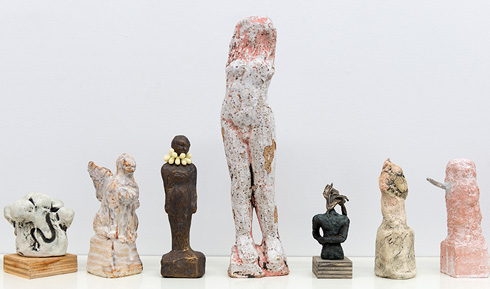
Susan Flavell. Freud’s Desk, 2013; installation view. Courtesy of the Artist and Turner Galleries.

This is irresistible fodder for an artist like Flavell, who is fascinated by the systems through which we attempt to make sense of the world and give form to things beyond our comprehension, mythology and psychoanalysis among them. One of her ongoing interests concerns the ways that humans represent and act upon the animal world, and the autonomy of nonhuman creatures in spite of these attempts to enculturate them. The animal-human hybrids on Freud’s desk have spurred the production of “unquiet objects” that amalgamate and improvise upon the disparate cultural and historical currents at work in his collection.

Read More »

Share

Hashtags

#Hashtags: The Ethnicity Exhibition

#race #ethnicity #gender #institutions #access #identity

Since the Civil Rights Era, it has become commonplace for marginalized ethnic communities to instate their own institutions of sociological and cultural study such as university Ethic Studies departments and museums like Brooklyn’s Museum of Contemporary African Diaspora Arts. In the face of extreme prejudice and exclusion from the discourses of history and art, many have felt the necessity and urgency of race-focused research. Nonetheless, in a global art market such as we have today, the existence of numerous star artists of color has prompted some to ask whether the race-based exhibition has run its course as a format for relevant artistic exchange. Recently, Adrian Piper’s request to withdraw her work from the exhibition Radical Presence: Black Performance in Contemporary Art at NYU’s Grey Art Gallery stirred up debate around ethnocentric exhibitions once more.

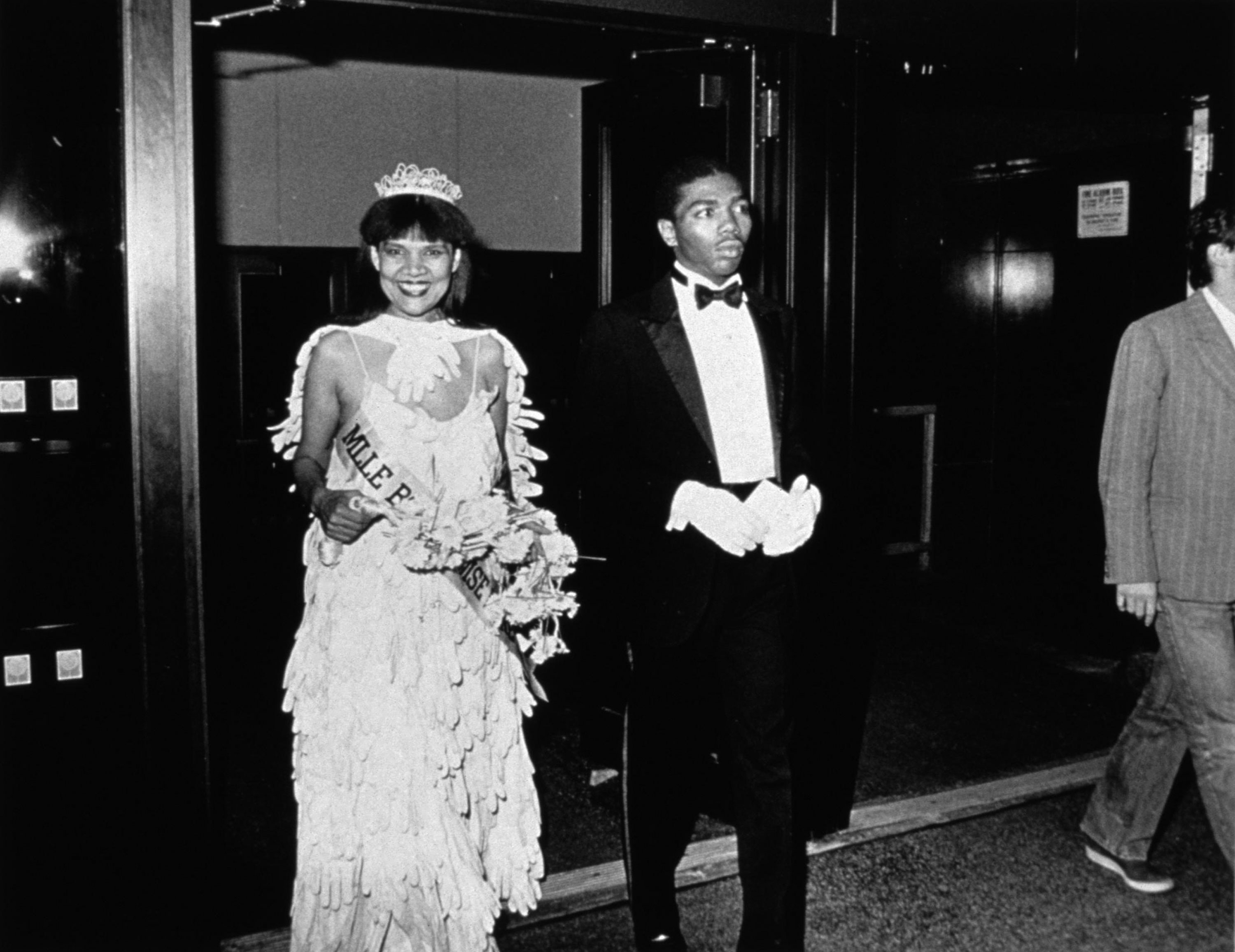
Lorraine O’Grady. Untitled (Mlle. Bourgeoise Noire and her Master of Ceremonies enter the New Museum), 1980–83, printed 2009. Gelatin silver print. 7 1/4 x 9 1/4 in. Courtesy the artist and Alexander Gray Associates, New York.

Lorraine O’Grady. Untitled (Mlle. Bourgeoise Noire and her Master of Ceremonies enter the New Museum), 1980–83, printed 2009. Gelatin silver print. 7 1/4 x 9 1/4 in. Courtesy the artist and Alexander Gray Associates, New York. Included in Radical Presence at Grey Art Gallery.

Piper’s request that documentation of her work The Mythic Being (1973) be pulled from the exhibition was executed with high drama, coming after the show had opened and the work was already on view. The timing of her withdrawal is inexplicable considering the work had been included in the full run of Radical Presence at its originating institution, Contemporary Arts Museum Houston. Her request read, in part: “Perhaps a more effective way to ‘celebrate [me], [my] work and [my] contributions to not only the art world at large, but also a generation of black artists working in performance,’ might be to curate multi-ethnic exhibitions that give American audiences the rare opportunity to measure directly the groundbreaking achievements of African American artists against those of their peers in ‘the art world at large.’”[i] For her part, curator Valerie Cassel Oliver has said that Radical Presence intends to “resist reductive conclusions about blackness”[ii] and to present a version of performance in black history that transcends traditional categories of music, dance, and storytelling. Seeking to define African American art practice as more than theater or folk art, Cassel Oliver has opted to locate recent art by black artists within a conceptual framework.

Read More »

Share

Shotgun Reviews

Sean McFarland: Glass Mountains at Stephen Wirtz Gallery

Shotgun Reviews are an open forum where we invite the international art community to contribute timely, short-format responses to an exhibition or event. If you are interested in submitting a Shotgun Review, please click this link for more information. In this Shotgun Review, Danica Willard Sachs reviews Sean McFarland’s Glass Mountains at Stephan Wirtz Gallery in San Francisco.

Sean McFarland. Glass Mountain, 2013; gelatin silver print, 8 x 10 inches, edition of 3. Courtesy of the artist and Stephen Wirtz Gallery, San Francisco.

Sean McFarland. Glass Mountain, 2013; gelatin silver print, 8 x 10 inches, edition of 3. Courtesy of the artist and Stephen Wirtz Gallery, San Francisco.

For Sean McFarland, there’s no such thing as a straight photograph. In Glass Mountains, McFarland’s first solo exhibition at Stephen Wirtz Gallery, the artist manipulates digital chromogenic prints, Polaroids, and cyanotypes, creating images that confound and beguile. McFarland renders his nominal subject—landscapes—unfamiliar, experimenting with photography’s most basic components (light and paper) to challenge the veracity of what we see.

Read More »

Share