San Francisco

Anoka Faruqee: Substance and Accident at Hosfelt Gallery

From our partners at Art Practical, today we bring you a review of Anoka Faruqee‘s paintings at Hosfelt Gallery in San Francisco. Author Rob Marks notes that critics of Op art who characterize the genre as superficial are ignoring the possibilities that lie beneath the surface: “Faruqee’s 2013P-29, 2013P-32, and 2013P-34 (all 2013), for example, could appear as little more than decoration, gimmickry, or novelty…. But such easily drawn conclusions—the perception that Faruqee’s patterns are self-evident—arise only because the conventional idea of moiré-ness, like an insidious stereotype, may distract viewers from the particular conditions that characterize Faruqee’s expression of the pattern, and from the nature of her painted surfaces.” This article was originally published on December 2, 2013.

Anoka Faruqee. 2013P-34, 2013; acrylic on linen on panel; 33.75 x 33.75 in. Courtesy of the Artist and Hosfelt Gallery, San Francisco.

Anoka Faruqee. 2013P-34, 2013; acrylic on linen on panel; 33.75 x 33.75 in. Courtesy of the Artist and Hosfelt Gallery, San Francisco.

Anoka Faruqee’s abstract artworks are demanding, not because they defy associations—as a Pollock drip painting does—but because the immediate associations they invite seem unproductive. If this sounds like a condemnation of the show, it is not.

There is a persistent critical tradition that dismisses abstract artwork whose conceptual content seems overshadowed by its form. Art critic and curator Lucy Lippard’s 1965 denunciation of optical art sums up the feeling: “an art of little substance with less to it than meets the eye.” Lippard’s evaluation comes to mind because Faruqee’s thirteen paintings currently on view at the Hosfelt Gallery depict moiré patterns, one of the effects that Op artists explored.

Read the full article here.

Share

Elsewhere

An Interview with Leeah Joo

In her most recent collection of paintings, Dokkebis and Other Tales, Leeah Joo conjures myths by way of textiles. Joo, who was born in Seoul, South Korea, immigrated to the U.S. at age 10. She received her MFA in Painting from the Yale School of Art, and her work has been featured nationally. Next year, Joo’s work will be featured in February at Artspace in New London, CT, and in a solo show in the fall at Andrew Bae Gallery.

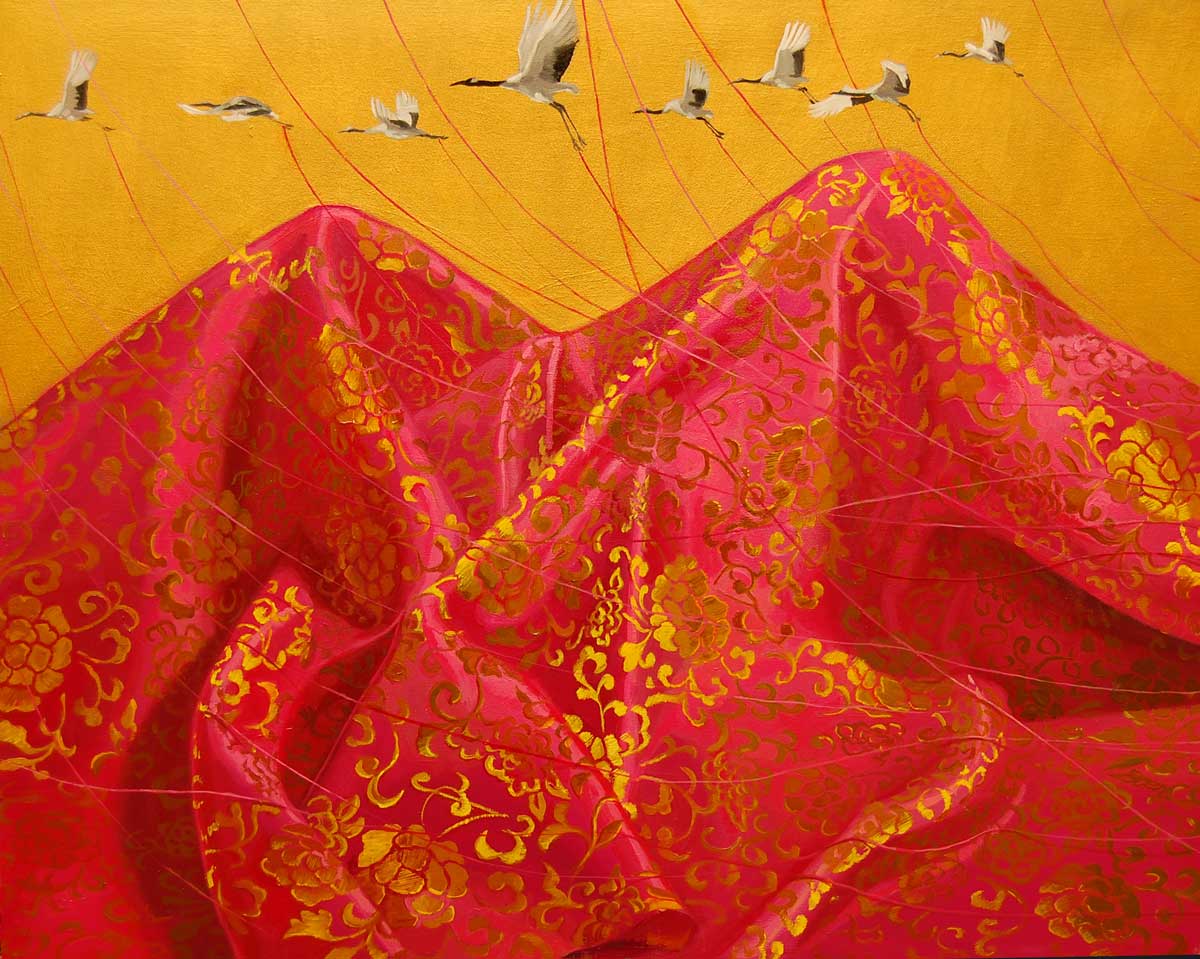
Leeah Joo. Flight of Crane Wives, 2013; oil on wood panel; 16 x 20 in. Courtesy of the Artist.

Leeah Joo. Flight of Crane Wives, 2013; oil on wood panel; 16 x 20 in. Courtesy of the Artist.

Robin Tung: Many of your collections emphasize curtains, windows, and lattice doors. What interests you about surfaces?

Leeah Joo: I have always been fascinated with narrative-driven artwork, from Man-wha (Korean manga) to Old Masters. In the Windows and Doors series, I refer to literature and a cinematic approach to canvas. For example, Hitchcock’s Rear Window and the seduction of voyeurism. We often find ourselves inadvertently peeking into neighbors’ lives with a passing glimpse of their lit windows. From these fleeting images, we weave a tale to satisfy our curiosity.

For me, my emphasis on the detail of the surface of the fabric, glass, wood is a way to draw attention, to pique your interest.  There is an ancient tale of two Greek painters, Parrhasius and Zeuxis, who had a contest: Zeuxis paints a bowl of grapes so realistic a bird tries to peck at the painting.  Zeuxis then turns to Parrhasius’ painting, which has a curtain draped over it. When Zeuxis demands the curtain be pulled back, Zeuxis discovers that the curtain is Parrhasius’ painting. I love this story because it combines the power of realism and anticipation created by the concealing curtain. In great storytelling, the buildup and the anticipation keep us interested, not the ending itself. I like to think my “surface” is the buildup.

Read More »

Share

New York

Yayoi Kusama: I Who Have Arrived in Heaven at David Zwirner

Still working in feverish catharsis at the age of 82, Yayoi Kusama is Japan’s most famous living artist. Yet in the United States she has only recently received a slice of the recognition that her expansive body of work and visionary approach deserve. Following a critically acclaimed retrospective at the Whitney last year, Kusama was picked up by David Zwirner in early 2013. For her current exhibition, her first at the gallery, she has created two new “infinity rooms” and an impressive collection of large, square-format paintings.

Yayoi Kusama. Manhattan Suicide Addict, 2010-present; Video projection and mirrors; overall dimensions vary with each installation. Courtesy of the artist and David Zwirner.

Yayoi Kusama. Manhattan Suicide Addict, 2010-present (video still); video projection and mirrors; overall dimensions vary with each installation. Courtesy of the Artist and David Zwirner.

Kusama’s practice develops a cult of personality as a result of the simple fact that she is her work. Compulsive in quantity and in form, Kusama’s work consists totally of her own hallucinatory obsessions; the spots, tentacle forms, and phalluses in her work are based on visual hallucinations she has experienced since childhood. A permanent resident at a psychiatric institution since her return to Japan in 1973, Kusama has crafted an immense body of work as an extension of her disorder and as a balm for it, effectively enshrouding herself and her viewers in her own hallucinations.

Read More »

Share

Perth

Valentina Vannicola: Dante’s Inferno

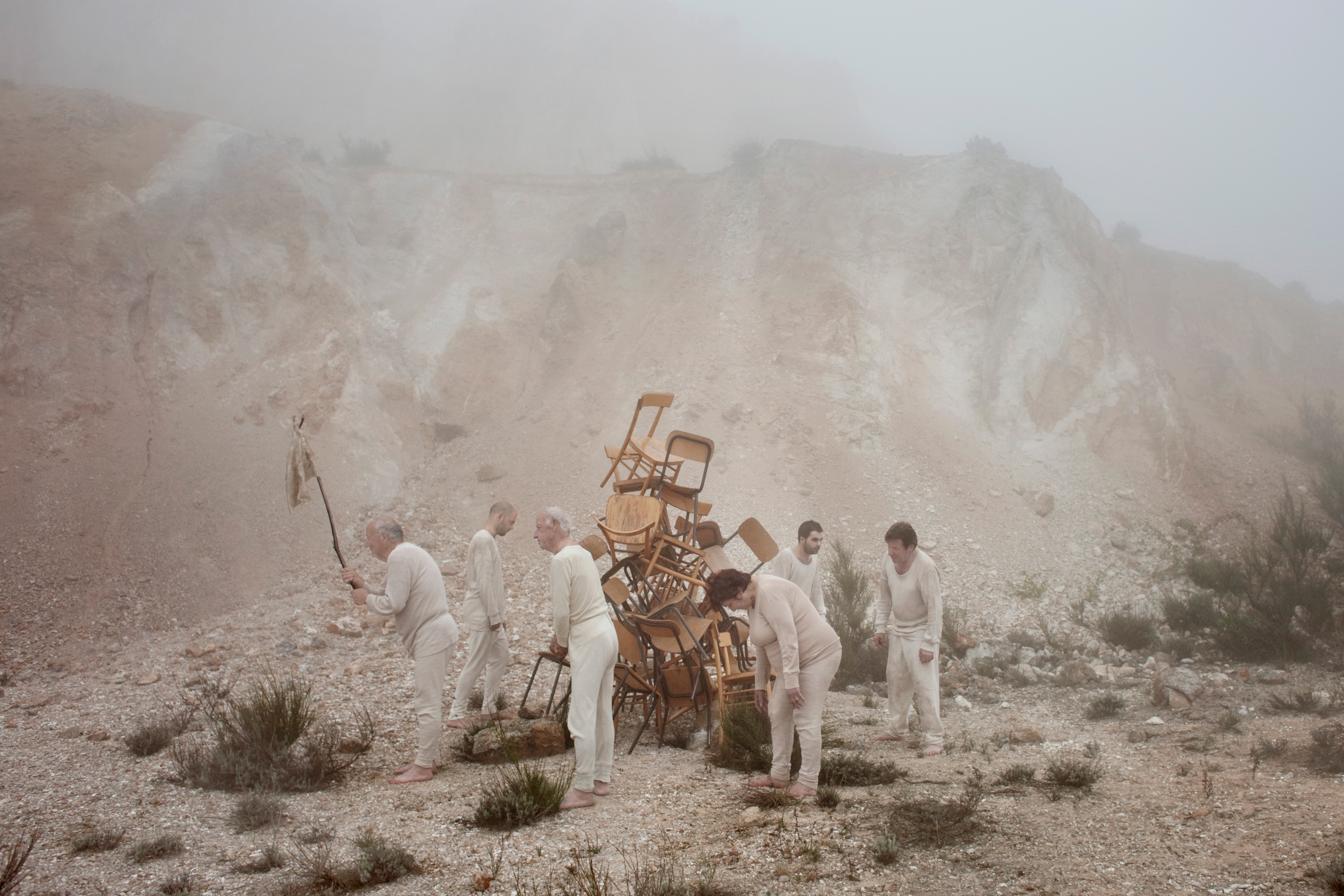
In Dante’s Inferno Italian artist Valentina Vannicola merges staged photography with socially engaged practice, resulting in a rich body of work reminiscent of the postdramatic theater of Romeo Castellucci and the Societas Rafaello Sanzio. Using non-professional performers from her hometown of Tolfa, north of Rome, Vannicola has constructed absurdist scenes recreating Dante’s journey through the strata of hell. While the outcome could easily have been predictable and illustrative, the mise-en-scène of landscape, objects, and untrained actors suggests rituals both playful and tragic.

Inferno. Tolfa, Rome, Italy, April 2010 February 2011. ### Infer

Valentina Vannicola. # 01 – Canto III – Slothful, 2010; Giclée print. Courtesy of the Artist and OnOff Picture.

 In Vannicola’s optic, the classical text is transported to a wasteland bearing marks of industry and agriculture; the damned wear soiled thermal underwear and endure miseries particular to the contemporary world. # 02 – Canto III – Slothful depicts the fate of the complacent and ethically impoverished:

 “This miserable fate

Suffer the wretched souls of those, who liv’d

Without praise or blame, with that ill band

Of angels mix’d, who nor rebellious prov’d

Not were true to God, but for themselves

Were only.” (Dante, Canto III)

Read More »

Share

London

Sarah Lucas: SITUATION Absolute Beach Man Rubble at Whitechapel Gallery

Think 1990s YBA and what artworks come to mind? A pickled shark, a bawdy story tent, a head made of frozen blood… and a photo of Sarah Lucas looking defiant with a limp cigarette in her mouth. Or better yet, her bent, worn mattress with anthropomorphically inserted fruit and veg with metal bucket. Mostly, her pieces distill the human body down to a sexualised and/or consumed object. The key to Lucas’ work is that it’s beautifully uncomplicated in concept and execution. Nothing is superfluous. Regardless of whether you like the work or not, it’s impossible to not get it. That simplicity is what makes each work powerfully memorable as an image.

Sarah Lucas. Installation view, 2013 Courtesy Whitechapel Gallery, London, Photo: Stephen White

Sarah Lucas. Installation view of SITUATION Absolute Beach Man Rubble, 2013; Courtesy of Whitechapel Gallery, London. Photo: Stephen White.

SITUATION Absolute Beach Man Rubble at Whitechapel Gallery is a fully considered three-room installation that weaves the entire oeuvre onto itself to create a full-on, brilliantly funny, and in-your-face kind of endeavour. Photos and collages are blown up and made into Warholian wallpaper onto which other works are hung. Sculptures are combined, or positioned in near-overlapping proximity, or supported by stuff that might or might not be new sculpture. The interesting restraint to this new amalgamation is that individual works retain their identity courtesy of the museum wall tag. One example of this layering effect in the first gallery is the back wall, which is covered with an enlarged and repeating pattern from Soup (1989). Originally a photo collage measuring at 152.5 x 122 cm. (60 x 48 in.), it’s an image of an unidentifiable creamed soup adorned with about three dozen penis glans. Size matters in this show, and so the image is scaled up so that the glans are around the size of a human head. Framed and hung right of center over Soup is the iconic Eating a Banana (1990). Just off to the right, the sculpture Mechanical Wanker (1999) rests on a slick-looking table made of breeze (cinder) block and MDF. And this is just the back wall of the first gallery.

Read More »

Share

Help Desk

Help Desk: Studio Visits for a Post-Studio Practice

Help Desk is an arts-advice column that demystifies practices for artists, writers, curators, collectors, patrons, and the general public. Submit your questions anonymously here. All submissions become the property of Daily Serving. Help Desk is co-sponsored by KQED.org.
Help Desk Leader

As an artist, what can I do to make studio visits (with critics, curators, etc.) really, really great? I often feel like I don’t know what I’m doing. It might not help that I don’t exactly have a studio-based practice. I’m wondering if there’s anything I should be doing that I don’t know about.

I’ve responded to questions about studio visits before, so take a look at the answers to see if there’s anything that applies to your situation. However, you’re the first artist to ask specifically about visits for a non-studio-based practice, so this time I reached out to some curators and artists who understand what it means to work away from the studio, and they had some tips for you.

Barbara Probst. Exposure #109: Munich studio, 09.19.13, 5:31 p.m. , 2013; Ultrachrome ink on cotton paper, 2 parts, 24 x 24 inches each, edition of 5

Barbara Probst. Exposure #109: Munich Studio, 09.19.13, 5:31 p.m., 2013; ultrachrome ink on cotton paper, 2 parts, 24 x 24 in. each, edition of 5.

No matter what your practice consists of, the normal rules apply: clear away trash and health hazards; offer a beverage and maybe a snack; don’t have anything out that you’re not interested in discussing. One curator in San Francisco told me, “Like a strong artist’s talk, it’s helpful if you walk through your practice either thematically or chronologically. This guides the visitor through your thought process and development, so they understand the issues and ideas that concern you as an artist. It really shouldn’t matter if you have a studio-based practice or not; it’s more important that you effectively communicate what it is that you do and why you do it.”

Read More »

Share

San Francisco

Lindsay Benedict: dirty domestic at Martina }{ Johnston Gallery

Shotgun Reviews are an open forum where we invite the international art community to contribute timely, short-format responses to an exhibition or event. If you are interested in submitting a Shotgun Review, please click this link for more information. In this Shotgun Review, Susannah Magers reviews Lindsay Benedict’s dirty domestic at Martina }{ Johnston Gallery in Berkeley, California.

Lindsey Benedict. I'm Drinking My Hand (Roughing Up The Lips) 2010/2013.16 mm film transferred with live-Foley sound. 9 minutes. Courtesy of the artist.

Lindsay Benedict. I’m Drinking My Hand (Roughing Up the Lips), 2010/2013; 16 mm film transferred with live Foley sound; 9 min. Courtesy of the Artist.

dirty domestic’s premise benefits from its location in the home gallery of Indira Martina Morre and Farley Johnston Gwazda, integrating (and imposing) Lindsay Benedict’s life with their own.

Benedict’s paintings are grouped by the emotional context in which they were produced:  autobiographical relationships between gesture, color, and the events they reflect. There’s an evolving conversation between these moments. In two month self-imposed residency with my mom (2013), a set of 15 acrylic paintings on paper, basic geometric shapes jostle with squiggles that possess unexpected lightness. The works on the adjacent walls reference the death throes of a relationship, layered and more visibly reactionary with the addition of spray paint. Together, these paintings impart a deliberate physicality, and they are Benedict’s first foray into the medium. In this sense, they read as efforts in pushing self-limitations: the lighter, more subdued groupings made in Florida (while attempting to connect with her mother, a painter, and with the breakup pending), and the more visceral, murkier works with text made after the aforementioned breakup in Brooklyn.

Read More »

Share