Best of 2013 – #Hashtags: On the Political in Art
As we continue our Best of 2013 series, today’s pick comes from Bean Gilsdorf, who writes, “As the managing editor of Daily Serving, I get to work with over thirty super-talented authors from around the world, so it’s very hard for me to select just one article for this series. However, I really appreciate the energy that Anuradha Vikram has brought to writing and editing our #Hashtags series, a job that she took over in May of last year. This article in particular is one of my favorites because it’s knowledgeable and thoughtful, with a clear analysis of both the works that are presented and their future possibilities.” This review was originally published on August 26, 2013.
#race #class #access #commerce #representation #empowerment #codeswitching
As the values of the contemporary art elite veer ever farther toward commerce, art with a social justice conscience is rallying in New York—arguably the center of the global art market. This summer, three prominent artists known for their political consciences have been drawing attention for thoughtful, research-heavy projects. In Chelsea, Hank Willis Thomas and the team of William Powhida and Jade Townsend have brought discussions of race and class to a gallery scene where such concerns are often absent. Farther afield, Thomas Hirshhorn entices art audiences to venture to the South Bronx with his Gramsci Monument (2013), sponsored by Dia Art Foundation, at the Forest Houses public housing complex.
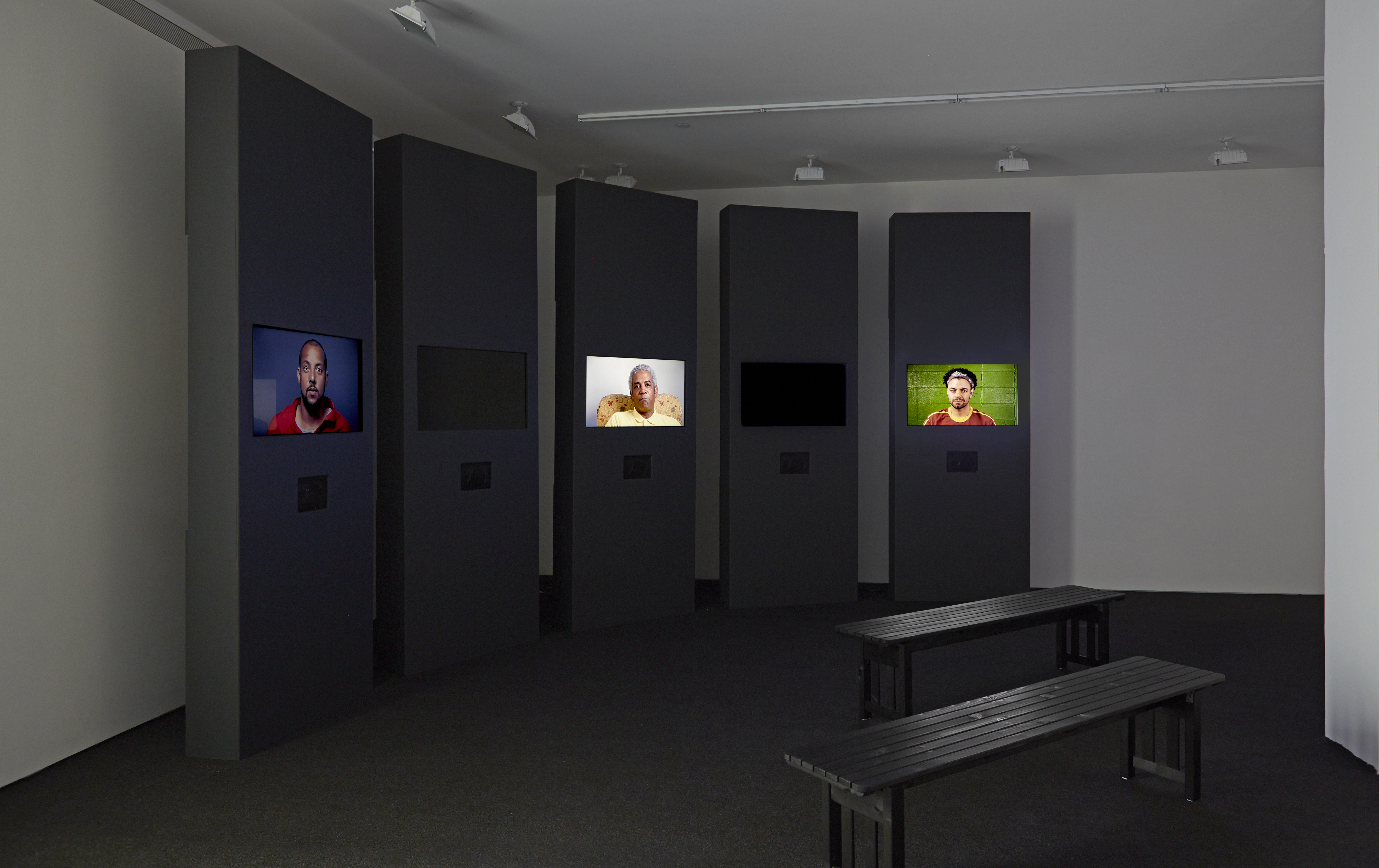
Hank Willis Thomas, Chris Johnson, Bayeté Ross-Smith, and Kamal Sinclair. Question Bridge: Black Males, 2012. Interactive video installation. Photo courtesy of Jack Shainman Gallery, New York
Thomas continues to mine the history of photography’s depictions of black men in America with his current show at Jack Shainman. His solo photographic and assemblage works, on view in the front gallery, appropriate nineteenth-century photographs and African American quilt patterns as frameworks for commentary on the performance of race and the necessity of code-switching as a strategy of resistance to assimilation. The work is political in content but not in its execution, existing as fairly traditional objects for collection and consumption. More radical is the back gallery’s installation, Question Bridge: Black Males (2012), a collaborative work by Thomas, Chris Johnson, Bayeté Ross-Smith, and Kamal Sinclair. Building on the idea that implicit bias is fed by lack of familiarity, Question Bridge is formulated as a testimonial document. Over 150 black men were interviewed for the project, asked to respond to questions posed by one another addressing masculinity, discrimination, opportunity, love, ego, family, and other loaded topics. The men range in age from late teens to octogenarians and in occupation from professors to performers to gang members. Some testify from the classroom or pulpit, others from behind bars. Some are self-aware, while others adopt a defensive posture. Their dialogue, framed as internal to a community too often viewed externally, is made transparent to us but does not include us. As a viewer, I was engrossed in the individual expressions of these men. I felt a responsibility to see and recognize each one, though that proved difficult to accomplish as the work’s duration exceeds three hours.