Best of 2013 – #Hashtags: On the Political in Art

As we continue our Best of 2013 series, today’s pick comes from Bean Gilsdorf, who writes, “As the managing editor of Daily Serving, I get to work with over thirty super-talented authors from around the world, so it’s very hard for me to select just one article for this series. However, I really appreciate the energy that Anuradha Vikram has brought to writing and editing our #Hashtags series, a job that she took over in May of last year. This article in particular is one of my favorites because it’s knowledgeable and thoughtful, with a clear analysis of both the works that are presented and their future possibilities.” This review was originally published on August 26, 2013.

#race #class #access #commerce #representation #empowerment #codeswitching

As the values of the contemporary art elite veer ever farther toward commerce, art with a social justice conscience is rallying in New York—arguably the center of the global art market. This summer, three prominent artists known for their political consciences have been drawing attention for thoughtful, research-heavy projects. In Chelsea, Hank Willis Thomas and the team of William Powhida and Jade Townsend have brought discussions of race and class to a gallery scene where such concerns are often absent. Farther afield, Thomas Hirshhorn entices art audiences to venture to the South Bronx with his Gramsci Monument (2013), sponsored by Dia Art Foundation, at the Forest Houses public housing complex.
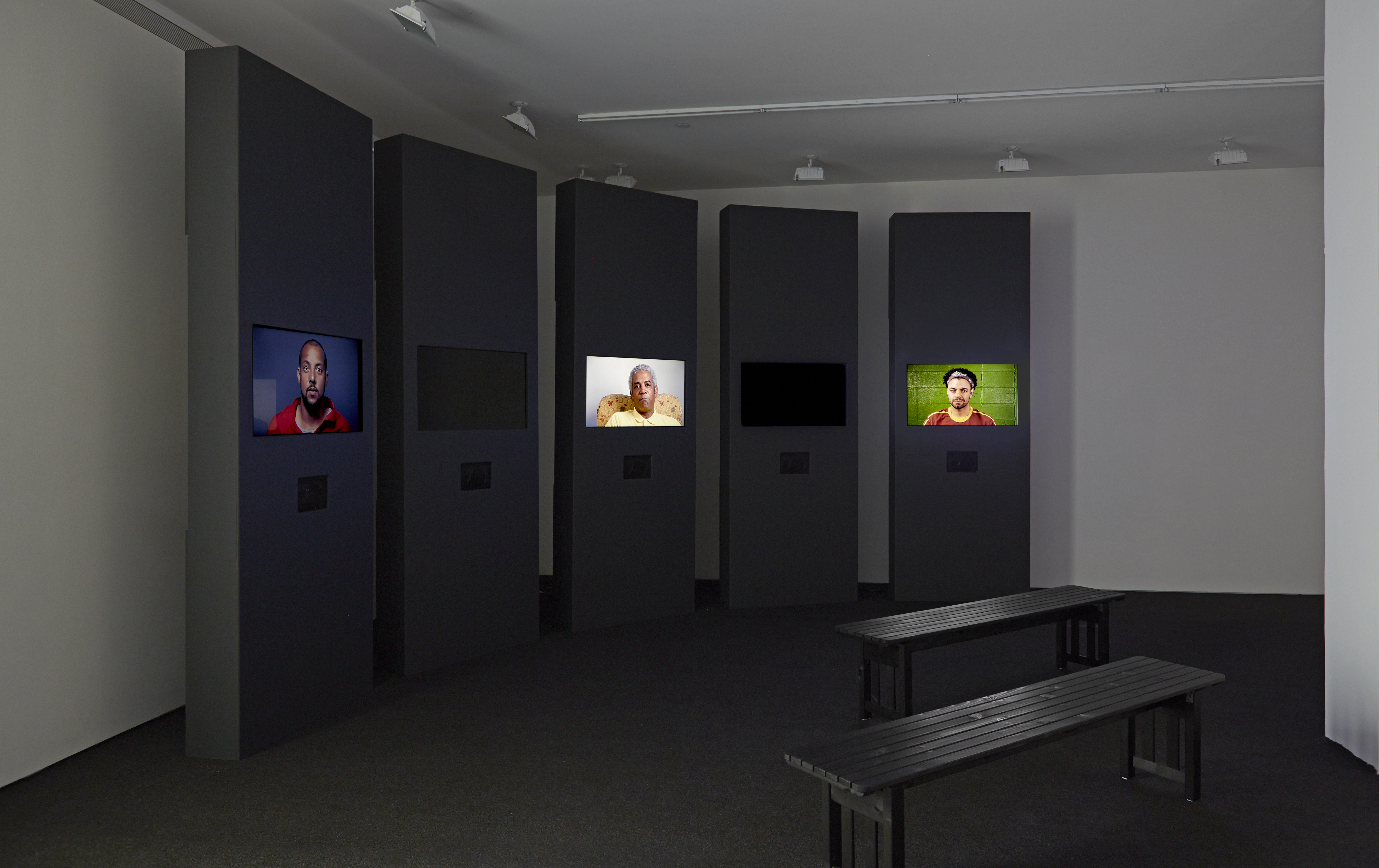
Hank Willis Thomas, Chris Johnson, Bayeté Ross-Smith, and Kamal Sinclair. Question Bridge: Black Males, 2012. Interactive video installation. Photo courtesy of Jack Shainman Gallery, New York.

Hank Willis Thomas, Chris Johnson, Bayeté Ross-Smith, and Kamal Sinclair. Question Bridge: Black Males, 2012. Interactive video installation. Photo courtesy of Jack Shainman Gallery, New York

Thomas continues to mine the history of photography’s depictions of black men in America with his current show at Jack Shainman. His solo photographic and assemblage works, on view in the front gallery, appropriate nineteenth-century photographs and African American quilt patterns as frameworks for commentary on the performance of race and the necessity of code-switching as a strategy of resistance to assimilation. The work is political in content but not in its execution, existing as fairly traditional objects for collection and consumption. More radical is the back gallery’s installation, Question Bridge: Black Males (2012), a collaborative work by Thomas, Chris Johnson, Bayeté Ross-Smith, and Kamal Sinclair. Building on the idea that implicit bias is fed by lack of familiarityQuestion Bridge is formulated as a testimonial document. Over 150 black men were interviewed for the project, asked to respond to questions posed by one another addressing masculinity, discrimination, opportunity, love, ego, family, and other loaded topics. The men range in age from late teens to octogenarians and in occupation from professors to performers to gang members. Some testify from the classroom or pulpit, others from behind bars. Some are self-aware, while others adopt a defensive posture. Their dialogue, framed as internal to a community too often viewed externally, is made transparent to us but does not include us. As a viewer, I was engrossed in the individual expressions of these men. I felt a responsibility to see and recognize each one, though that proved difficult to accomplish as the work’s duration exceeds three hours.

Read More »

Share

Best of 2013 – LUXUS Magazine at Wrocław Contemporary Museum

As we continue our look back over the year, today’s Best of 2013 selection comes from Ashley Stull, who writes, “I’ve never been to Poland. I’ve thus far remained shielded from the weight of Communist regimes; and my best protest to date has been limiting my mother on my portion of cauliflower. Succeeding where I have failed, Michal Wisniowski visited the Wrocław Contemporary Museum and left with a review of a political-ephemera lover’s dream. Luxus has leveraged a rich, tumultuous history. Among their achievements is amassing an archive that seems the ideological best of art born of resistance. Particularly for those minded toward the connection between aesthetics and politics, Luxus was generous with moments of both chaos and virtue. Collective activity against perceived state and institutional failures has long been captivating. I can’t yet say my projects have occasioned the use of an air-raid bunker—though I’m keeping my fingers crossed for the future. For now, Wisniowski’s introducing us to cheeky Luxus mantra “tu wolno kochać się” (making love allowed here) will serve as lingering image of romantic interventionist tactics.” This article was written by Michal Wisniowski and originally published on August 6, 2013.

The art scene in Wrocław, Poland, seems especially taken with collectives at the moment. While the Awangarda Gallery recently brought in work by Russian group Chto Delat, this city has its own rich history of collectives tied heavily to tumultuous sociopolitical events of the past. The groups Orange Alternative and LUXUS developed concurrently out of the revolutionary 1980s—spurred on by student protests and the Solidarity resistance movement—with a mutual understanding that developed into a loose affiliation.

LUXUS. Tu Wolno Kochać Się, 2013; mixed media, LUXUS Magazine; Photo: Michal Wisniowski.

LUXUS. Tu Wolno Kochać Się, 2013; mixed media, LUXUS Magazine; Photo: Michal Wisniowski

Encoding actual protest actions, the Orange Alternative sought to turn resistance into a symbolic narrative and thereby circumvent the communist regime’s policing and military countermeasures. It confronted the political situation head on, and in this way, it differentiates itself from LUXUS. The latter continues to virtualize a kind of reactionary reality against the failures of the state and of ideology and against the avant-garde. It operated in opposition to existing art movements such as Conceptualism and Abstract Expressionism—somewhat belated arrivals to the Eastern Bloc perhaps—but also became an early vehicle of capitalist critique in a place where capitalist activity was still limited.

LUXUS. Hydro-electric Installation, 2013; mixed media, LUXUS Magazine; Photo: Michal Wisniowski.

Jerzy Kosałka. Instalacja wodno-elektryczna (Hydro-electric Installation), 1993; Photo: Michal Wisniowski

Under the weight of its historical context, the LUXUS collective is currently involved in a multipart exhibition inside a massive air-raid bunker. The towering concrete cylinder is now home, albeit temporarily, to the Wrocław Contemporary Museum and is the site of a collection of LUXUS artifacts. The LUXUS Magazine exhibition serves as an archive housed inside the safety of the museum and is poised for some potential, not-so-theoretical future crisis.

Read More »

Share

Best of 2013 – Camille Henrot: Cities of Ys at the New Orleans Museum of Art

Continuing our Best of 2013 series, Anuradha Vikram writes, “Camille Henrot’s work is global in the best sense of the word. Mining source material from around the world, she creates works that draw out commonalities between Enlightenment cultures and the cultures that they have historically Othered. She uses technology as is logical for an artist of her generation-yet the subjects she explores are ancient as well as contemporary. Her work operates across the strata of time and counteracts the dominant tendency to view time as a linear progression moving ever forward. She reckons with the aftermath of colonialism in ways that are both necessary and generous.” This review was written by Tori Bush and originally published on October 22, 2013.

French video artist Camille Henrot creates parallels between the mythical and the contemporary. In her first solo exhibition in the United States at the New Orleans Museum of Art, she investigates the legendary city of Ys in France and the vanishing coastal area of southern Louisiana that is occupied by the ancestral Houma Indians. Coastal erosion, in real and mythical tales, is at the heart of this exhibit.

Camille Henrot. Cities of Ys, 2013 installation view. Courtesy of the Artist and Gallery Kamel Mennour

Camille Henrot. Cities of Ys, 2013; installation view. Courtesy of the Artist and Gallery Kamel Mennour

For over two years, the artist interviewed and researched the acculturation of the United Houma Nation. The exhibit is composed of sculpture, prints, and nine new videos mostly shot in Terrebonne Parish, the home of approximately 6,000 members of the Houma Nation.[1] The Houma have been in the process of seeking federal recognition as an American Indian tribe since 1979, when they first filed a letter of intent. That petition was rejected in 1994 and today the Houma are still waiting for recognition to be granted.

Henrot was born in Brittany, France, the home to the mythical city of Ys. According to legend, Ys was lost to the sea when the daughter of the king was tricked by the devil into opening the seawall, allowing the ocean to swallow the city whole. In southern Louisiana, over 2,000 square miles of marsh and swamp have become open water in the last seventy years.[2] This landscape took 6,000 years to build and with the help of oil companies and navigation canals, it has been quickly destroyed. In the next two decades, parts of the Houma Nation’s land will be completely submerged.

Read More »

Share

Best of 2013 – With Cinder Blocks We Flatten Our Photographs at Romer Young

Regular contributor Randall Miller selected With Cinder Blocks We Flatten Our Photographs for today’s edition of Daily Serving’s Best of 2013. Of his selection, Miller says, “Right now it feels like there is a sea change going on in photography. This past year, I noticed quite a few photographers who are exploring really thought-provoking conceptual territory, while pushing the formal boundaries of the medium in exciting ways. In her essay, Patricia Maloney writes, ‘The notion of the photograph has been largely displaced by that of the image. Images are origin-less: endlessly reproducible and malleable, their content easily manipulated and re-presented.’ This idea perfectly sums up the type of incredibly inventive photographic explorations I have also witnessed in Chicago. It’s been my experience that some of the most interesting art of the past year has been in photography. Ms. Maloney does a fantastic job of dissecting what photography is up to.” This review was originally published on July 24, 2013.

With Cinder Blocks We Flatten Our Photographs, installation view, Romer Young Gallery, San Francisco, 2013. Courtesy of Romer Young Gallery

With Cinder Blocks We Flatten Our Photographs, currently on view at Romer Young Gallery, includes work by San Francisco artists C. Wright Daniel, Pablo Guardiola, Jonathan Runcio, and Emma Spertus; the Los Angeles–based John Pearson; and New York–based artists Deric Carner and Letha Wilson. The press release notes as precedent curator Peter C. Bunnell’s Photography into Sculpture exhibition, mounted in 1970 by the Museum of Modern Art in New York.[1] Like Photography into Sculpture, With Cinder Blocks includes works that emphasize the imagined qualities of a photograph—specifically tactility and spatiality—by crafting sculptural or dimensional objects that incorporate photographic processes and imagery. Bunnell describes this process: “The maker of a photograph takes subjects—things—as he finds them and, with the selectivity necessary to determine their significance, manipulates them into an expression of his sensibilities so that they may constitute a revelation.”[2] The sensibilities that come to the fore in the works at Romer Young suggest a preoccupation with transformation, phenomenology, and materiality.

The notion of the photograph has been largely displaced by that of the image. Images are origin-less: endlessly reproducible and malleable, their content easily manipulated and re-presented. With Cinder Blocks explores the contemporary parlance by which photography reestablishes its physical parameters. It begins with process-driven explorations of exposure and gesture in which the image’s generative action is synchronous to its subject. Examples of this are Daniel’s silver gelatin prints, Untitled (Portrait) and Untitled (Profile Portrait) (all works 2013 except where noted), and Pearson’s Untitled (No. 2), a wall-hung cyanotype on silk and cotton fabric. To make his works, Daniel presses his face into the photographic paper, exposes, and then flattens the paper so that it records the creases and folds as shadows and peaks. Alternatively, Pearson draped his treated fabric on the desert floor; one sees the traces of dust or sand across the surface but also the rocks that held the edges down for the duration of the exposure. In an e-mail to gallery owner Joey Piziali, Pearson notes that while “photographs always look AT something, these cyanotypes are more an attempt to record being IN something.”[3] Both Daniel and Pearson depend on the direct contact of objects with photosensitized material to create records of their actions.

Read More »

Share

Best of 2013 – Jonathan Ehrenberg: The Outskirts at Nicelle Beauchene Gallery

Continuing our Best of 2013 series, Nandita Raghuram writes, “This thought-provoking article, rich with colorful images, provides a concise examination of the multi-faceted video by Jonathan Ehrenberg. The vivid descriptions usher the reader into the macabre world of the video, while the thoughtful visual analysis justly captures Ehrenberg’s interwoven themes. Rather than sidestepping the ambiguity inherent to the piece, the author embraces its jarring nature, noting contrasting shots and motifs, along with their effects. The article points out the nuanced cinematography used in the video while connecting it to larger societal issues at play. I enjoyed the article because it leads us in a journey through the video, in a clear and beautiful way.” This article was originally written by Emily Macaux and published on April 25, 2013.

Jonathan Ehrenberg, still from “The Outskirts,” video, 12 min. 43 sec. All images courtesy the artist/Nicelle Beauchene Gallery.

Jonathan Ehrenberg‘s The Outskirts conjures a world of mesmerizing, haunting, and deeply disorienting beauty. Currently on view at Nicelle Beauchene Gallery, the artist’s latest video envisions a world of visual enchantment and visceral disquiet, of existential ambivalence and psychic uncertainty.

With its opening shot of a shadowed, densely wooded landscape, The Outskirts plunges us into a world that is superficially suggestive of yet atmospherically apart from our own. As the emergent strains of Timothy Andres’ score penetrate the obscurity, the camera shifts to reveal a lone male figure, his face a pallid, dimly lit mask, gazing through the surrounding tangle of tree branches. This image is succeeded by one of yet another, similarly solitary being, a creature of indeterminate nature whose hollowed-out eyes and disembodied, skull-like head are a compelling conflagration of animation and decay, vitality and death.

Read More »

Share

Best of 2013 – Cripplewood at the Venice Biennale

Here at Daily Serving we count down the days to the New Year by presenting you with our best writing from the outgoing year. Today’s review was selected by writer and Regional Editor Marilyn Goh, who says, “I came to know about Ghent-based artist Berlinde De Bruyckere through Thea’s pitch of Cripplewood-Kreupelhout at the 55th Venice Biennale. Months later, the unsettling images of Bruyckere’s works are still indelibly printed in my mind and I just felt that I had to select Thea’s article because of her nuanced and erudite review of the show.” The review was written by Thea Costantino and originally published on August 20, 2013.

Berlinde De Bruyckere: Kreupelhout – Cripplewood, 2012 – 2013 wax, epoxy, iron, textile, rope, paint, gypsum, roofing image © mirjam devriendt

Berlinde De Bruyckere. Kreupelhout–Cripplewood, 2012–13; wax, epoxy, iron, textile, rope, paint, gypsum, roofing; 368 7/8 x 394 1/2 x 663 3/4 in. Courtesy of the Artist and S.M.A.K., the Museum of Contemporary Art, Ghent. Photo: Mirjam Pevriendt

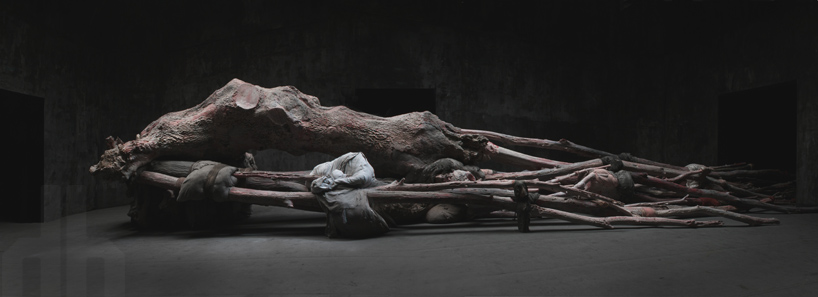
It takes a moment for my eyes to adjust. It’s dim and dank in here, despite the warmth of the Venetian summer. A long, gnarled mass lies sprawled across the length of the floor; in the gloom of the pavilion its flesh seems luminous. In places, its limbs are bound with rags. Sometimes they rest on threadbare cushions. It’s a fallen tree, but it seems like a body.

Berlinde de Bruyckere’s Cripplewood (2012–13) occupies the Belgian Pavillion of the Venice Biennale like a dead weight. For much of her career, the artist has used wax to form misshapen, tortured bodies that are the antithesis of the heroic bodies of classical art. These cadaverous, tragic figures are at once hyperrealistic and impossibly contrived; composed of absences, often lacking heads, they also appear to have been deprived of innards and bones. They are marked by the touch of real bodies; De Bruyckere makes casts of body parts that she reworks and combines in assemblages that connote the presence of a real body whilst presenting incontrovertible evidence of its absence.

Read More »

Share

Shotgun Reviews

Kim Anno: Water City Berkeley at Kala Art Institute

Shotgun Reviews are an open forum where we invite the international art community to contribute timely, short-format responses to an exhibition or event. If you are interested in submitting a Shotgun Review, please click this link for more information. In this Shotgun Review, John Zarobell reviews Water City Berkeley at Kala Art Institute in Berkeley, California.

Kim Anno. Water City Berkeley, 2013 (still); dual-projected video; 21:00. Courtesy of the artist.

Kim Anno. Water City Kids, 2013. Large format photograph; 38 x 28 in. Courtesy of the artist.

Why celebrate when the world is going to hell? Kim Anno’s ambitious effort to envision the future of humanity through a multiplatform work of art offers an answer with play and consistent hope, despite imagery of rising waters and the gravitas of an ancient Greek chorus.

Water City Berkeley—a live musical performance centered around a dual projection that ran for two shows on Saturday, December 7, at the Kala Art Institute—is the fourth chapter in Anno’s Men and Women in Water Cities series, and it is the most ambitious to date. This ongoing project of Anno’s, who is Professor of Painting at California College of the Arts, marks two important turns that inform one another: the first, from abstract painting to film-centric work that engages contemporary political content; and the second, from working solo in her studio to a collaborative mode of production. Anno has embraced other artists—composers, choreographers, dancers, musicians, even cheerleaders—in order to enrich and to complicate the visions she harbors of our world and its future development.

Read More »

Share