





San Francisco

Work in Progress: Considering Utopia at Contemporary Jewish Museum

Today from our partners at Art Practical we bring you a review of Work in Progress: Considering Utopia at the Contemporary Jewish Museum in San Francisco. Author Mary Anne Kluth notes, “The exhibition as a whole positions art as a space to think through, test, and potentially develop goal-oriented models of human interaction.” This article was originally published on January 7, 2014.

Oded Hirsch. 50 Blue, 2009; single channel video w/sound, 12:30. Courtesy of Contemporary Jewish Museum

Oded Hirsch. 50 Blue, 2009; single channel video w/sound, 12:30. Courtesy of Contemporary Jewish Museum

The three artists in Work in Progress: Considering Utopia at the Contemporary Jewish Museum offer varying perspectives on attaining a social and pastoral golden age. The works are united by a shared interest in collective activity. Elisheva Biernoff’s and Ohad Meromi’s installations in painting and sculpture invite audience participation, and Oded Hirsch presents videos and photos at once documenting and fictionalizing communal labor on a kibbutz.

Biernoff’s The Tools Are In Your Hands (2013) is an enormous landscape mural painted over metal that allows viewers to apply cut-out magnets depicting plants, animals, and simple geometric forms, which can be found sorted into nearby bins.  Her flat, graphical paint application in blues, greens, and neutral tones suggest calm skies, and fertile land, inviting viewers to finish an image of a valley of well-tended farms in harmony with nature.

On the afternoon of Sunday, November 10th, however, the audience had instead produced a hurly-burly of magnetic rabbits, chickens, tree leaves, tomatoes, lemons, and abstract shapes, sometimes coalescing into mandala-like circular arrangements, sometimes canvassing wide swaths of Biernoff’s landscape in Dadaist clouds. The temporary effect, looking like a kindergarten exercise and not a picture of sustainable agriculture, deftly demonstrates one challenge facing collective action. The ideal outcome seems obvious, given the parts Biernoff provides, yet the anonymous group effort diverges wildly from any logical cohesion, throwing the specific goals of the project into doubt.

Read the full article here.

Share

Elsewhere

Material Practices: Stitching, Fabric, and Textiles in the work of Contemporary Chinese Artists

Mao Zedong once said that revolution is not a dinner party. Less famously, he said it is not embroidery, either. Interestingly, however, some female contemporary Chinese artists have chosen to work with thread and textiles—and embroidery—in experimental, maybe even revolutionary ways. From Lin Tianmiao’s overt exploration of sexuality, fecundity, and the aging and decay of the body, to Yin Xiuzhen’s use of the embodied memories in old clothing; from Lin Jingjing’s stitched paintings of the recorded details of many lives, to Gao Rong’s embroidered, padded simulacra of quotidian elements of daily life in Beijing, they variously apply stitching, embroidery, felting, padding, binding, and fabric. Artist/alchemists, they transform the everyday materials of “women’s work,” reflecting personal memories and cultural identities.

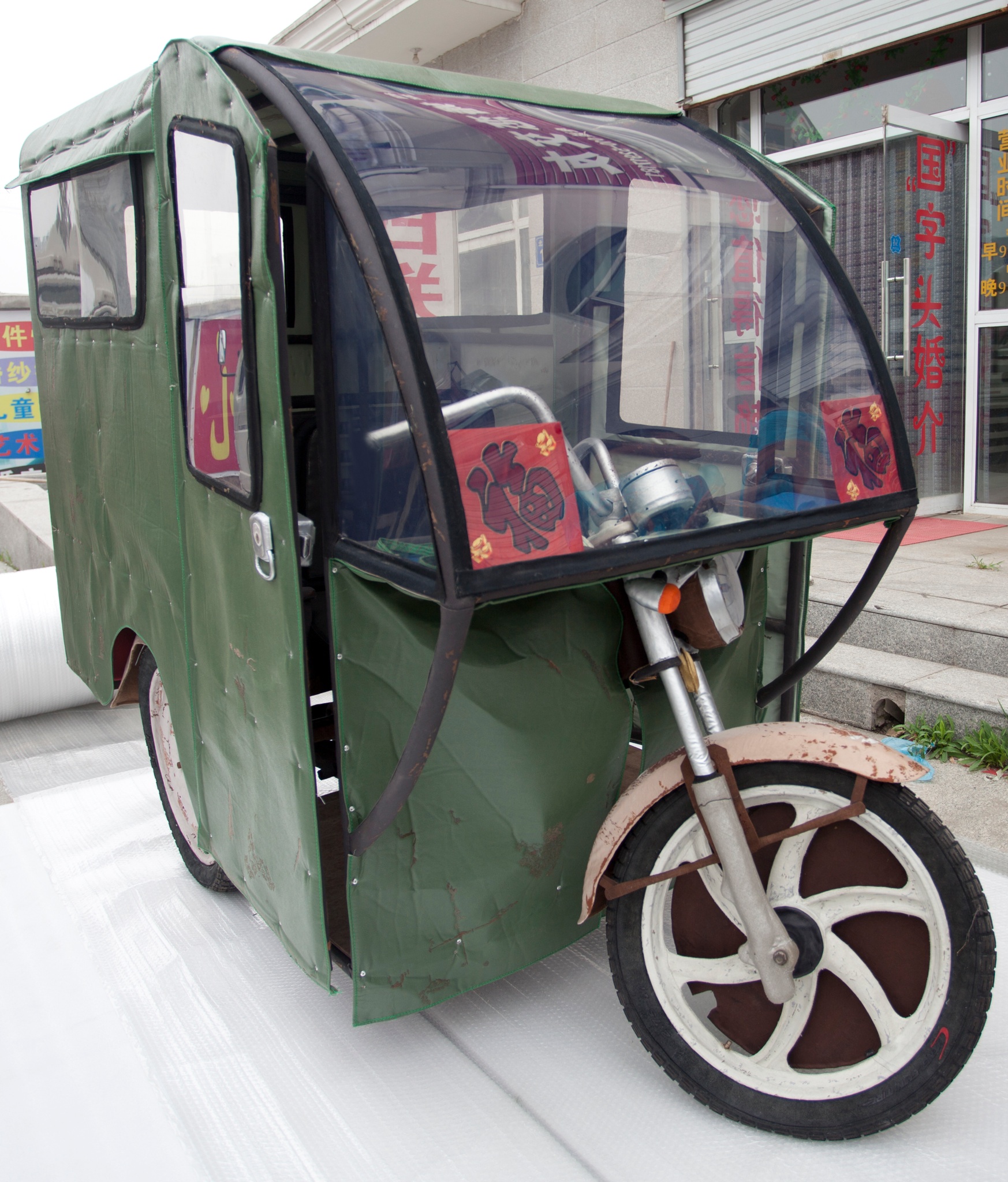
Gao Rong, What Type of Car Can a Motor-Tricycle be Exchanged For?, 2013 Embroidery, cloth, wooden board, iron shelf, leather, and plastic 70 7/8 x 76 3/4 x 37 3/8 inches (180 x 195 x 95 cm) image courtesy the artist

Gao Rong. What Type of Car Can a Motor-Tricycle be Exchanged For?, 2013; embroidery, cloth, wooden board, iron shelf, leather, and plastic; 70 7/8 x 76 3/4 x 37 3/8 in. (180 x 195 x 95 cm). Image courtesy of the Artist.

As a young girl, Lin Jingjing yearned to discover a world beyond the confines of her neighborhood. She rode her bicycle as far as she could in each direction, a little further each week, measuring the time so that she would be sure to return before dark. This is an apt metaphor for her art practice, which has pushed the boundaries of painting, performance art, and installation. In Public Memories, photographic images of events both public and private are reproduced in bright monochrome colors, with selected areas neatly stitched. Rows of stitches erase and hide parts of the painted image, suggesting the unreliability of memory. Lin’s performance, video, and photographic works—in which barely opened long-stemmed roses are stitched/sutured closed—play with the binaries of beauty and cruelty, wounds and healing.

Read More »

Share

New York

Nicola Hicks at Flowers Gallery, New York

Nicola Hicks’ recent sculptural tableaux, depicting humans, animals, and frightful crossbreeds of towering stature, exemplify art’s ability to produce rich, nonverbal worlds. Though the works on view at Flowers Gallery are classified merely as plaster (to be cast in bronze upon purchase), they in fact begin with wire skeletons that the British artist then stuffs with a mélange of straw and dirt before coating. This gives the sculptures a raggedly textured surface that evokes scarecrows, effigies, or other such ritualistic totems—an association compositionally redoubled in works like Dressed for the Woods (2013), which depicts an apparent rendezvous between two hooded human figures and a bear. Looming large, the works put physical presence before formal detail (barely discernable facial expressions just faintly register sobriety or sorrow), calling forth the occult, the unspeakable, the deeper semantic layers of a fairy tale.

Nicola Hicks; Dressed for the Woods II, 2013; plaster (to be cast in bronze), 79 x 71 x 71 inches. Courtesy of Flowers Gallery.

Nicola Hicks. Dressed for the Woods II, 2013; plaster (to be cast in bronze); 79 x 71 x 71 in. Courtesy of Flowers Gallery.

There is a lot to be said for art capable of tapping into and elaborating upon these deeper reservoirs of significance. Ms. Hicks, however, does not seem comfortable with straying too far from the more prosaic realm of social life. The works now on display at Flowers Gallery all emerged in the wake of the economic recession that began in 2008, and explicit responses to this event abound in the series. One need look no further than Hicks’ titles for her interpretational instruction: Banker I (2009) depicts a diminutive, pot-bellied man in tattered tails leading a small bear by a leash, while Banker II resembles an enormous man with a bull’s skull in place of his head, striding with the halves of a severed dog in each hand. Thus, Hicks employs her powerful aesthetic sensibilities in the service of visual puns about bull and bear markets.

This tension between what I have portrayed as the nonverbal and verbal qualities of Hicks’ work is somewhat frustrating. The former generate emotionally arresting realms through scenes of inscrutable sorrow, conspiracy, violence, and humility—an entirely apt, historically specific reaction to the ugliness of the financial system that came into high relief in 2008—while the more articulated statements threaten to flatten the works into clichés (greed turns humans into beasts) or bottom out in toothless social critique (the financial system is like an occult order).

Read More »

Share

Toronto

Geoffrey Farmer: A Light in the Moon at Mercer Union

One imagines that Geoffrey Farmer must go through millions of X-Acto knives a year. The Vancouver-based artist is known for his cutouts of images culled from books, magazines, and other printed material, which have been exhibited at Documenta(13) and at the Tate. In his new work Boneyard (2013), currently on view at Mercer Union, Farmer adapts his signature technique—excising  any traces of context through the careful removal of images that are then arranged in strikingly disconcerting staging—to sculpture.

Geoffrey Farmer. Boneyard, 2013. Courtesy of Mercer Union Gallery, Toronto. Photo: Toni Hafkenscheid.

Geoffrey Farmer. Boneyard, 2013; paper; dimensions variable. Courtesy of Mercer Union, Toronto. Photo: Toni Hafkenscheid.

A commissioned work, Boneyard features figures—sculptures from the canon of art history—in shades of beige, ivory, brown, and taupe arranged on a flat, circular plinth. I was reminded of the Cast Courts at London’s Victoria and Albert Museum (V&A). At the V&A, the casts are life-size and were used as study objects to train generations of artists and art historians. These casts represent some of the most iconic Western art sculptures, architectural elements, and monuments. Imagine then that Farmer’s installation is the situation in reverse—instead of being dwarfed by the “canon” at Mercer Union, visitors find themselves giants among reproductions.

Read More »

Share

New York

Coco Fusco: Observations of Predation in Humans at the Studio Museum in Harlem

Critical distance can be an ambitious aspiration for an artist, particularly if her practice strives to directly engage complex economic, environmental, or social-justice issues. How can traditionally partisan discourses be avoided? Can a political viewpoint be communicated without merely contributing to a staunchly divisive cultural dialogue that is easy to tune out? There is no one strategy or formula for this challenge. Coco Fusco’s recent performance at the Studio Museum in Harlem deftly employed science fiction to gain some critical space. Her successful approach afforded her a new viewpoint and a platform—from a whole species away.

Coco Fusco.

Coco Fusco. Observations of Predation in Humans: A Lecture by Dr. Zira, Animal Psychologist (study), 2013. Photo: Noah Krell.

For Observations of Predation in Humans (2013), her contribution to the exhibition Radical Presence: Black Performance in Contemporary Art, Fusco revived and fully embodied the character of Dr. Zira, the female chimpanzee animal psychologist from the 1968–1971 Planet of the Apes films. With a Skyped-in introduction from Donna Haraway, an esteemed commentator on hominoid interrelations, it was explained that despite the narrative of the 3rd film, Escape from Planet of the Apes, which portrayed the character’s assassination by the U.S. government, Dr. Zira had actually survived and been in hiding in an isolated cabin in the Midwest for more than 20 years. Over the course of this seclusion, she had been observing human behavior via the Internet and television. It wasn’t until the 2012 Cambridge Declaration, in which brain scientists concluded that non-human animals do have consciousness, that Dr. Zira felt safe enough to resurface as a public intellectual and present her findings on human predation.

Read More »

Share

Help Desk

From the Archives – Help Desk: Internship Woes

This week, our intrepid Help Desk columnist is on the road, so we bring you some advice from 2012 that still applies to many people: how to navigate the shoals of internships, especially in terms of taking credit for ideas and labor. Help Desk is an arts-advice column that demystifies practices for artists, writers, curators, collectors, patrons, and the general public. Submit your questions anonymously here. All submissions become the property of Daily Serving.

In general, blog writing is a tricky area in terms of authorship. I wrote the blog for a gallery for over six months without having my name attached. The blog did very well and was picked up on by a local magazine that asked the gallery owner to contribute a regular guest column for their publication. Unbeknownst to them, the blog was written by me, the intern. I proceeded to plan and outline the next six months of art-related subject matter with the pretext that I would be getting paid as my internship was completed. After the internship had ended, I wrote three posts for the gallery’s blog before the owner told me it was no longer in his budget.

I was never paid for those entries and my ideas continue to be used thereafter. As interns, I realize that we must be willing to work without pay and cannot expect full agency in the work we do without a real job title. Still, I am wondering how you would suggest interns find a balance here? Where do we draw the line on our unpaid time and efforts while aspiring to get recognition for the work that we do?

Yoyoi Kusama. Dots Obsession, 1999; mixed media. Collection Les Abattoirs,Toulouse.

I talked to Jonathan Melber, the co-author of ART/WORK, about your dilemma. He had a few thoughts about your predicament: First, in terms of authorship of a blog, “If you write it, then it’s your intellectual property unless you’ve granted it to someone else in writing, for example in the blog owner’s terms of service or in a gallery’s employment agreement.” Second, “You can still ask to get proper credit for this work. Maybe you can get them to add a byline, or get permission to link to it, or to list it on your resume.” Mr. Melber recommended that you talk with the gallery owner to see if you can get credit for the blog; and, if you manage to obtain that acknowledgement, then talk to the editors at the magazine about retroactive credit there. He also pointed out, “Of course, you could threaten a lawsuit which might result in the gallerist having to take the blog entries down, but the repercussions are probably not worth it,” so think long and hard before you travel that road—lawsuits are ugly and expensive. If you have no luck with the gallery owner (and you didn’t hear this from me), there’s a blog called How’s My Dealing? where arts workers vent anonymously about how galleries have treated them. At least you’d have your revenge.

Read More »

Share

Shotgun Reviews

U.S. Department of Illegal Superheroes (ICE DISH) at Galería de la Raza

Shotgun Reviews are an open forum where we invite the international art community to contribute timely, short-format responses to an exhibition or event. If you are interested in submitting a Shotgun Review, please click this link for more information. In this Shotgun Review, Callie Humphrey reviews U.S. Department of Illegal Superheroes (ICE DISH) by Neil Rivas (a.k.a. Clavo) at Galería de la Raza in San Francisco, California.

Neil Rivas (Clavo). San Francisco Field Office, 2013; installation view, U.S. Department of Super Heroes (ICE DISH), 2013. Courtesy of Neil Rivas. Photo: TBD.

Neil Rivas (Clavo). Interior view (with Supergirl), ICE DISH SF Field Office & Detention Facility, 2013-2014. Courtesy of ICE DISH. Photo by Alanna Haight.

Galería de la Raza is currently hosting its very first resident artist, Neil Rivas. The San Francisco-based artist has converted the back half of La Raza into the headquarters of the U.S. Department of Illegal Superheroes, or ICE DISH. The agency deals with the capture and deportation of undocumented superheroes. Superman, Wonder Woman, Spider-Man, and the whole iconic lineup are at high risk for deportation, their immigration status unregistered with the U.S. Department of Homeland Security. The ICE DISH headquarters is replete with a physical training station, lockup cells, surveillance monitors, a most-wanted bulletin board, cabinets filled with presumably top-secret files, authoritative black desks, swivel chairs, and other austere institutional furniture. Populating the ICE DISH facilities are its six local agents, who carry out all departmental proceedings both on- and off-site.[1]

High-stakes immigration debates are occurring across the country, but what actually constitutes the conversation appears to be little more than empty political banter. Through ICE DISH, Rivas has created an artistic platform for social intervention, though I hesitate to call it outright activism. The agency conveniently positions familiar, culturally beloved characters at the face of a critical discourse that the project hopes to engage, and as such functions equally well as both an educational outreach tool and as art. The reality of the immigration discussion is one increasingly devoid of empathy; it is a faceless battle driven by rhetoric rather than humanization. By aestheticizing the conversation through established iconography, Rivas makes the entry point more accessible for those who may otherwise not actively seek to participate in such a dialogue. The discussion ICE DISH generates does not forefront race, specifically, but rather highlights general ideas of difference, belonging, and the quintessential role of the other.

Read More »

Share




