San Francisco

Net Art in the Wild

Today we bring you an essay on internet-based art from our partners at Art Practical. Author Ben Valentine explores the culture of net art and remarks, “Online art can be completely decontextualized from an art context or the original artist’s intent, which raises interesting questions for the creator and critic alike. How has a weakened context changed net-based art practices? How can art criticism understand this new audience, and its importance to the work?” This article was originally published on December 4, 2013.
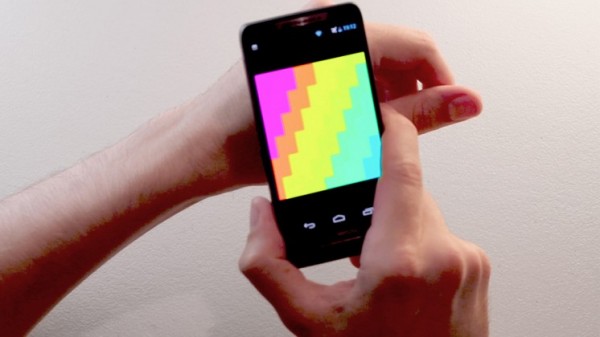
Anthony Antonellis, Net Art Implant, 2013; RFID chip, artist's skin, animated GIF. Courtesy of the Artist.

Anthony Antonellis. Net Art Implant, 2013; RFID chip, artist’s skin, animated GIF. Courtesy of the Artist.

Art viewers have long relied on context and written texts to fully understand and appreciate works of art. Audiences who meet conceptual and minimalist works with the reaction, “Well, I could do that,” fail to understand that context, concept, and history are vitally important to the meaning of contemporary artwork. Stripping them away can inhibit the artwork’s legibility and be highly disorienting to its audience. While such a reaction has been commonplace ever since Marcel Duchamp called a urinal a work of art, internet-based artworks have been subject to this decontextualization at a faster rate and often to a more complete degree than physical artworks.

Lacking the traditional grounding of a physical space, net-based artworks can be found without a contextual frame. Furthermore, net-based artworks can be effortlessly taken out of their original context into new arenas, to be read by entirely different audiences. This unmooring that the digital space allows has greatly amplified issues of readership, legibility, and audience, which have already long been present in contemporary art.

Read the full article here.

Share

Fan Mail

Fan Mail: Tom Pazderka

Tom Pazderka’s work has a visual weight and intensity—scarred and blackened reused wood, grids made of charred book jackets, charcoal- and wood-burning drawings of ancient, destroyed, and invented places—that is matched only by the artist’s descriptions of his subjects. Pazderka takes an interest in history as a flexible structure with multiple readings: “That which most [people] would rather leave alone I find the most interest in, not because of a morbid fascination, but because history of any kind has two readings, that of the profane and that of the secret, that of the exoteric and of the esoteric.”

TP Image 1

Tom Pazderka. United States of America with Self-Destructing Mechanism Attached, 2011; recycled wood, nails, electrical outlets, cords, and plugs; 70 x 32 x 3 in. Courtesy of the Artist.

United States of America with Self-Destructing Mechanism Attached (2011) is a barely recognizable replica of an American flag made of found wood (light blue, gray, white, and brown), an electrical outlet with a plugged-in cord, and nails. The work conjures up notable art flags by Jasper Johns, Alexandre de Cunha, Mungo Thomson, and David Hammons, but does so only inasmuch as the work is a flag. Pazderka’s flag incorporates an electrical outlet, plugged into the wall when exhibited, as a critique of the U.S.’s destructive use of global resources to power itself; however, the artist’s ideas for the work extend beyond this. Pazderka explains, in part, his impetus for United States of America with Self-Destructing Mechanism Attached: “The whole piece now seemed to me like a metaphor for how America functions on the world stage, as a behemoth that takes power from the outside (bottom plug) and never gives any of it back, cannibalizing it in the process because it is constantly recycled within itself.” The work provides a penetrating portrait of American society, all with reused materials, perhaps freeing the work and Pazderka’s artistic impetus from the uneven power relationships the work critiques.

Read More »

Share

Los Angeles

Annie Lapin: Various Peep Shows at Honor Fraser

Whenever it seems that painting has run its course, an exhibition like Various Peep Shows comes along to restore our faith in the medium. For her third solo show at Honor Fraser Gallery, Annie Lapin presents a series that contains within each work the broad spectrum of paint’s physical and representational possibilities. These are much more than postmodern pastiches, however, as they show a sincere celebration of the myriad options available to produce meaning on the canvas. Instead of resurrecting an anachronistic style or playing out some formalist endgame, Lapin mines painting’s history to produce lively, fresh works that keep viewers constantly questioning what exactly it is they are looking at.

Annie Lapin. Various Peep Shows (Through), 2013; Oil and acrylic enamel spray-paint on canvas; 82 x 72 inches. Courtesy of Honor Fraser Gallery, Los Angeles. Photo: Brian Forrest.

Annie Lapin. Various Peep Shows (Through), 2013; oil and acrylic enamel spray-paint on canvas; 82 x 72 in. Courtesy of Honor Fraser Gallery, Los Angeles. Photo: Brian Forrest.

Most of the works in the show are based very loosely on a grid, with rough horizontals and verticals defining the composition. But within that basic structure, organized chaos reigns. Between the poles of impressionistic depiction and spray-painted letters, Lapin has smeared, dabbed, brushed, stained, and poured her way across the surface. The results often resemble the décollage of urban facades—torn posters, peeling paint, crumbling walls—hovering between creation and destruction, accretion and dissolution.

Despite the initial appearance of randomness, these works are carefully composed. Lapin has not simply attacked the canvas with all manner of mark-making, but has clearly preconceived her execution, as areas of thin wash abut patches of thick impasto. These different techniques lie side by side on the surface, only giving the impression of overlapping planes in the mind of the viewer.

Read More »

Share

Elsewhere

Cai Guo-Qiang: Falling Back to Earth at the Queensland Gallery of Modern Art

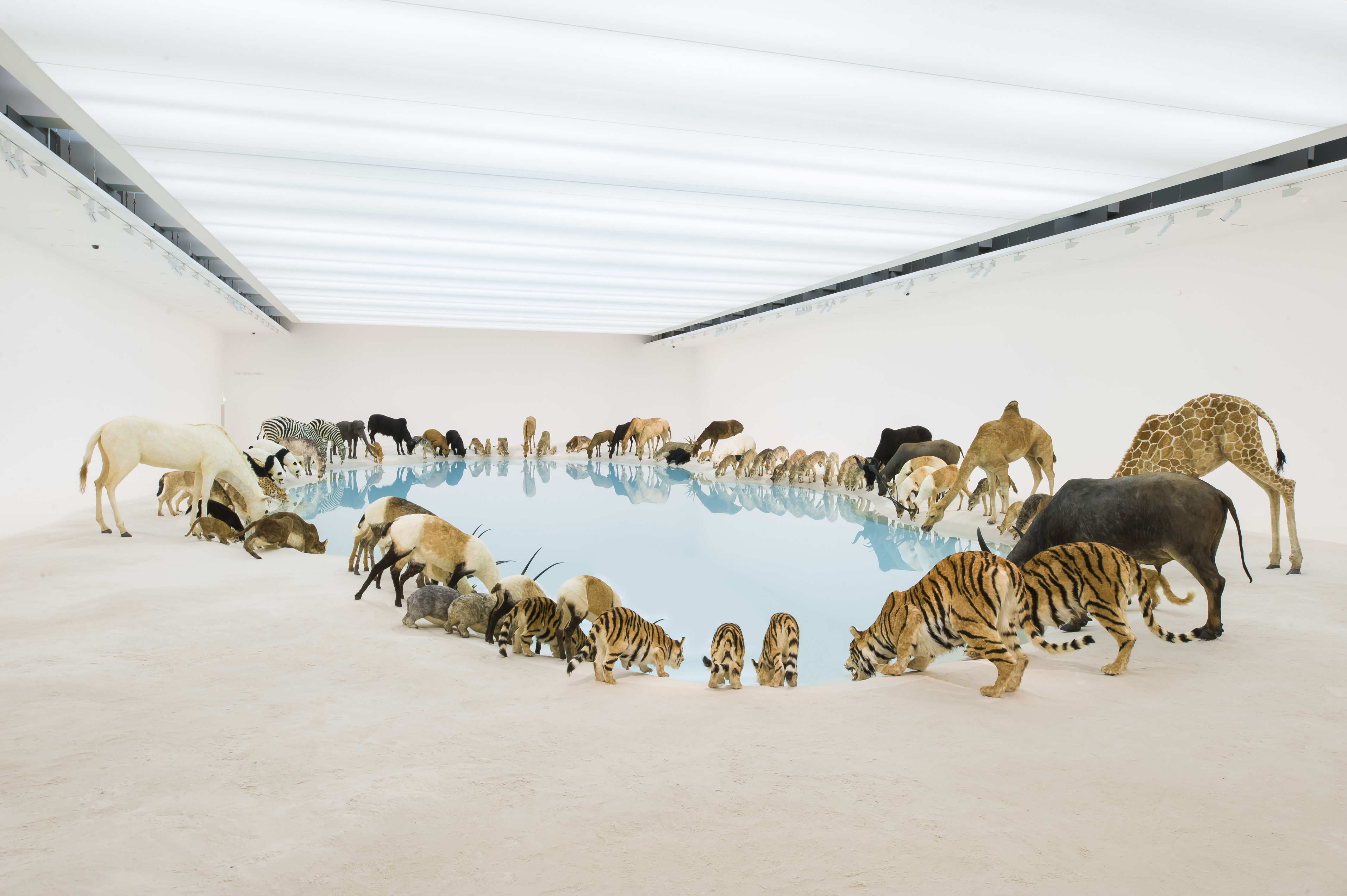
Ninety-nine animals stand in a circle, heads bent, drinking from a clear pool of impossibly blue water. Predators and prey are lined up in peaceful harmony: lions and tigers together with giraffes, zebras, and antelope; a big black bear with small furry creatures. What utopian vision is this? In Cai Guo-Qiang′s allegorical installation for the Queensland Gallery of Modern Art, he has abandoned his usual ephemeral pyrotechnic extravaganzas for something altogether quieter and more contemplative.

Cai Guo-Qiang, Heritage, 2013. 99 life-sized replicas of animals, water, sand, drip mechanism; installed dimensions variable  commissioned for the exhibition ‘Falling Back to Earth’, 2013; proposed for the Queensland Art Gallery collection with funds from the Josephine Ulrick and Win Schubert Diversity Foundation through and with the assistance of the Queensland Art Gallery | Gallery of Modern Art Foundation.

Cai Guo-Qiang, Heritage, 2013. 99 life-sized replicas of animals, water, sand, drip mechanism; installed dimensions variable;
commissioned for the exhibition Falling Back to Earth, 2013; proposed for the Queensland Art Gallery collection with funds from the Josephine Ulrick and Win Schubert Diversity Foundation through and with the assistance of the Queensland Art Gallery | Gallery of Modern Art Foundation.

Born in Fujian Province in 1957, Cai is best known for his use of gunpowder as art medium. Together with ink and paper—those most Chinese of inventions—fireworks have played a significant role in his practice. He began igniting gunpowder on canvas and paper in the mid-1980s, a way of “drawing” that owes something to the calligraphic mark of the traditional Chinese ink painter, and something to the “Laws of Chance” of Dada artists such as Hans Arp. His  first open-air pyrotechnic project took place on the River Tama, near Tokyo, in 1989. In this and his later dramatic explosive works—site-specific, performative, and ephemeral—Cai explores notions of creation and rebirth, making connections with Taoist philosophies.

Read More »

Share

New York

Alex Prager: A Face in the Crowd at Lehmann Maupin

Alex Prager’s first exhibition at Lehmann Maupin makes a blood pact with the myth of cinema. The gallery’s downtown location hosts large-format stills from Prager’s newest film, A Face in the Crowd, alongside highly staged photographs taken from slightly different angles than those represented in the film. Lehmann Maupin’s Chelsea gallery features more of these beautifully rendered, high-quality stills, as well as a viewing room for the three-channel film itself. Posed to look candid, Prager’s series of “crowd shots” were in fact elaborately orchestrated on a Hollywood sound stage, and each participant’s movements and appearance were meticulously directed. The realization of how intensively these shots have been staged is frightening, as Prager deprives us of a choice we are usually able to make in viewing photography: the subconscious organization of a hierarchy of moments. Nothing in Prager’s images can be overlooked; she positions every hair, every gesture, and every moment to seem not real but realistic.

Alex Prager. Face in the Crowd, 2013; installation view, Lehmann Maupin, New York City. Courtesy of the artist and Lehmann Maupin.

Alex Prager. Face in the Crowd, 2013; installation view, Lehmann Maupin, New York City. Courtesy of the Artist and Lehmann Maupin.

Prager’s lens positions Los Angeles as uncanny valley: a place where reality is never for certain and real life is infected by the cinematic. I am reminded of the audition scene in David Lynch’s 2001 film Mulholland Drive, where Naomi Watts’ character Betty says her heavily scripted lines in a terrifyingly convincing manner, a way we’ve never heard her speak before, even when she was participating in the film’s version of “real life.” For Lynch, as well as for Prager, the script becomes reality as reality becomes the script—or it ceases to matter which is which. This transmutation is uncontrollable and therefore terrifying, and we are sent on a spiraling trip toward a non-place.

As a harbinger of this weird spin, Prager’s film begins with a unibrowed man describing a recurring nightmare about falling off the edge of a cliff. The “man” happens to be Tyson Ritter (recognizable to millennials as the lead singer of pop-punk band The All-American Rejects), inspiring another twinge of uncanny recognition. This is the most compelling aspect of the uncanny, whose dark force Prager harnesses expertly—this edge of the cliff, this excess. The uncanny lingers in those moments where there is too much—the signifier overflows, bleeds onto something else, or bleeds out.

Read More »

Share

Hashtags

#Hashtags: Culture, Class, and the New Economy

#access #technology #gentrification #class #labor #place

The recent election of Mayor Bill de Blasio in New York was hailed by many as a sign that the trend of economic displacement in major American urban centers was coming to an end. De Blasio ran on a progressive platform of government that serves the neediest, rather than campaign donors, and won handily on that message despite the city’s twelve prior years of wealth consolidation under billionaire mayor Michael Bloomberg. Even de Blasio’s art credentials are more populist than those of his philanthropist predecessor, whose namesake corporation appears on the donor boards of several major institutions in the city. While many have greeted his inauguration with a level of optimism not seen since President Obama’s first term, far fewer have raised the necessary question of what exactly defines the problems and the solutions we hope he will seek. Using current discussions of gentrification, shifting labor conditions, and the role of the arts in creativity and culture, I will attempt to do this here.

Stephanie Syjuco. Bedazzle a Tech Bus (I Mock Up Your Ideas): John Gourley "Gringo" Bus, 2014. Digital image. Submission to Mission Local's "Bedazzle a Tech Bus" Call for Entries.

Stephanie Syjuco. Bedazzle a Tech Bus (I Mock Up Your Ideas): John Gourley “Gringo” Bus, 2014. Digital image. Submission to Mission Local’s “Bedazzle a Tech Bus” Call for Entries.

Artist Martha Rosler’s recent book, Culture Class (2013), is a herculean attempt to frame the scope and the terms of the gentrification debate as it concerns artists and other laborers in the new “creative economy.” Her critique centers on the influential theories of Richard Florida, whose Rise of the Creative Class (2002) is credited with establishing that term. Rosler gained prominence in the 1970s as a conceptual photographer and video artist deconstructing the implicit social conditioning conveyed by popular images in works such as The Bowery in Two Descriptive Systems (1974-75) and House Beautiful: Bringing the War Back Home (1967-72). Her extensively researched book identifies other theorists of urban renewal, addressing their perspectives from race, gender, and class angles. Her discussion of Florida’s legacy outlines how his acolytes in business, education, and urban planning have promoted an idea of contemporary white-collar labor as a creative pursuit while promoting investment in the arts as a benefit to property values. As such, wage laborers are encouraged to consider themselves engaged in fulfilling acts of creativity rather than trading their labor for compensation. Artists are supported and valued for their ability to revitalize buildings and neighborhoods rather than for their contributions to the breadth of human experience.

Read More »

Share

London

From the Archives – Jacob Hashimoto: The Other Sun

Today from our archives we bring you Margaret Zuckerman‘s review of Jacob Hashimoto‘s 2012 exhibition at Ronchini Gallery in London. Hashimoto has a new exhibition opening in February at Martha Otero Gallery in Los Angeles, hopefully as “buoyant, ethereal, and celebratory” as the work reviewed here. This article was originally published on July 19, 2012.

Jacob Hashimoto. Installation view of Paper Paradise at Ronchini Gallery, London. Courtesy of Michele Roberto Sereni and Ronchini Gallery.

American-born Jacob Hashimoto’s eye-catching exhibition, The Other Sun, at London’s Ronchini Gallery in Mayfair certainly brings to mind planetary brilliance in color and splendor. Hashimoto uses traditional kite-making materials and techniques to create singular, modular units collectively arranged into numinous, monumental installations and smaller, woven, three-dimensional wall pieces. Hanging by threads, the thousands of multicolored translucent kites are hand-made with rice paper and bamboo, each tiny kite delightfully constructed with exacting care. Elegant white, solid gold, or patterned, the cascading assemblage of kites moves like a flowing river of shimmering color, rolling through the space with extraordinary buoyancy and energy. It’s difficult for the eye to focus on an individual kite without getting lost in the whole, all-encompassing space. Some of the more decorated kites are like tiny paintings; each “superflat” composition floats above or below its surrounding neighbour, intrinsically incorporated into the design like the patterned scales of a fish.

At the entrance to the gallery, Hashimoto’s large-scale installation flows into motion with a subtle, meditative rhythm as I open the glass door and pass underneath. It conveys a sense of wonder and playfulness as the texture, lighting, and angle of the work shifts and changes while traveling through the speckled environment. While meandering beneath, the bright, fluttering work reveals itself to be an illuminated, celestial landscape borrowed from traditional Japanese painting or Manga animation—each viewer becoming a figure suspended in a handcrafted paper paradise. The temptation to reach out and touch is too much for most, and many forfeit at least to blow a small breath of wind, causing a delightful tremble to ribbon through the work.

Read More »

Share