San Francisco

Locating Technology: Participatory Economics

Today from our partners at Art Practical, we bring you the latest installment of Genevieve Quick‘s Locating Technology column, which explores “the evolution of technology and its effects on artists’ processes, disciplinarity, and the larger social context of media creation, dispersal, access, and interactivity.” This column was originally published on February 12, 2014.
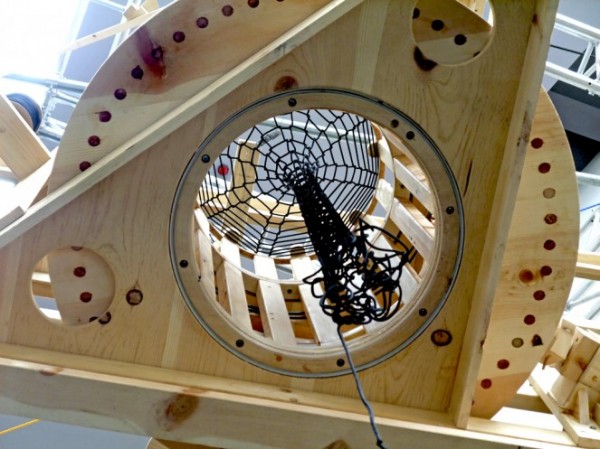
Bernie Lubell. A Theory of Entanglement (Detail of knitting after two days), 2009; pine, maple, rubber rope, black poly cord, and music wire; 32 x 40 x 60 ft. Courtesy of the Artist.

Bernie Lubell. A Theory of Entanglement (detail of knitting after two days), 2009; pine, maple, rubber rope, black poly cord, and music wire; 32 x 40 x 60 ft. Courtesy of the Artist.

The trajectory of history suggests that increased opportunities for individuals to engage in art and technology facilitates or represents egalitarianism and innovation, i.e., that greater participation is a social, cultural, or technological good. With today’s unprecedented levels of interactivity, the “Facebook Revolutions,” and the constant bombardment of “smart technologies,” status updates, and GIFs both affirm and challenge this paradigm. In contrast to escalating high-tech interactive solutions, some decidedly low-tech and DIY projects provide simple routes to participation and economic consciousness-raising. For example, Bernie Lubell’s interactive wooden contraption A Theory of Entanglement (2009) operates as a physically interactive diagram of capitalism. Additionally, Packard Jennings’s website Destructables (2011–present) aggregates and distributes DIY projects that interrupt corporate marketing campaigns at the local retail level. While lighthearted, Lubell and Jennings use technology to facilitate participation with sharp critique while viewers engage in learning, teaching, exploring, and challenging their roles in the economic system.


Read the full article here.

Share

Elsewhere

The Song of the Shirt: Feminist Performance Artist Wu Meng

In her 2013 performance work And They Chat (also called Chat with Women), Wu Meng walked the streets of the old city of Haikou in a wedding dress made of newspaper, tying discarded domestic objects such as pots and pans, a broom, and a large mosquito net onto her body as she went. Her load became heavier and heavier as she dragged herself down the road, followed by small children and curious onlookers. The performance concluded with a reading from Engels on marriage and monogamy. A new collaborative work, Metamorphosis Garden, reveals her consistent interest in exploring aspects of women’s lived experience. “… sweet fairy tales, strange, even bloody little allegories, interwoven with real-life female stories. How should women view themselves and respond to this complex and lonely world?” In asking this question, Wu Meng creates a body of work that explores the contested territory of gender in today’s China.

Wu Meng, 'Chat with Women' Haikou, 2013, documentation of performance work

Wu Meng. Chat with Women, Haikou, 2013; documentation of performance work. Image courtesy of the Artist.

The contemporary Chinese art scene is exciting and dynamic, but at times seems fueled by a heady mixture of testosterone and “baijiu,” the Chinese white spirit that fells unsuspecting foreigners like rocket fuel. In my quest to meet women artists, I had been told by numerous people in Shanghai that I must interview Wu Meng: performance artist, freelance writer, and founding member of Grass Stage experimental theater collective. In addition to her work with Grass Stage, Wu has created solo works in Hong Kong, the German Pavilion at Shanghai EXPO (2010), Hamburg (2011), Leipzig (2012), and throughout China.

Read More »

Share

Chicago

Feeling Is Mutual at Chicago Artists Coalition

Steven L. Bridges’ catalog essay for Feeling Is Mutual at Chicago Artists Coalition invokes a quote by Marcel Duchamp as a mission statement for this exhibition of performance and relational art works. Duchamp’s quote reads, “The creative act is not performed by the artist alone; the spectator brings the work in contact with the external world by deciphering and interpreting its inner qualifications and thus adds his contribution to the creative act.” Artists Jake Myers, Latham Zearfoss, and collaborators Katy Albert and Sophia Hamilton (a performance duo also known as Mothergirl), each in their own way invite audience members to participate in the creative zones they have constructed, in both a psychological and a real physical sense.

Mothergirl, If You See Two of Something, Buy It, 2014. Mixed media. Courtesy of Chicago Artists Coalition

Mothergirl. If You See Two of Something, Buy It, 2014; mixed media. Courtesy of Chicago Artists Coalition.

The artists were brought together by CAC’s HATCH Projects, a residency program for artists and curators that appears to be a useful incubator for collaboration. Each zone has a polished aesthetic and is imbued with a sense of potential energy waiting for release.

Just in time for the Winter Olympics, Jake Myers assembles the necessary elements for a game-room curling match. The work, titled Stone Throw (2013), includes a long, slick game mat with targets on both ends, brooms, matching flannel-pajama uniforms, and stones made of Frisbees, spray filler, and handles. On the nearby wall, two monitors show stones gliding toward the floor targets. The word “Triumph!” is spelled out in flannel cloth.

Read More »

Share

New York

David Altmejd: Juices at Andrea Rosen Gallery

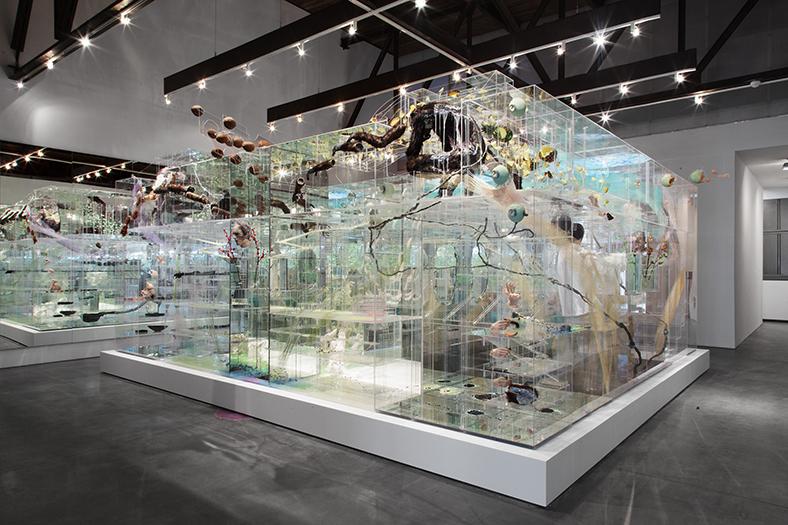
In the main space of Andrea Rosen Gallery, David Altmejd’s gridded plastic network The Flux and the Puddle forms a labyrinthine rectangle—a wrinkle in time. In an homage to science and metaphysics, behind a network of clear vitrines, a series of human-animal hybrids construct themselves out of resin, epoxy, and clay, morphing in and out of candied fruits as harbingers of a kind of alternate evolutionary model, a schizophrenic mutation on a Punnett square.

David Altmejd. The Flux and the Puddle, 2014; Plexiglas, quartz, polystyrene, expandable foam, epoxy clay, epoxy gel, resin, synthetic hair, clothing, leather shoes, thread, mirror, plaster, acrylic paint, latex paint, metal wire, glass eyes, sequin, ceramic, synthetic flowers, synthetic branches, glue, gold, feathers, steel, coconuts, aqua resin, burlap, lighting system including fluorescent lights, Sharpie ink, wood; 129 x 252 x 281 inches. Courtesy of the artist and Andrea Rosen Gallery.

David Altmejd. The Flux and the Puddle, 2014; Plexiglas, quartz, polystyrene, expandable foam, epoxy clay, epoxy gel, resin, synthetic hair, clothing, leather shoes, thread, mirror, plaster, acrylic paint, latex paint, metal wire, glass eyes, sequin, ceramic, synthetic flowers, synthetic branches, glue, gold, feathers, steel, coconuts, aqua resin, burlap, lighting system including fluorescent lights, Sharpie ink, wood; 129 x 252 x 281 in. Courtesy of the Artist and Andrea Rosen Gallery.

In the fractured landscape of the labyrinth, Altmejd’s figures exist in a mirage, suspended simultaneously between past, present, and future (1). The vitrine is populated by fantastic archetypes of werewolves, clay golems, and profane angels, but the mythology of the landscape is undercut by uncanny touches such as a partially disembodied, blue-sequined dress framed by sculpted pineapples. As if teleported from the wreckage of a copacabana, the blue dress is a signifier of our world—it appears as if pulled out of close time. In Altmejd’s vitrine, time itself becomes spatial, three dimensional, repetitive, redundant, twisted, and folded back in upon its own permutations. As Altmejd’s sculpted human forms work to create more copies of themselves, and as clear plastic becomes mistaken for mirrors shattered with a terrifying deliberation, the viewer’s sense of any kind of primary referent is irreparably distorted.

Read More »

Share

London

Martin Creed: What’s the Point of It? at the Hayward Gallery

In a world full of arbitrary choices, Martin Creed is an artist who uses systems to make decisions and create order. Unlike most of the YBAs, who are mainly traditionalists using unconventional materials, Creed is a true conceptualist, and his work embodies the 2.0 of contemporary British art. In the lineage of Sol LeWitt—but also radically departing from his precedent—Creed examines ideas and material, identifying a problem-solving strategy that then dictates the rules and the end product. Decisions and flourishes in the work are defined and justified by the limits of his methodologies, materials, or both. And in identifying these strategies, the viewer sees how absurdly ingenious Creed can be.

Martin Creed. Work No. 396, 2005; Planks of Wood; 102 x 482 x 29.5 cm. Courtesy of Hayward Gallery. Photo: Linda Nylind.

Martin Creed. Work No. 396, 2005; planks of wood; 102 x 482 x 29.5 cm. Courtesy of Hayward Gallery. Photo: Linda Nylind.

One framework that is readily apparent for all of Creed’s work at his major survey show at Hayward Gallery is a numbering system that he started using around 1991. Every work has a unique number assigned to it, but not every work receives a title. Whilst considering one of the large gallery walls covered with 1,000 multicolored imprints of broccoli on card, titled Work No. 1000: Broccoli Prints (2009-10), I considered the idea of frameworks and was reminded of a joke my wife’s grandmother used to tell frequently. In some ways, it works as a nice analogy for the moment one has when looking at Creed’s work. To paraphrase:

A woman walks into a grocery store and asks the clerk for some broccoli. The clerk responds that they’re fresh out of broccoli, but the woman refuses to yield on her request. After a bit of back-and-forth, the exasperated clerk offers:

Read More »

Share

Help Desk

Help Desk: Trading Up

Help Desk is where I answer your queries about making, exhibiting, finding, marketing, buying, selling–or any other activity related to contemporary art. Submit your questions anonymously here: http://bit.ly/132VchD. All submissions become the property of Daily Serving. Help Desk is cosponsored by KQED Arts.Help Desk Leader

I’ve been with my gallery for about four years, and had two solo shows (and participated in a few group shows) with them. They are nice people and there have been some sales, but lately I’ve been thinking that it’s time to move on. Recently I’ve had some very encouraging studio visits with other art dealers, and I think one of them might ask me to join their roster. How do I break up with my current gallery without creating hard feelings? I would definitely be moving up in the world with the new gallery.

Back in 2008, art critic Roberta Smith wrote, “An overheated art market sets all kinds of things in motion. Big galleries with money to burn and multiple spaces to fill start circling smaller galleries, eyeing their most successful artists like the underdeveloped properties they sometimes are. Artists get itchy and think about moving up the gallery food chain. And boom or bust, even the friendliest, most mutually beneficial artist-dealer relationships can prove finite. They are outgrown or become stale. Suddenly, it’s time to move on.” And lucky you, to be in a position where you can pick and choose! Most artists I know would love to be in your shoes right now—and yet we all know that everything has its price. You may not be able to advance your career without incurring some hurt feelings. The question is perhaps not if  but how much.

John Divola. Cells, 87CA1, 1987-9. Internal Dye-diffusion Print, 20 x 24 in. © John Divola

John Divola. Cells, 87CA1, 1987-9;
internal dye-diffusion print; 20 x 24 in. © John Divola.

But unless you’re being coy, it sounds as though you may be counting your proverbial chickens before they are even out of the shell. In advance of planning your great leap forward, I want you to read this Help Desk column from 2013, in which artists talk about how to find a gallery that’s a good match. They offer lots of pertinent questions, such as, “Do you like and respect the people running the gallery? Do you trust them, feel that they understand your work, and that they are both interested in and capable of promoting it in a way that will advance your career? Do you feel that they understand the business, and have done well for the other artists that they represent? Do you know any of those artists, or talked with them about how they feel their career is doing? Remember that you are entering into a business partnership with these people, possibly for an extended period of time. Do you have a clear sense of what your expectations and theirs are regarding this relationship?” Read through the advice and think very carefully about where you want to be, and with whom you want to be working.

If you do get an offer and decide to move on, here are some tips:

Read More »

Share

From the Archives

From the Archives – Kevin Cooley: Skyward at the Boiler

The weather has been unusually brutal all across the U.S. this winter, from the unending snow and ice in most of the country to the ongoing drought in Northern California. With even more snow predicted for the Northeast this weekend, we thought we’d take our readers back to revisit Kevin Cooley‘s Skyward project, a bright, sunlit space reminding us of warmer times ahead. This article was written by Allegra Kirkland and originally published on February 12, 2013.

Kevin Cooley. Skyward Installation, 2013.

In an unassuming brick building on a gray Willamsburg street, adjacent to a used-car lot and several doors down from a polythene bag manufacturer, there is a portal to the West Coast. Kevin Cooley’s Skyward, currently on view at the Boiler—the project space of the Pierogi Gallery—captures the quintessence of Los Angeles life: the car as constant, the looping freeways, the towering palm trees and impossibly blue Southern California sky.

Skyward is projected on a huge screen hung from the 40-foot-high ceiling of this former factory’s boiler room, and viewers lie on the floor on a patch of asphalt scattered with pillows to watch the film. In a radical reversal of bird’s-eye perspective, it was shot through the open sunroof of a moving car, providing an unusual, exhilarating view of the city. The juxtaposition of the unheated, industrial New York gallery space with the bright, open images of L.A. is striking, and, according to Cooley, entirely intentional. He is familiar with both cities, having grown up in Los Angeles and having spent the last 15 years living in New York; the piece speaks to what he called his “nostalgia for my childhood L.A.”

Read More »

Share