Elsewhere

Queering the Archive: When a Personal Act of Collecting Turns Political

Today we bring you Queering the Archive: When a Personal Act of Collecting Turns Political, an article on queer art and activism in Eastern Europe recently featured on our sister site, Art Practical. Author Ela Bittencourt notes, “Kisiel’s slides…reverse the commonly accepted notion that there was no room for individual expression, least of all same-sex eroticism, in communist Eastern Europe. At the same time, their secretive circulation reminds us of the very real dangers that surrounded such expression.” This article was originally published on February 6, 2014.

Karol Radziszewski. Kisieland, 2012 (film still); High definition video; 30:00. Courtesy of the artist.

Karol Radziszewski. Kisieland, 2012 (film still); high-definition video; 30:00. Courtesy of the Artist.

Kisieland (2012), a documentary film by the Polish artist Karol Radziszewski, explores the importance and historical context of the personal slide collection of Ryszard Kisiel. Kisiel, his boyfriend, and a small circle of friends shot more than three hundred homoerotic slides (some of them featured in Kisieland) mostly between 1985 and 1986, while Poland was still under a communist government. Kisiel kept the collection secret. Radziszewski’s project, which in addition to the film includes a book that will feature reproductions of all the slides, makes Kisiel’s work available to a wider public for the first time. Kisieland has been recently shown in the United States, at Performa 2013, and has also been extensively screened in Europe, where it has stirred debates on the implications of divulging a private, homoerotic body of work and the contextualization that this requires. When I spoke with Radziszewski about the film, he said he hoped it would draw attention to the way that Poland’s LGBT movement has banished sexuality from its contemporary public discourse, feeding into what Radziszewski sees as a generally sex-phobic climate.

Read the full article here.

Share

Fan Mail

Fan Mail: Hugo Orlandini

Diminutive triumphal arches, human-sized Playmobil figures, and model prison quarters (both to scale and miniature) are a few of the many forms Hugo Orlandini’s work has taken. For categorization’s sake, we could call Orlandini a conceptual sculptor; however, his work incorporates layers of visual and social research culled from public events that richly complicate this subject matter. Orlandini approaches each work by digging deeply into an image from the news, a monument in a city park, or even into the banal nature of what makes a working-class kitchen unique. The artist notes: “I usually start from actual historical events or from situations that have had great impact and visibility. These occasions become meaningful for me as they give me the opportunity to question and reconstruct them, in order to dig below the surface information and the obvious, in order to offer a new perspective.”

Hugo Orlandini. Victoria, 2013; reinforced concrete and polyester resin; 190 x 136 x 60 cm. Images courtesy of Tatiana Kourochkina art gallery and Hugo Orlandini.

Hugo Orlandini. Victoria, 2013; reinforced concrete and polyester resin; 190 x 136 x 60 cm. Images courtesy of Tatiana Kourochkina Art Gallery and Hugo Orlandini.

Altering scale, by increase or decrease, is a method that figures into much of Orlandini’s work. Victoria (2013) comprises a fireplace-sized replica of the Arc of Victory in Madrid, which was constructed in the 1950s to commemorate Franco’s triumph during the Spanish civil war. The concrete remake, while detailed and scaled proportionally—and altered to include a contemporary roll gate so commonly used to shutter closed businesses—confronts the hubris the triumphal arc embodies by manipulating the size down to a more manageable human scale. Orlandini strives to reclaim the monument itself, and the moment in history it marks, as less-than-triumphal, shifting the focus to the inevitably forgotten and personally felt human scale of suffering and loss of the Spanish civil war.

Read More »

Share

Chicago

Archive State at the Museum of Contemporary Photography, Columbia College

On view across three levels of the Museum of Contemporary Photography at Columbia College in Chicago, the exhibition Archive State presents five discrete bodies of work developed by six artists. (One of the installations is made by a duo.) Spatially expansive and ideologically packed, each of these five groups of works deserves individual attention. Likewise, the title of the exhibition itself is due some unpacking.

Akram Zaatari, Dance to the End of Love, 2011; four-channel video installation; 22 mins. Installation view at MUSAC. Courtesy the artist and Sfeir-Semler Gallery, Hamburg/Beirut.

Akram Zaatari. Dance to the End of Love, 2011; four-channel video installation; 22 mins. Installation view at MUSAC. Courtesy of the Artist and Sfeir-Semler Gallery, Hamburg/Beirut.

Using the term Archive—one that seems ever more fashionable in the contemporary art milieu—the title calls forth a ready image. We may imagine a dusty or orderly collection of papers, books, ephemera, and photographs, understanding the archive as a contained entity, one of history, knowledge, specialization, and significance; an institutional repository of the past. Archive State yanks the rug out from under this term—and us—quite quickly, however, developing an expanded notion of what “the archive” comprises within our digital culture. Here we find YouTube clips, spliced together into a tonal montage; found photographs, discarded by their originators, but now reclaimed and re-presented; and other anonymous images. The idea of the archive, as expressed through the majority of these projects, becomes nebulous. While our image of ordered knowledge quickly fades, it is replaced with a form of knowing and being that reflects our haphazard, messy, subjective, and contentious present.

Read More »

Share

Providence

Andy Warhol’s Photographs at the RISD Museum

What, one might ask, remains to be said of Warhol? This perennial darling of the art gallery and the auction house, so irreverent and unpredictable in his own time, increasingly registers as tame, tasteful, and non-threatening in our own. Yet Andy Warhol’s Photographs, a small, focused exhibition at the Museum of the Rhode Island School of Design, reaffirms the artist’s bracing vitality against the backdrop of his commoditized, commercialized myth.

Andy Warhol, Pia Zadora, 1983. © Andy Warhol. Gift of The Andy Warhol Foundation for the Visual Arts, Inc. RISD Museum, Providence, RI.

Andy Warhol. Pia Zadora, 1983; Polaroid photograph. © Andy Warhol. Gift of the Andy Warhol Foundation for the Visual Arts, Inc. Courtesy of the RISD Museum, Providence, RI.

A 2008 gift from the Andy Warhol Foundation, the exhibition’s 105 color and 52 black-and-white photographs hint at what the curators describe as Warhol’s “compulsive use of the medium,” both as prefatory sketch and documentary vehicle. Warhol embraced photography as early as the 1950s, when appropriated photos often served as the basis for his advertising and portrait work. The show’s images, however, date from 1970 onward, when Warhol discovered and became enamored of Polaroid’s SX-70 Big Shot camera. The resulting flood of color snapshots, a mere sampling of which are on view here, were integral to Warhol’s larger creative process. Yet seen today, and installed as they are at RISD in thought-provoking clusters, they acquire a fascination all their own as surreptitious character studies—absorbing, elusive, yet resolutely open-ended. Read More »

Share

Elsewhere

30 Americans at the Contemporary Arts Center, New Orleans

In a nod to Linda Nochlin’s famous query, Michele Wallace asked, “Why are there no great black artists?”[1] 30 Americans is the response to this question, a beautiful, rambunctious show that gathers the work of 31 African American artists. Unfortunately, 30 Americans, similar to Thelma Golden’s Freestyle in 2001, is not about a specific curatorial theory or thought, but rather a placing of African American artists, who have been historically and systematically marginalized in the world of art, directly into the center of the machine.

Kehinde Wiley, Equestrian Portrait of Count Duke Olivares, 2005; Oil on Canvas; 108 x 108 in. Courtesy of CAC & Rubell Family Collection.

Kehinde Wiley. Equestrian Portrait of Count Duke Olivares, 2005; oil on canvas; 108 x 108 in. Courtesy of CAC & Rubell Family Collection.

30 Americans opened at the Contemporary Arts Center in New Orleans, but originated from the Rubell Family Collection in Miami.[2] There is a pure, assertive joy in 30 Americans. The CAC begins with Kehinde Wiley’s rococo-esque paintings in the entrance. Wiley’s large paintings place contemporary black men into the rich tradition of European royal portraiture. Recalling Velázquez’s painting of the same name, Equestrian Portrait of Count Duke Olivares (2005), Wiley depicts a white steed rearing while the Count, wearing Nikes and a red hoodie, holds a staff into the air. While looking at mug shots, Wiley realized that contemporary portraits of black men were stripped of symbols of power and stature. By inserting contemporary men into grand, gilt-framed traditions, Wiley emphasizes a dichotomy between historical systems of power and elite status. Decorative gold textile patterns adorn the background, abstracting the space and highlighting the fact that this scene does not exist in the real world.

Read More »

Share

Hashtags

#Hashtags: The Social and the Political

#engagement #social practice #institutions #academia #authenticity #representation

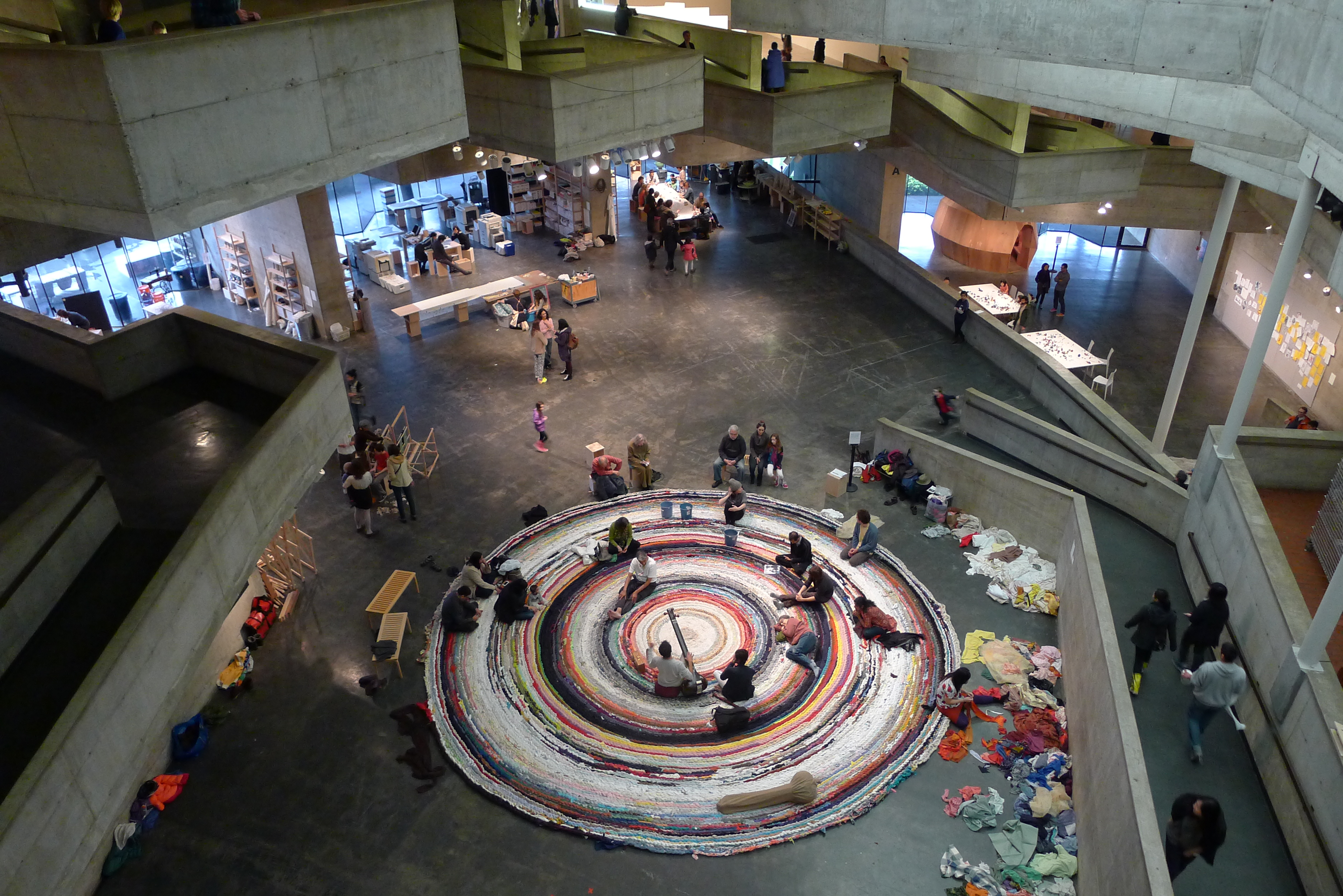
Berkeley has lately been abuzz with social practice of a politically conscious nature that befits the People’s Republic. The Berkeley Art Museum is presenting David Wilson’s The Possible, an exhibition as creative platform that includes numerous artist collaborators and participatory activities for the public. Concurrent with that exhibition, UC Berkeley’s Center for South Asia Studies presented the conference “Collecting South Asia, Archiving South Asia” at the Berkeley Art Museum on February 18. One of the day’s speakers on contemporary art, Dr. Atreyee Gupta of the Haus der Kunst in Munich, presented a paper on Ghari/Ghar Pe/At Home, a social practice exhibition in Dharavi, Mumbai, in 2012. She attests that the exhibition reached a level of engagement with the disadvantaged women who were invited to participate that few such art projects have thus far managed to satisfy. At Berkeley Art Center, Weston Teruya has curated Feature, a selection of work by BAC members that includes Pallavi Sharma’s politically and socially activated work. Sharma’s performance for Feature addressed violence and servitude in the domestic sphere, touching on themes relevant to the installation in Dharavi and emerging from a similar school of thought and practice as David Wilson.

The Possible Workshop, February 9, 2014. Photo: Peter Cavagnaro. Courtesy of Berkeley Art Museum.

The Possible Workshop, February 9, 2014. Photo: Peter Cavagnaro. Courtesy of Berkeley Art Museum.

Such projects raise questions: Should art serve the public good? Does it have a reason to exist beyond the artist’s need for expression? Social Practice as an extension of performance art seems to indicate that many artists believe this is so. Public engagement complicates the idea of art for art’s sake because it functions to expand art dialogues and institutions structurally, opening points of entry for the individual perspectives of participants who do not necessarily consider art to otherwise be a priority in their lives. Read More »

Share

Shotgun Reviews

White Hot Lamp Black at Southern Exposure

Shotgun Reviews are an open forum where we invite the international art community to contribute timely, short-format responses to an exhibition or event. If you are interested in submitting a Shotgun Review, please click this link for more information. In this Shotgun Review, Suzanne L’Heureux reviews White Hot Lamp Black at Southern Exposure in San Francisco.

Hillary Wiedemann. Transit of Venus, 2013 (video still); color HD video; 2:50. Courtesy of the Artist.

Hillary Wiedemann. Transit of Venus, 2013 (video still); color HD video; 2:50. Courtesy of the Artist.

Southern Exposure’s group exhibition White Hot Lamp Black explores the edges of perception, featuring artists who capture bright lights and deep shadows, fathoming spaces both concrete and infinite (caves and outer space) that test the physical and metaphorical limits of seeing. All of the artists employ research-based practices, allowing the work to be experienced on multiple levels beyond the recurring symbolic themes of light and dark.

Carrie Hott’s video installation, Part One: To Cover (2014), draws upon the artist’s extensive investigations into ways humans have historically experienced and conceptualized darkness and produced light, touching on subjects from blackouts and solitary confinement to deep-ocean whale falls. Abstract images—a flashlight beam lighting a dark path, photographs of dark shapes and rudimentary objects—interspersed with moments of blackness viscerally and poetically evoke the subject matter against the artist’s documentary-style voiceover.

Read More »

Share