Odd Jobs

Odd Jobs: Conor Fields

Welcome back to Odd Jobs, where I interview artists about their varied and untraditional career arcs. For this installment I spoke with Conor Fields. Born in Trenton, New Jersey, he received his BFA from Tyler School of Art in 2008 and his MFA from California Institute of the Arts in 2013. He has exhibited in New York, Los Angeles, Philadelphia, and Rome. Fields lives and works in Los Angeles and is co-director of the artist-run gallery space Ms Barbers. His work was most recently exhibited in the group show Other Better Things curated by Adrian Rosenfeld. 
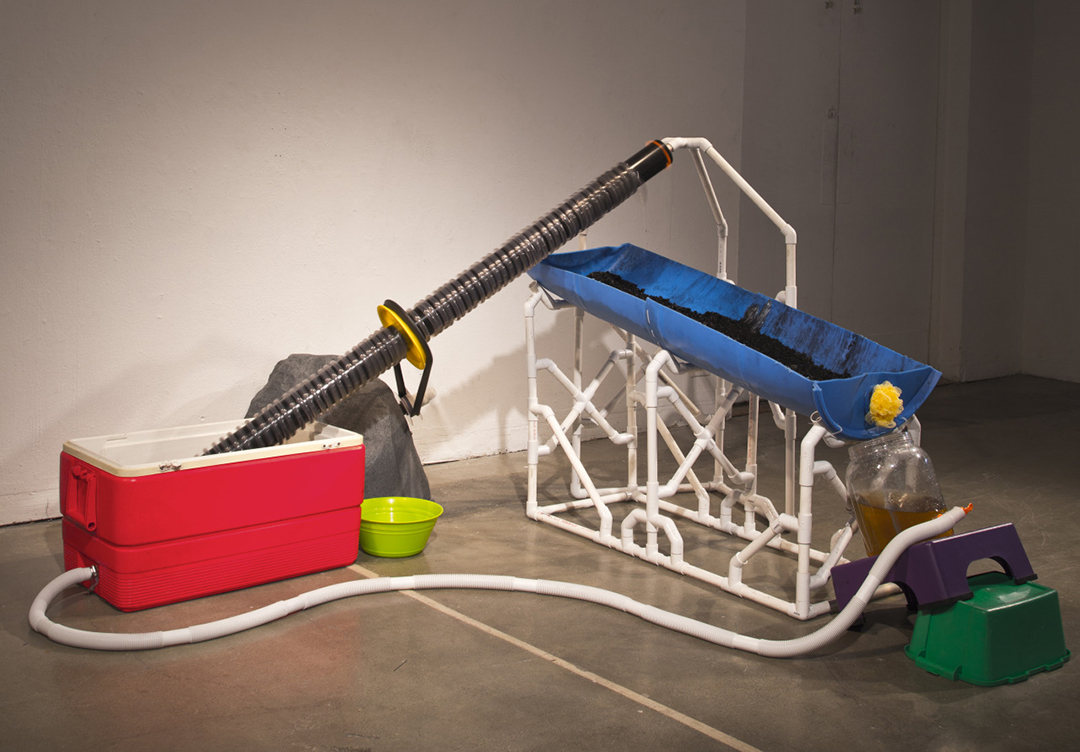
Conor Fields. Achaemedis Screw. 2014; cooler, 55 gallon drum, PVC, motor, charcoal, water, nylon tubing, water jug, step stool, bucket, wheel rim, bicycle tube; dimensions variable. Courtesy of the artist.

Conor Fields. Achaemedis Screw, 2014; cooler, 55 gallon drum, PVC, motor, charcoal, water, nylon tubing, water jug, step stool, bucket, wheel rim, bicycle tube; dimensions variable. Courtesy of the Artist.

Conor Fields: I was looking at your other interviews and I definitely have the fewest markers of career success compared to those you’ve interviewed. And so my outlook might be a little bleaker, because right now, I’m working and there’s nothing coming back. It’s so intimidating and frustrating to hear, “You gotta put in your time! You gotta be poor!” “For…ever?” “…Until it happens!”

Calder Yates: It sounds like you’re saying that when “it” happens—whatever “it” is—its timing or its arrival feels arbitrary.

CF: Oh yeah. Totally. I read about this study on music that showed that once the product, music in this case, is at a certain quality level, after that any additional success or popularity it got was arbitrary.

CY: So you’re not working at [a boutique Los Angeles hotel bar] anymore, right?

CF: I stopped in December. I realized I wasn’t going to get off for the holidays.

Read More »

Share

Meat Is Murder

Today from our friends at REORIENT we bring you Zöe Hu’s article on artist Soukaina Joual. Hu says of Joual’s exploration of meat as a subject, “Meat’s link to violence is an easily made one, and it only takes the viewer another thoughtless step forward to affix the MENA region onto that relationship; but Joual avoids the obvious constellation of meat–violence–Arab world, instead tinkering with a type of humor that seems almost prankish in how it addresses viewers.” This article was originally published on February 13, 2017.

Soukaina Joual. Halal, 2016; light panel; 13.7 x 13.2 in.

Soukaina Joual. Halal, 2016; light panel; 13.7 x 13.2 in.

Soukaina Joual is not afraid of blood, and doesn’t understand why anyone else would be, either. I know this because I spent a weekend with her in Fes in Morocco for an arts conference, during which we joined an organized group tour at a local horse clinic. Joual is from Fes, where horses and mules play an essential role in the economic circuit of the city’s old Medina, one of the largest pedestrian-only areas in the world. Halfway through the clinic tour, I wandered into a stable to find the guide explaining an ongoing procedure in which veterinarians were amputating a horse’s tongue. Crouching in front of the horse, staring into the silver sea urchin of needles and instruments clustered in its mouth, was Joual.

Flesh and blood lend much inspiration to Joual, a 26-year-old artist whose first step in 2017 will be a residency at Rabat’s historic l’Appartement 22, which has seen the likes of Mona Hatoum and Adel Abdessemed cross its threshold. Her art spans multiple mediums and often invokes the raw, the red, and the repulsive. Because of its vivid imagery, it sometimes darts into the territory of gore; but what makes Joual’s pieces so provocative in particular is the playfulness involved. There is an underlying gesture in her oeuvre that swivels like a weathervane between the fake and the real. A piece like Saucisse may have all the similarities and texture of a sausage, but it is deceptive, a bloody ruse crafted from acrylic and clay. “It’s interesting—when people see meat, they have such a strong reaction,” Joual tells me. “It’s just something that exists beneath your own skin. I don’t think I’m using meat or this image of meat to shock; it’s a way of expression.”

Read the full article here.

Share

Shotgun Reviews

Rina Banerjee: Human Likeness at Hosfelt Gallery

Shotgun Reviews are an open forum where we invite the international art community to contribute timely, short-format responses to an exhibition or event. If you are interested in submitting a Shotgun Review, please click this link for more information. In this Shotgun Review, Maddie Klett reviews Rina Banerjee: Human Likeness at Hosfelt Gallery in San Francisco.

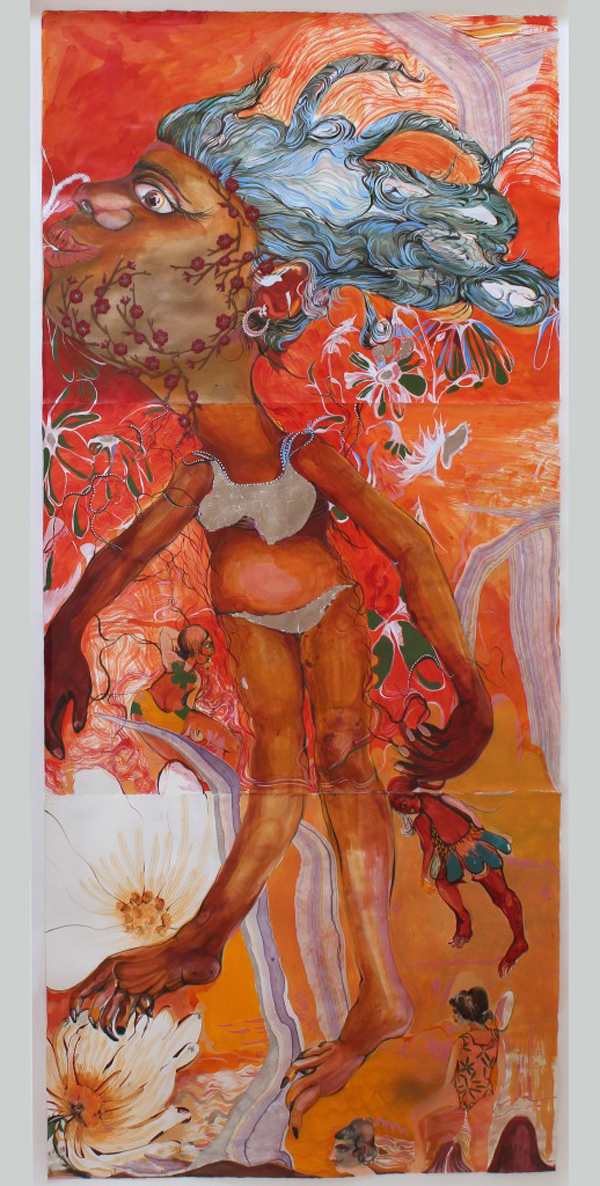
Rina Banerjee. Heavens no place for girls, no sand, no flowers no count of curls no irons to flatten nor straighten or curl you coiled corns, your hair would not leave you naked as girls when all but one could leave open my calls to trumpet her thoughts, stainless steel bikini and sanding wheels for girls who will not open, 2016; blue silver leaf, acrylic, aluminum leaf, and ink on paper; 66 x 30 inches. Courtesy of Hosfelt Gallery, San Francisco.

Rina Banerjee. Heavens no place for girls, no sand, no flowers no count of curls no irons to flatten nor straighten or curl you coiled corns, your hair would not leave you naked as girls when all but one could leave open my calls to trumpet her thoughts, stainless steel bikini and sanding wheels for girls who will not open, 2016; blue silver leaf, acrylic, aluminum leaf, and ink on paper; 66 x 30 inches. Courtesy of Hosfelt Gallery, San Francisco.

Indian artist Rina Banerjee titles her bold paintings and intricate sculptures in a disjointed, poetic prose ranging between ten and sixty words each. Deliberately inconvenient, they are the artist’s critique of “Americanized” English, which privileges brevity. As a result, when writing about the work, one can only include the first eight words of Jack Fruit Johnny she was a diasporic Devi…, (2015), in lieu of its original forty-five word text.

In her solo show at Hosfelt Gallery,
Human Likeness, Banerjee crafts eccentric constellations of materials in her ornate assemblages—much like her elaborate titles. Brightly colored lace, eyelet fabric, and feathers wrap around animal horns, glass bottles, and bones in the seven sculptures. Despite their initial celebratory and playful appearance, the sculptures’ intent is subtler. Born in Kolkata, reared in the UK and based in New York City, Banerjee lives the migratory reality of many Indians—the largest global diaspora. Her work reflects this fractured existence, and the nostalgia and desire for home that exists in many migrants’ minds.

Read More »

Share

San Francisco

Dread Scott: Past, Present & Future at Guerrero Gallery

Dread Scott has a long history of creating provocative works that address the hypocrisies and injustices within the United States. Unfortunately, his extremely sparse solo exhibition, Past, Present & Future at Guerrero Gallery, underwhelms. Spread between the main gallery and the project space, the show presents three very commanding works that span a thirteen-year period. Scott’s exhibition feels like a local display of highly publicized works by a New York–based artist that collectively don’t sustain a focus or shed new light on older works. Importantly, though, the exhibition prompts questions about the role of galleries in the current politicized climate, and their goals and obligations to national and local artists.

Dread Scott. A Man Was Lynched by Police Yesterday, 2015; embroidered nylon; 84 x 52.5 in. Courtesy of the Artist and Guerrero Gallery, San Francisco.

Dread Scott. A Man Was Lynched by Police Yesterday, 2015; embroidered nylon; 84 x 52.5 in. Courtesy of the Artist and Guerrero Gallery, San Francisco.

The most prominent work in Scott’s exhibition is A Man Was Lynched by Police Yesterday (2015). Scott invokes the flags that the National Association for the Advancement of Colored People (NAACP) flew as part of their anti-lynching campaigns of the 1920–30s. Spurred by the murders of Alton Sterling and Philando Castile, Scott updated the original flag—which simply stated, “A Man Was Lynched Yesterday”—by naming the perpetrators: the police. Scott’s black-and-white banner somberly reminds us of the institutional violence that was regularly committed under Jim Crow and continues today under different legal contexts and justifications.
Read More »

Share

Sydney

Before the Rain at 4A Centre for Contemporary Asian Art

Partly an archive of ephemera, mementos of a time already vanished into history, and partly an investigation of the role of the artist at historical flash points of social and political crisis, Before the Rain at Sydney’s 4A Centre for Contemporary Asian Art is also an exploration of present-day shifts in geopolitical currents and tensions in Asia. The exhibition gathers an intergenerational group of artists from Hong Kong, Taiwan, and the People’s Republic of China to explore moments of change and reaction. Why “Before the Rain”? Curator and 4A director Mikala Tai says that in the humid air of Hong Kong, there is a particular moment when you know the skies are about to open and the deluge will arrive. As with barometric pressure, so too with human systems and political tipping points.

Reproduced items and images from The Umbrella Movement Visual Archive, (2014), installation view (detail), 4A Centre for Contemporary Asian Art. Courtesy the Umbrella Movement Visual Archive. Image: Document Photography.

Reproduced items and images from The Umbrella Movement Visual Archive, 2014; installation view, 4A Centre for Contemporary Asian Art. Courtesy of the Umbrella Movement Visual Archive.

If pink “pussy hats” are the artifacts by which the 2017 Women’s March on Washington will be remembered, what are the objects that signify Hong Kong’s brief moment of revolutionary fervor, the Umbrella Revolution of 2014?[1] The yellow umbrellas used by the protesters to shield themselves from tear gas, and the yellow Post-it notes used in impromptu art installations around the city, come to mind immediately. Not included in Before the Rain, but significant as a comparison, is the work of Hong Kong artist Samson Young. Young’s Stanley (2015) is a large, neon-pink text work that reads, “NOTHING WE DID COULD HAVE SAVED HONG KONG IT WAS ALL WASTED.” This work proclaims the despair felt by many around the globe right now: an unnerving and destabilizing sense that taken-for-granted democratic foundations may be less secure than we assumed. The work of the nine artists in Before the Rain, however, represents a rather different view. They reflect on possibilities of resistance and a sense of exhilaration, albeit at times mixed with sadness.

Read More »

Share

Los Angeles

Jimmie Durham: At the Center of the World at the Hammer Museum

Among obsidian stones, an upturned police barricade, a beat-up refrigerator, and cow vertebrae, the detail that lingers longest in Jimmie Durham’s retrospective, on view at the Hammer Museum, is Durham’s absence. Born in Arkansas in 1940, Durham left the United States thirty years ago for Europe and has largely refrained from exhibiting in the U.S. since, giving a provocative tone to the retrospective’s title, At the Center of the World.

Jimmie Durham: At the Center of the World, installation view, Hammer Museum, Los Angeles, January 29 – May 7, 2017. Photo: Brian Forrest.

Jimmie Durham: At the Center of the World, installation view, Hammer Museum, Los Angeles, January 29–May 7, 2017. Photo: Brian Forrest.

The first work in the show, A Pole to Mark the Center of the World in Berlin (1995), is a staff of hawthorn wood with a hand mirror attached, nonchalantly leaning against the wall. At first glance a send-up of self-absorption, the work carries significance belied by its relatively slight proportions. Durham made and placed several of these poles in different locations, alluding to multiple centers of the world. It’s not fixed to the gallery wall or floor, but in true slapstick form, liable to roll off of its resting place against the wall. In creating the marker as a lightweight, movable, and contingent form, Durham presents a “center” that transcends the conventional boundaries of a specific location, similar to the “I” in Walt Whitman’s “Song of Myself”: “I pass death with the dying, and birth with the new-washed babe… and am not contained between my hat and boots.”

Durham was a writer as well as a visual artist, allowing his morals to dictate his travels. After studying in Europe, Durham moved back to the United States to organize for the American Indian Movement. He later curated exhibitions in New York City responding to the exigent political issues of the ’70s and ’80s, highlighting under-recognized artists.

Read More »

Share

From the Archives

A Quinquennial and Two Biennials

Today we honor the work of our friend and contributor Leigh Markopoulos, who died tragically on Friday after a car accident in Los Angeles. Leigh worked at Serpentine Gallery, Hayward Gallery, and the Wattis Institute for Contemporary Arts; eventually becoming the Chair of the Graduate Program in Curatorial Practice at California College of the Arts, where she shaped more than a decade of cohorts of MA students in the first program of its kind on the West Coast. Leigh will be remembered by colleagues around the world as whip-smart, wonderfully direct, and incredibly generous with her time and knowledge. There are any number of reasons to revisit this review, which she wrote in 2012, but foremost because it summarizes Leigh’s contributions to the field: a careful consideration of art and exhibitions, an honest wrestling with themes both broad and narrow, “a restorative encounter with art—and life.” 

Forget Fear, 2012; installation view of the KW Institute for Contemporary Art’s ground floor, 7th Berlin Biennale, 2012. Courtesy of Frieze.

Forget Fear, 2012; installation view of the KW Institute for Contemporary Art’s ground floor, 7th Berlin Biennale, 2012. Courtesy of Frieze.

It is hard to do justice to this summer’s triumvirate of European mega-exhibitions—Documenta 13, Manifesta 9, and the 7th Berlin Biennale—within the confines of a single article. It is hard to cover the multiplicity of venues—from museums and galleries to train stations, defunct mining complexes, park pavilions, movie theaters, department stores, and hotel ballrooms—by foot, let alone by pen. It’s harder to convincingly illuminate a tenth of the hundreds of works collectively on display without losing even the most dedicated reader. But the hardest is to analyze the themes at play without resorting to generalizations. What follows here, then, is a sprint through some of the artistic and curatorial highlights and low points, in search of commonalities, contradictions, and the ultimate conclusions to be drawn from three very different iterations of more or less the same idea: wresting art from the thrall of the market and restoring it to a conscientious existence.

It’s perhaps useful to preface these observations with a reminder about the forces of capitalism at play in the organization and staging of these exhibition events. All three are recognized art magnets. Documenta, the grande dame, is expected to attract audiences upwards of 750,000 this year, at the same time it will net somewhere in the region of 100 million euros for Kassel’s denizens. Established in 1955 as an enlightened endeavor to return art to the ruins of the heavily bombed city, the quinquennial has been heavily subsidized by the city government since the late ’70s—giving the curatorial team an extremely healthy budget with which to work—and is increasingly beloved by its inhabitants. Documenta occupies the 18th-century building of the Fridericianum Museum, as well as numerous other locations, and its artistic directors are free to designate additional sites. This year’s edition occupies the most square footage and number of venues to date. Traces of previous iterations live on in the form of commissioned works—such as Joseph Beuys’s ongoing 7,000 Oaks project— that gradually ameliorate the brutality of Kassel’s grim postwar architecture and enmesh the exhibition ever further in the fabric of the city.

Read the full article here.

Share