





Green Dream at kijidome

From our partners at Big Red & Shiny, today we bring you a review of Green Dream at kijidome in Boston. Author Edmond Caldwell notes, “Individually and collectively, the digital videos that comprise kijidome’s Green Dream come to no easy conclusions and issue no final statements. Instead, they leave the audience to continue the collaboration in their thoughts and discussions.” This article was originally published on February 19, 2014.

Tara Merenda Nelson (with Madge of Honor). Beautiful Secrets, episode 2, 2014; video still.

Tara Merenda Nelson (with Madge of Honor). Beautiful Secrets, Episode 2, 2014; video still.

For five weeks early in this year, half of a modestly sized art space in Boston’s South End became a field of infinite possibility, courtesy of chroma-key green and the kijidome group. Susan Metrican, Lucy Kim, Carlos Jiménez Cahua, and Sean Downey don’t consider it a gallery but a space for collaboration, and this project, Green Dream, was all about collaboration. The group created a green-screen room—which allows digital projections to be layered into video along with live actors—and put a call out to artists they knew or wanted to work with to come and play. The resulting anthology of sixteen videos screened on February 8 before an appreciative audience in a larger studio upstairs.

All the videos were recorded in the presence of Dushko Petrovich’s Green Screed, a ceiling-to-floor text on the space’s fourth wall. By turns funny and anguished, the screed exposes the fatuousness of “green” discourse in contemporary culture and its almost comically feeble consumerist-based “solutions” to the impending ecological tsunami. Nothing is spared, from bumper-sticker slogans and organic veggies to technofuturist idylls of unlimited sustainability. But what the text dwells on most are the mental feints and blinds we use to put off the day of reckoning. The densely packed lines of shiny green vinyl and rounded, nonthreatening font almost appear to abet these equivocations, inviting the eye to slide away. Thus green ultimately figures as “the very plane of fantasy” on which we project our doomed—but artisanally crafted—dreams.

Read the full article here.

Share

Elsewhere

Sculpture after Sculpture at the Art Center College of Design

Last Saturday, curator and Artforum editor-at-large Jack Bankowsky moderated a roundtable on “Sculpture after Sculpture” (more on the title in a moment) at the Art Center College of Design in Pasadena, in anticipation of his forthcoming three-artist survey of the same name at the Moderna Museet in Stockholm this October. The three artists, Katharina Fritsch, Jeff Koons, and Charles Ray, are united by work that is, in Bankowsky’s words, “pointedly figural, quotidian in reference, and resolutely sculptural”; work that, when it emerged in the 1970s, was “all but unimaginable as the shape of serious art to come.” Thus the organizing question for the roundtable: How did we get to the point that figural sculpture seems viable and significant again?

Jack Bankowsky at the Sculpture after Sculpture Panel Discussion, Art Center College of Design. Photo: Chris Hatcher

Jack Bankowsky presenting at the Sculpture after Sculpture Panel Discussion, Art Center College of Design, Pasadena. Photo: Chris Hatcher.

The “what’s changed” as suggested by Bankowsky includes minimalism, industrial production, and the legacy of the readymade; but the speakers, who each gave a ten minute talk devoted to an “epiphany, quandary, or suspicion” that these three artists raised, focused as much on economic, political, and technological changes as on art history. The roundtable might have been better named “Production after Production.”

The panelists themselves formed a forceful and not unpolemical group: sculptor Charles Ray himself; Whitney curator Scott Rothkopf, (who is currently working on the first American museum restrospective on Koons’ art); Isabelle Graw, critic and founder of Texte Zur Kunst; Michelle Kuo, Editor-in-chief of Artforum (who previous collaborated with Rothkopf on a special issue devoted to artistic production); and critic and art historian Michael Fried. What follows is a summary of each of their ten-minute talks.

Read More »

Share

Toronto

Nobuo Kubota: Sonic Scores at YYZ Artists Outlet

Schwoop. Bap. Tschk-tschk. Dom. Dung.

No, the start to this review isn’t full of typos; it’s my attempt at onomatopoeia to capture the sounds that greet viewers at Nobuo Kubota’s YYZ exhibit Sonic Scores. Kubota is a Canadian multimedia artist who often uses sound in his work. His practice is inspired by an interest in jazz and Zen Buddhism, and Sonic Scores presents elements attributed to both of these traditions.

Nobuo Kubota. Sonic Scores, 2014; installation view. Courtesy of the Artist and YYZ Artists Outlet. Photo: Allan Kosmajac.

Nobuo Kubota. Sonic Scores, 2014; installation view. Courtesy of the Artist and YYZ Artists Outlet. Photo: Allan Kosmajac.

Kubota’s rich audio recordings—the inspiration for his drawings—play on headphones located at the center of the gallery. His calligraphic renderings of the sounds swirl around visitors as they listen, creating a fully immersive experience. Image and sound compete for attention as viewers attempt to locate where the peaks of sound on the audio pair up with Kubota’s drawings.

Read More »

Share

Elsewhere

Jim Hodges: Give More Than You Take at the Walker Art Center

I love sculpture. Fundamentally, though, I am a ‘drawer.’ But I love spatial relationships and dimensionality. I’m interested in theatrical moments and choreographing experiences in space. I think as a drawer and make as a sculptor.” —Jim Hodges [1]

With butterflies, silk flowers, spiderwebs, mirrors, camouflage, and gold, Jim Hodges draws in space. Constantly assembling and disassembling natural imagery and everyday items, he creates objects and installations that invite viewers to consider mortality and memory. Co-organized by the Dallas Museum of Art and the Walker Art Center, Jim Hodges: Give More Than You Take is the first comprehensive survey in the United States on the work of the New York–based artist. With nearly 75 pieces made from 1987 through the present, the exhibition brings together photographs, drawings, objects, and several room-size installations, showcasing Hodges’ commitment to probing yet poignant investigations of space and materiality.

Jim Hodges. Deformed, 1989; altered shopping bag; 30 1/2 × 34 in. Photo by Ronald Amstutz ©Jim Hodges.

Jim Hodges. Deformed, 1989; altered shopping bag; 30 1/2 × 34 in. Photo by Ronald Amstutz. © Jim Hodges.

Hodges began his career making objects from the dirt and waste around him, often destroying the finished result. This fascination with creation through destruction emerges early in the exhibition. In Deformed (1989), the artist deconstructs a purple pansy-printed paper shopping bag, splitting it along its seams. Installed flat and pinned to the wall, the resulting cruciform is an enigmatic totem. Likewise, in A Line to You (1994), Changing Things (1997), and You (1997), Hodges disassembles vibrant silk flowers, reassembling them variously into a vertical garland, an abstract wall drawing, and a vibrant tapestry. Hodges carefully transforms these everyday materials into poetic, ethereal objects that are like three-dimensional paintings.

Read More »

Share

New York

Queer Threads: Crafting Identity and Community at the Leslie Lohman Museum of Gay and Lesbian Art

Queer Threads: Crafting Identity and Community, currently on view at the Leslie Lohman Museum of Gay and Lesbian Art, confirms how productive a dialogue between queer theory and critical craft theory can be. The twenty-four participating artists in the exhibition interpret and complicate the rich histories of these theoretical frameworks in a variety of ways. The resulting conversation illuminates certain commonalities between the two fields, in particular a shared struggle against marginalization and denigration.

Nathan Vincent. Locker Room, 2011 (installation view); 144 x 228 inches. Courtesy of the artist. Photo: Stephen Miller

Nathan Vincent. Locker Room, 2011 (installation view); 144 x 228 in. Courtesy of the Artist. Photo: Stephen Miller.

The terms “queer” and “craft” have both been reclaimed by their communities to dislodge disparaging and ghettoizing stereotypes (in considering the reclamation of terms historically associated with marginalized communities into ones of agency and empowerment, I am indebted to L.J. Roberts’ article, “Put Your Thing Down, Flip It and Reverse It: Re-imaging Craft Identities Using Queer Theory”).[1] “Queer” became employed as a term of agency and empowerment in the 1980s, embraced for its ability to recognize a wide and fluid range of sexual identifications, and for shedding the associations with which the term “gay” was saddled at the height of the AIDS crisis. “Queer” is by nature ambiguous, rejecting simplistic heteronormative labels and systems. Likewise, in the early 2000s, the field of craft was in dire need of reclamation. Connotations of craft as amateurish, hobbyist, traditionally feminine, or conceptually empty spurred several major art institutions to drop the term from their official title. In 2002, the Bay Area art school California College of Arts and Crafts became just California College of the Arts, despite the institution’s deep history with the Arts and Crafts movement. In 2003, the American Craft Museum in New York became the Museum of Arts and Design. These very public dissociations from the word “craft” have prompted a new generation of craft activists and theorists to fight against craft’s second-class status in visual culture. New terms like “critical craft” or “contemporary craft” are being employed to shape a new progressive discourse around the medium.

Read More »

Share

Help Desk

Help Desk: Selling Unconventional Work

Help Desk is where I answer your queries about making, exhibiting, finding, marketing, buying, selling–or any other activity related to contemporary art. Submit your questions anonymously here: http://bit.ly/132VchD. All submissions become the property of Daily Serving.
Help Desk LeaderI work for a gallery that has become known as a place for artists to take risks. (While this is exciting and great, it is also frustrating—especially for the owner of the gallery, who has been in business for around 20 years and whose patience and enthusiasm, and subsequent income, is waning as a result of these artists’ unconventional and less-popular work.) How do we use that to our advantage? Also, I want to see the gallery do well, but don’t really know how to pitch new work to potential collectors. Any tips?

Probably one out of every ten or so submissions to Help Desk seems slightly…off. Usually, with a little digging, I can figure out if the query is fake (people, please find another hobby), but in this case I don’t have much to go on. Assuming this question is real, it leaves me with doubts: Why don’t you know how to pitch work to collectors if you work in a gallery? Didn’t the owner teach you? Twenty years in the biz seems like long enough to figure it out.

Nina Beier. The demonstrators (Broken Rope), with Haim Steinbach, 2012; Installation view at The Artist's Institute, New York.

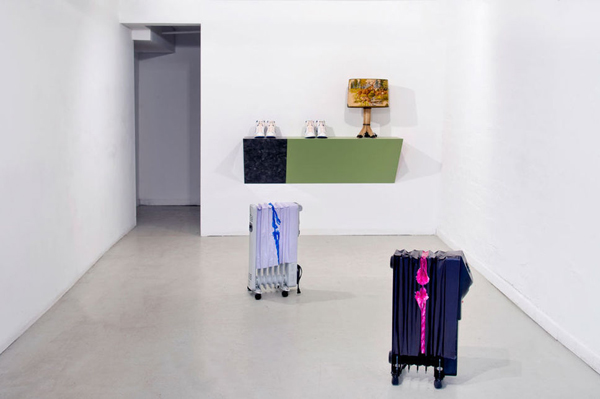
Nina Beier. The Demonstrators (Broken Rope), with Haim Steinbach, 2012; installation view at The Artist’s Institute, New York.

But setting aside my initial skepticism, I see that the answer to this inquiry has merit for both gallery employees and independent artists who are looking to make a sale. How can you sell your work if you’re not making dentist-office-friendly paintings?[1] Can your work be challenging and still be marketable? The short answer is yes, but your client base is admittedly going to be much smaller than it would if you were producing seaside watercolors. You might have to work a little harder to make people appreciate what you’re doing.

First things first: What’s the story? Everyone has a good story to tell, and if you don’t already know the stories behind these artworks, you’re going to have to dig them out of the artists themselves so that you can communicate them to potential collectors. Why? Because people love to have the behind-the-scenes intelligence about everything, and art is no exception. Connecting a potential buyer to that information creates an affinity for the work. How many times have you seen good work become great through the story of its creation? I think business people call it “value added” or some such thing, but we’re going to call it “intrinsic worth.” Please note that I’m not suggesting that you or the artists should be disingenuous or dishonest; most art, especially unconventional work, has an interesting history—you just want to tease this out.

Read More »

Share

From the Archives

From the Archives – Are you a Rauschenberg or a Johns?

Last Friday, the New York Times reported a decision by the Robert Rauschenberg Foundation to “find homes in important public collections…for nine important late-career pieces.” These pieces will pass into the collections of the Museum of Modern Art, the Metropolitan Museum of Art, and the Guggenheim Museum. Today, in honor of this decision to share these works with the public, we bring you this essay by Catherine Wagley, which was originally published on September 30, 2011, as part of Wagley’s weekly series “L.A. Expanded: Notes from the West Coast.”

Robert Rauschenberg. Canyon, 1959; oil, housepaint, pencil, paper, fabric, metal, buttons, nails, cardboard, printed paper, photographs, wood, paint tubes, mirror string, pillow & bald eagle on canvas, National Gallery of Art, Washington, D. C.

Robert Rauschenberg. Canyon, 1959; oil, housepaint, pencil, paper, fabric, metal, buttons, nails, cardboard, printed paper, photographs, wood, paint tubes, mirror string, pillow & bald eagle on canvas, National Gallery of Art, Washington, D.C.

A block of Grand Avenue in downtown L.A. was completely blocked off a few days ago, but hanging across the barricades was a big red arrow pointing down Bunker Hill with “jurors” written across it. No other signs told passers-by anything about the construction or about detours, but to let the jurors get lost would be un-American. A friend of mine, an artist, was recently “Juror One” in an L.A. case thrown out after only a day. In that day, however, she parked below Disney Concert Hall and got in for free at MOCA. Jurors, it turns out, get certain perks.

The jury happened to include another, younger, self-declared artist, who at first struck my friend as savvy.  The two of them decided to visit MOCA together and, walking through the room with the Johns and Rauschenberg work from the museum’s permanent collection, G. asked the question: “Rauschenberg or Johns? Who’s best?” “Well, I really liked those Rothkos,” the kid she was with said, “but I guess Rauschenberg, if I had to choose, but Pollock’s my favorite.” Clearly, he didn’t get it. Rauschenberg vs. Johns is the litmus test. Your answer shines a mirror on what you want from the world, and on the art scene, it’s a way better personality gauge than, say, Meyers Briggs: the repressed, introverted, and calculating Johns vs. the all-out exhibitionist Rauschenberg.

Read More »

Share



