Lalla Essaydi: New Beauty at Jenkins Johnson Gallery

From our sister site Art Practical, today we bring you a review of Lalla Essaydi’s photographs now on view at at Jenkins Johnson Gallery in San Francisco. Author Danica Willard Sachs notes that in Essaydi’s work, “the effect of the ceremonial fabrics and calligraphy is to flatten the women into almost abstract images that retreat into the background like furniture.” This article was originally published on February 24, 2014.

Lalla Essaydi. Bullets #5, 2009; chromogenic print; 48 x 60 in. Courtesy of the Artist and Jenkins Johnson Gallery, San Francisco.

Lalla Essaydi. Bullets #5, 2009; chromogenic print; 48 x 60 in. Courtesy of the Artist and Jenkins Johnson Gallery, San Francisco.

Lalla Essaydi’s highly staged tableaux employ the domestic spaces of her native Morocco to challenge the Orientalist imaging of Arab women. New Beauty at Jenkins Johnson Gallery brings together sixteen photographs from the artist’s two most recent series, Harem Revisited and Bullets Revisited, which expand her investigation of the harem as an architectural and social structure of confinement for women in Islamic culture.

Essaydi’s large-format chromogenic prints, all shot in the isolated space of the harem in palaces and homes around Marrakech, are visually alluring. The pictured women glint with gold clothing and jewelry made from bullet casings, or are swathed in intricately adorned fabrics in saturated hues. For the models’ poses and groupings, the artist references an art-historical lineage that includes 19th-century painters Jean Auguste Dominique Ingres, Jean-Léon Gérôme, and Eugène Delacroix, twisting familiar imagery into disconcerting scenes.

Read the full article here.

Share

Fan Mail

Fan Mail: Wendy Given

Mythos: fantasy, fiction, legend, saga, parable, fable, narrative, invention, fabrication, yarn. The conceptual distance between myth and the concrete manifestations of mythology is a potentially endless—yet meaningfully orderable—list of synonyms. But with each word the gap shrinks, as mental images of processes and then objects emerge, even if just as puns. Wendy Given is bridging the gaps between the abstract idea of a mythos and its textural and visual components—the story.

Wendy Given. Gaest No. 11, To Lucybelle, 2012; C-Print; 20” x 20” inches. Photo courtesy of the artist.

Wendy Given. Gaest No. 11, To Lucybelle, 2012; C-print; 20 x 20 in. Photo courtesy of the Artist.


Given’s work includes photography, sculpture, and installation, often combining all three to create imagery for mythologies and stories. These stories simultaneously capture and unite the literal and abstract components of the processes of mythmaking. She pays particular attention to the natural world and provides placeholders for the components of stories—characters, settings, objects, rituals—and in so doing constructs nearly identifiable narratives. It’s important to note that Given is neither illustrating existing stories nor inventing new ones—her practice does something in between. Her works are not quite archetypal, but they hold just enough familiarity to stimulate the imagination.

Read More »

Share

London

BP Walk through British Art at Tate Britain

Can you remember the last time you were really excited about seeing your local museum’s pre-modern permanent collection? Familiarity is the antagonist for the seasoned art viewer, and growing weary of a permanent collection becomes inescapable. Perhaps this is excusable in the case of a small collection in a provincial museum—but quite a different thing when the collection bills itself as the nation’s definitive authority on British art.

Installation view; BP Walk through British Art; Courtesy of Tate Britain. Photo: A. E. Driggs.

Installation view; BP Walk through British Art. Courtesy of Tate Britain. Photo: A. E. Driggs.

In 2000, a well-needed schism occurred at the Tate Gallery in London. The result was the birthing of the internationally focused, contemporary Tate Modern. Taking residence in a massive, ultra-cool former power plant, it immediately became (and continues to be) the most visited gallery in the world. What then was left at the original site—with its staunchly English-looking galleries—became Tate Britain. “Able to return to its original function as the national gallery of British art,” the art guardians of all things British doubled down on what they knew. The gallery thus suffered from its remit of being too British and unyielding on keeping things as they should be—or rather, as they always have been. Precedent is the opposite of cool, and Tate Britain reveled in its gray soul, treating visitors to a convalescent home for art.

Read More »

Share

New York

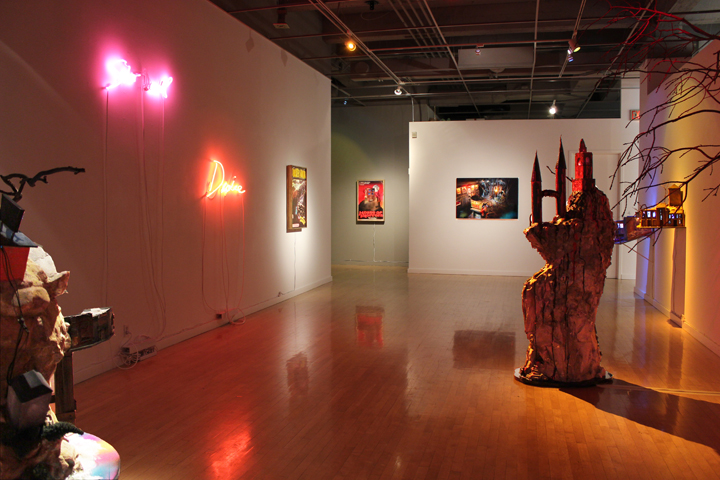
Michelle Segre: Symptoms of Escape Velocity at Derek Eller Gallery

The constructions of Israeli-born artist Michelle Segre—towering webs of yarn, wire, and organic matter—resemble dispatches from another planet or totems of some long-lost civilization. Unfinished and roughly made, her work still evidences painstaking attention to detail, a ritualistic practice in which all the constituent elements impart shrouded, mystical meaning. A small show of her most recent work, currently on view at Derek Eller Gallery, expands on her long-running obsession with Neolithic idols, craft techniques, and Surrealism. The three monumental pieces included in the exhibit seem to occupy a middle space between the earthly and the otherworldly, the familiar and the unknowable.

Michelle Segre. Symptoms of Escape Velocity, 2014; installation view. Courtesy of the artist and Derek Eller Gallery, New York.

Michelle Segre. Symptoms of Escape Velocity, 2014; installation view. Courtesy of the Artist and Derek Eller Gallery, New York.

Through the glass doors of the gallery—located on an unassuming, industrial block near the West Side Highway—Segre’s mythological assemblages assault visitors with their vivid colors and overblown scale. Segre, who began producing these idiosyncratic sculptures in the 1990s, takes an intuitive, highly personal approach to materials, integrating found objects with papier-mâché constructions, tangles of yarn, and scraps of iron and wire. While her formal vocabulary varies, certain key concepts and motifs make regular appearances: fungi, paganism, comestibles, the cosmos. Themes are meditated upon, picked apart, and then brought back into the fold years later. This constant recycling of both forms and materials lends Segre’s work a sort of cosmic grace, conjuring associations with reincarnation or the first law of thermodynamics: that energy can never be created or destroyed, only changed in form. Her fascination with outer space and repurposing objects recalls Carl Sagan’s avowal that “the Cosmos is all that is or was or ever will be.”

Read More »

Share

Elsewhere

Subverting the Sublime: Wondermountain at Penrith Regional Gallery

It seemed entirely appropriate that my journey to see Wondermountain at the Penrith Regional Gallery and Lewers Bequest was through rain, a concrete landscape of freeways and overpasses obscured by my windscreen wipers. I arrived beside the swollen Nepean River, the Blue Mountains shrouded in mist, reflecting on the continuing importance of shanshui (mountain/water) painting. A poetic approach to representing landscape evolving from the Tang Dynasty, the genre has continuing currency in the work of contemporary artists responding to dramatic changes in the natural environment, in China and elsewhere. Subtitled Landscapes of Artifice and the Imagination, the exhibition brings together works by thirteen Chinese and Australian artists, exploring curator Joanna Bayndrian’s interest in the endurance of some of shanshui’s core principles and  “the transient spaces of supermodernity.” Bayndrian wanted to explore the relationship between humans and the natural environment, the artistic appropriation of signs and symbols that have come before, and the visualization of imagined landscapes. These things, so central to traditions of Chinese art, are all relevant to young artists working today.

Hua Tunan, Fluorescent impression shanshui, 2013, spray paint, 300 x 500, image courtesy the artist

Hua Tunan. Fluorescent Impression Shanshui, 2013; spray paint; 300 x 500 cm. Image courtesy of the Artist.

A number of works depict dystopian landscapes, rather than the sublime vistas imagined by the literati painters in their gardens, or wandering scholars traveling in misty mountains. Yang Yongliang’s animated Phantom Landscape, at first sight a Song Dynasty scroll painting, is a melancholy vision of the fate of Chinese mega-cities. The mountains are actually stacked skyscrapers surmounted by cranes and pylons, while a torrential waterfall becomes a river of cars. Philjames appropriates a picturesque landscape into an image of the Three Gorges Dam in a comment on development and “progress.” Hua Tunan uses the language of street art and spray-can graffiti to reimagine shanshui in vivid fluorescent color far from the restraint and serenity associated with the conventions.

Read More »

Share

Hashtags

#Hashtags: The Squeezing of the Middle Class Gallery

#commerce #place-making #policy #class #gentrification

With their leases recently terminated, the mid-sized galleries at 77 Geary Street in San Francisco are the latest casualties of the massive wealth divide that plagues contemporary American society. Gallerists George Krevsky, Rena Bransten, and Mark Jawgiel were notified that their month-to-month leases would be discontinued to make space for technology company MuleSoft to expand into the building’s second floor. Patricia Sweetow Gallery, located on the mezzanine floor, has not yet received a lease termination but is in the process of looking for a new gallery space. Within the past year, other gallery tenants Togonon and Marx & Zavattero have departed 77 Geary in advance of the anticipated loss of space. Some of the galleries being displaced have been at 77 Geary for decades.

Tracey Snelling. "Mystery Hour," Rena Bransten Gallery, San Francisco, CA, December 19, 2013 - February 1, 2014. Photo credit: John Janca. Courtesy of the artist and Rena Bransten Gallery.

Tracey Snelling. “Mystery Hour,” Rena Bransten Gallery, San Francisco, CA, December 19, 2013 – February 1, 2014. Photo credit: John Janca. Courtesy of the Artist and Rena Bransten Gallery.

These circumstances, while particularly dramatic, are very much within the scope of experience for many mid-sized American galleries in multiple cities. Chelsea recently saw the departure of Postmasters for lower Manhattan, while Billy Shire Fine Arts is among the mid-sized spaces that have closed after years in L.A.’s Culver City. Meanwhile, the New Yorker recently reported that mega-galleries David Zwirner and Gagosian are doing record business. If the very top of the contemporary art market is thriving, one might ask why it matters that smaller galleries are closing and gallery districts relocating across the country. There are two main reasons why this news should warrant concern. First, mid-sized galleries represent the bulk of artists with gallery representation, for whom record auction prices are out of reach. For these artists, mid-sized galleries make the difference between maintaining a sustainable art career and abandoning creative work for more lucrative pursuits. Without them, artists must take second and third jobs, detracting from the time and energy they need to make their art. Alternative spaces, many of which are also closing, provide regional artists with visibility and community but can offer only minimal financial support. Casting aside the enormous community-building value offered by support for the arts, even the most dry-eyed capitalist ought to appreciate that mid-sized commercial galleries are the link between a community’s individual artists and artisans and a broader market for their goods.

Read More »

Share

Shotgun Reviews

Multiple Perspectives: New Works by Xie Xiaoze at Chambers Fine Art

Shotgun Reviews are an open forum where we invite the international art community to contribute timely, short-format responses to an exhibition or event. If you are interested in submitting a Shotgun Review, please click this link for more information. In this Shotgun Review, Adam Monohon reviews Multiple Perspectives: New Works by Xie Xiaoze at Chambers Fine Art in New York City.

Xie Xiaoze. October 19, 2007; Oil and Acrylic on Canvas, 60 x 72 in; March 16-17, 2013, I.H.T., 2013; Oil and Acrylic on Canvas; 80 x 93 in. Photo: Adam Monohon.

Xie Xiaoze. October 19, 2007; oil and acrylic on canvas; 60 x 72 in; March 16-17, 2013, I.H.T., 2013; oil and acrylic on canvas; 80 x 93 in. Photo: Adam Monohon.

Mass media plays an inescapable role in everyday life. The printing press, photography, the internet, and most recently the rapid growth of smartphone usage have all dramatically altered the way information is distributed and consumed. Xie Xiaoze’s paintings—currently on view at Chambers Fine Art—reflect on the various forms of communication that shape our lives. The exhibition includes three distinct groups of paintings that, assembled together, describe the progression of mass media.

The first of these three groups is composed of softly rendered, warm-toned depictions of stacks of books; the second, sharp-edged and tightly cropped paintings of newspapers; the last, near facsimiles of images taken from Weibo, a rough equivalent to Twitter. Xie’s book paintings are the most abstract of all; the brushwork is broad and irregular, though highly controlled. The palette of these paintings is warm, considerably warmer than that of the others, while the scale is large yet intimate. These paintings convey a deep nostalgia for the book, one that is heightened by Xie’s choice of old and beautifully bound volumes.

Read More »

Share