Shotgun Reviews

Malick Sidibé at Jack Shainman Gallery

Shotgun Reviews are an open forum where we invite the international art community to contribute timely, short-format responses to an exhibition or event. If you are interested in submitting a Shotgun Review, please click this link for more information. In this Shotgun Review, Bansie Vasvani reviews Malick Sidibé’s photographs at Jack Shainman Gallery in New York City.

Malick Sidibé. Pique-Nique à la Chaussée, 1972/2008; silver gelatin print, 17 x 17 in. (image size). Courtesy of the Artist and Jack Shainman Gallery, New York.

Malick Sidibé. Pique-Nique à la Chaussée, 1972/2008; silver gelatin print, 17 x 17 in. (image size). Courtesy of the Artist and Jack Shainman Gallery, New York.

Malick Sidibé’s photographs of Mali, Africa, at Jack Shainman Gallery, New York, are an ethnographic tour de force. Taken soon after the country gained independence from France in 1960, the compelling black-and-white images from the 1960s and 1970s capture the significance of music and dance in Malian culture.

In Regardez Moi (1962), Danseur Méringué (1964), and Dansez le Twist (1965), the impact of Cuban music, which became extremely popular in Mali in the 1960s, is apparent. Felt mostly in the francophone African countries that had historical ties with Cuba, the music was returning to its roots. Sidibé’s frames portray movement and energy from salsa or merengue in such a way that the viewer can feel the rhythm of the music and the pulse of the beat. The dapper dancers display an exaggerated sense of mobility as they commingle traditional cadence with modern movements, making a new pastiche. Time and again Sidibé, who was born in Mali in 1936, documents the spirit of this recently liberated, prosperous generation with the intimacy of an insider whose comfort with his subjects is palpable.

Read More »

Share

Elsewhere

Arlene Shechet: Meissen Recast at RISD Museum

Today from our friends at Big Red & Shiny, we bring you a review of Arlene Shechet‘s new works in porcelain at the RISD Museum. Notes author Anya Ventura, “Shechet frees the medium from its servitude to the decorative, allows it to be matter again, draws it back to the body, and puts it in play as a sculptural element.” This article was originally published on April 2, 2014.

Arlene Shechet, Overflow, 2012. © Arlene Shechet. Courtesy of the artist.

Arlene Shechet, Overflow, 2012. © Arlene Shechet. Courtesy of the artist.

In Arlene Shechet’s Meissen Recast at the RISD Museum, strips of clay lie in slag heaps atop intricately painted ceramic vessels. A delicate foot protrudes from the frilly underside of a petticoat. A figure lies trapped beneath a white kiln brick, splatters of pale blue and brown glaze leaking out like blood. There are endless strange protrusions and spillage, small feet and heads half-emerging from shapeless masses.

These works are the products of the artist’s residency at the Meissen factory in Germany, a palace of production whose 18th-century origins can be traced to the king of Poland’s insatiable desire for exotic porcelain. Created with the factory’s original molds, Shechet’s amorphous pieces are not quite vegetable, animal, or mineral, but something in between. The creations are exhibited alongside the museum’s collection of Meissen tableware and figurines, in both the contemporary gallery and in the period rooms of the museum’s Pendleton House.

Shechet’s work explores the dialectic exchange between the raw and the refined. Industrial excess is fused with the delicate and decorative; the result is a postmodern visual scramble of the original 18th-century Meissen pieces. Shechet uses glazes instead of acrylic paint to “fuse the skin with the body” in the process of firing. In her pieces, clay retains the memory of itself, preserving a sense of soft malleability. Her wild splotches of color, in the traditional Meissen palette, are punctuated with gold touches that recall Lynda Benglis as much as the gilded Baroque.

Read the full article here.

Share

San Francisco

On Laboring for Love

Today from our partners at Art Practical, we bring you another installment from their excellent issue on valuing labor in the arts. In this essay, author Elyse Mallouk (also an artist) notes, “While artists struggle publicly to make the value of art work visible, they are bound as a corporate body by the uncertainties and sacrifices they share in common… Artists can gain power by making their deliberations transparent to each other, especially their mixed feelings about their own artistic labor and its value.” This article was originally published on April 3, 2014.

Shannon Finnegan. 8 Hours of Work, 2012 (performance still); Saturday, June 9, 2012, 11 a.m.–7 p.m. Presented by Recession Art in conjunction with Everything Is Index, Nothing Is History at the Invisible Dog, Brooklyn. Courtesy of the Artist.

Shannon Finnegan. 8 Hours of Work, 2012 (performance still); Saturday, June 9, 2012, 11 a.m.–7 p.m. Presented by Recession Art in conjunction with Everything Is Index, Nothing Is History at the Invisible Dog, Brooklyn. Courtesy of the Artist.

Published in Slate in January 2014 and widely circulated on social media, the article “In the Name of Love” argued that an often repeated phrase, “Do what you love; love what you do” communicates an “anti-worker ideology.” The problem with the adage, the author contended, is that it devalues the vast majority of work (the tedious kind) while elevating the type of work—that of a designer or executive, for example—that feeds on the unfulfilling labor of others. In effect, the article reasoned, the phrase divides work and the workforce into “two opposing classes: that which is lovable (creative, intellectual, socially prestigious) and that which is not (boring, unintellectual, undistinguished).” Beyond reinforcing the aphorism’s oversimplifications, the essay neglected a whole group of workers—contemporary artists and cultural producers—who often undertake one type of work to enable another, and experience conflicted feelings about both.

Read the full article here.

Share

New York

Malick Sidibe at Jack Shainman Gallery

The photographs of Malick Sidibé remind us how the political content of an image can shift and evolve under the unpredictable influences of time and the arrival of new contexts. Currently on view at Jack Shainman Gallery, Sidibé’s work is a mix of black-and-white portraits and candid shots of local people from his native Bamako, Mali. The artist first began his work in photography by assisting a French colonial photographer and then later opened his own studio, Studio Malick, in 1962 in Bamako. Mali gained liberation from France in 1960, and Sidibé’s photographs taken throughout the ’60s and ’70s document a community of young Bamakois during this postcolonial transition and the subsequent socialist and military regimes.

Malick Sidibe. Courtesy of the artist and Jack Shainman Gallery, New York

Malick Sidibé. Untitled, 1969/2004; silver gelatin print, hand-painted wooden frame. Courtesy of the Artist and Jack Shainman Gallery.

In a brief documentary directed by Douglas Sloan, Sidibé stated he was most interested in letting people enjoy themselves and in making his subjects happy.[1]  At the time, he didn’t consider his portraiture as art, but rather as a service: providing people with striking, beautiful pictures of themselves. Some of the portraits shown in Jack Shainman are hung in hand-painted, colorful frames made by Checkna Toure, an artisan who had a studio around the corner from Studio Malick. This framing grants its photograph a status of distinct object rather than an endlessly reproducible image, and serves as a reminder that the initial prints were meant as keepsakes and items of proud display by the subjects themselves.

Read More »

Share

London

Michael Craig-Martin: Objects of our Time at Alan Cristea Gallery

Is a glass of water just a glass of water? Consider it for a fraction of a second and suddenly the glass of water carries a lot of Kosuthian baggage—the mind attaches a label to it, compares it to an ideal, then judges its function, and its value changes. Deconstruct the contextual outcome of that mental layering, and the glass of water not only offers multiple meanings but could become something else entirely. If you’re the seminal artist Michael Craig-Martin, that glass of water is an oak tree.

(from left to right) Michael Craig-Martin. Art & Design (Magritte / Saarinen), 2012; Art & Design (LeWitt / Mies van der Rohe), 2012; Art & Design (Koons / Le Corbusier), 2012; each work, series of 10 screenprints, edition of 50; 100.0 x 45.3 cm. Courtesy the Artist and Alan Cristea Gallery. NPC.

(from left to right) Michael Craig-Martin. Art & Design (Magritte/Saarinen), 2012; Art & Design (LeWitt/Mies van der Rohe), 2012; Art & Design (Koons/Le Corbusier), 2012; each work, series of 10 screenprints, edition of 50; 100.0 x 45.3 cm. Courtesy of the Artist and Alan Cristea Gallery. NPC.

Dublin-born Craig-Martin earned his BA and MFA at Yale (while it was still under Albers’ influence) and then left for England in 1968, where he has lived and worked ever since. Like Baldessari at CalArts in the late 1970s, he is credited with mentoring a generation of superartists to come out of Goldsmiths in the 1980s. Predisposed to American systems of minimalism and conceptual art, his early autonomous sculptures are stripped-down, idea-laden gestures. Of this early work, he is best known for An Oak Tree (1973), where he transubstantiates a glass of water using a conceptual text. By the late 1970s, he felt limited with the closed-ended nature of his work and started experimenting in “drawings that had no style.” The resulting line drawings depicting universally familiar objects in three-fourths perspective became his signature style. Once Craig-Martin draws an object, the image becomes the archetype for all future uses of that object. There are no alternative perspectives, versions, or updates to the drawing. Take his headphones image, for example. Sony may have updated them since the release of the original Walkman, but the Craig-Martin image stays the same. When used, the image is merely scaled up and/or layered over other drawn objects. Originally executed in tape applied directly to the wall, these images have also been done in neon, aluminum, painted steel, household paint, as well as the more traditional practice of acrylic on canvas.

Read More »

Share

Los Angeles

Allen Ruppersberg: Drawing and Writing 1972-1989 at Marc Selwyn Fine Art

For the first solo exhibition in his new Beverly Hills space, Marc Selwyn Fine Art has mounted a significant show of drawings by conceptual-art pioneer Allen Ruppersberg. Spanning almost two decades, from 1972 to 1989, these deceptively simple works on paper show Ruppersberg dealing with themes similar to those of his contemporaries—appropriation, language, identity, authenticity—but with a wry, nostalgic sensibility all his own.

Allen Ruppersberg. Self-Portrait Making a Face Like Barney Bear, 1975; pencil on paper; 23 x 29 in. Courtesy of the Artist and Marc Selwyn Fine Art.

Allen Ruppersberg. Self-Portrait Making a Face Like Barney Bear, 1975; pencil on paper; 23 x 29 in. Courtesy of the Artist and Marc Selwyn Fine Art. Photo: Robert Wedemeyer.

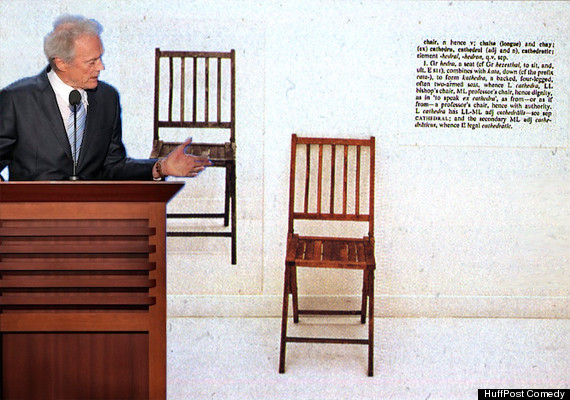
In these works, Ruppersberg depicts both images and words to produce what he describes as a “‘comparison’ of reading and looking and the ‘confusion of the two.’”[1] As Leslie Jones, Curator of Prints and Drawings at LACMA, notes in her insightful catalogue essay: “Choosing to draw it [the book] points to the graphic affinity between writing and drawing as well as the experiential distinctions between reading a book and drawing it, between interpreting its linguistic contents and rendering visually it as an object.”[2] Drawing and writing are constantly at play as drawings of books, drawings of words, and drawings of illustrations all compete to be recognized for their veracity. Reading Time (The Elements of Style), a drawing from 1973–74, captures this playful questioning of truth as Ruppersberg depicts a simple line drawing of the Strunk and White classic above a reading time of two hours and fifty-eight minutes written (drawn?) in expressive cursive. Following from Kosuth’s One and Three Chairs (1965), Ruppersberg questions which is the more accurate representation: a basic drawing of a book or his subjective temporal experience of reading it.

Read More »

Share

San Francisco

Notes on Visual Activism

Today from our partners at Art Practical, we bring you four different views on the recent Visual Activism conference, hosted by SFMOMA at the Brava Theater, March 14–15, 2014. Artists, curators, and scholars presented their thoughts on institutional domains, art, and activism. Four visual critics, Danielle Jackson, Natalie Catasús, Colin Partch, and Omar Mismar, were situated at points radiating out from the auditorium of the Brava Theater to respond to the conference.  

Conference attendees participating in Carmen Papalia's Blind Field Shuffle (2014).

Conference attendees participating in Carmen Papalia’s Blind Field Shuffle (2014).

Danielle Jackson:

What role does visual activism play in confronting such deep-seated social hegemonies as racism and heteronormativity? What strategies can be deployed to encourage silenced voices to emerge and become catalysts for change and transformation? These questions, two of many addressed through the Visual Activism conference, had particular resonance for me. As artist and visual activist Zanele Muholi put it in her keynote address, “Visual activism is about being and identities. It is an alternative way of agitating using visuals and digital media to convey messages.”

Muholi’s photographic portraits of black lesbian women portray her subjects as beautiful and intimate beings, rather than broken victims of the corrective rape that these individuals face far too often as a consequence of being out in these societies. By depicting them as community leaders and advocates for social change, Muholi’s portraits empower who they represent while undermining dominant stereotypes.

Read the full article here.

Share