Shotgun Reviews

Will Rogan: MATRIX 253 at Berkeley Art Museum & Pacific Film Archive

Shotgun Reviews are an open forum where we invite the international art community to contribute timely, short-format responses to an exhibition or event. If you are interested in submitting a Shotgun Review, please click this link for more information. In this Shotgun Review, Maria Porges reviews Will Rogan’s exhibition at the Berkeley Art Museum & Pacific Film Archive.

Will Rogan. Erase, 2014; still from video, silent; 8:10. Courtesy of the Artist, Altman  Siegel, San Francisco; and Laurel Gitlen, New York.

Will Rogan. Erase, 2014; still from video, silent; 8:10. Courtesy of the Artist, Altman
Siegel, San Francisco; and Laurel Gitlen, New York.

Viewing Will Rogan’s MATRIX show at the Berkeley Art Museum leaves one with a lingering impression of something that can only be described, somewhat paradoxically, as homely elegance. Rogan’s quiet yet extraordinarily powerful evocations of time—how one experiences its passage, quickly and slowly, or simply observes its arbitrary nature—manage to embody both of these qualities in their sparing installation throughout the odd, liminal space allotted to MATRIX exhibitions. The show’s centerpiece, literally and figuratively, is Seven (2014), a small, ceramic, staircase-shaped sculpture festooned with seven handmade “melting” brass clock faces à la Salvador Dali. This sly, slightly louche historical reference is enchanting—especially when made by a conceptualist of Rogan’s caliber and intelligence. It is a deliberate move, a deadpan sleight of hand and eye that Rogan’s work as a whole invokes through both temporal and spatial manipulation.

Read More »

Share

San Francisco

Locating Technology: Against Recognition

From our partners at Art Practical, today we bring you an essay by Emily K. Holmes, who analyzes the work of artist Zach Blas: “Blas creates space for facial-recognition technology to be not only strange, but dangerous and deserving of our critical questioning.” This article was originally published on April 16, 2014.

Zach Blas. Facial Weaponization Suite Communiqué: Fag Face, 2012 (video still); HD video; 08:10. Courtesy of the Artist. Photo: Zach Blas.

Zach Blas. Facial Weaponization Suite Communiqué: Fag Face, 2012 (video still); HD video; 08:10. Courtesy of the Artist. Photo: Zach Blas.

Biometric technologies aim to “authenticate” and “verify” individuals by digitally scanning physical traits on the body, ranging from iris scans to fingerprint matching and facial-recognition technology. These technologies scan bodies at borders to administer international mobility in the form of digitized passports, and act as proxy guards in high-security workplaces. Biometric technologies also appear in popular social media, such as when Facebook asks us to tag our friends when we upload photographs (the company is researching ways to increase accuracy), as well as in smartphones, tablets, and some gaming consoles. Before we get too swept up in the excitement of unlocking iPhones with our grinning faces, artist Zach Blas suggests we question the normalization of facial-recognition technology.

In Blas’ digital video Facial Weaponization Suite: Fag Face Communiqué (2012; HD video; 8:10), he presents a montage of clips to survey the current uses of facial-recognition technology, similar to those listed above. Other than sheer proliferation, why should we rethink facial-recognition technology? In one scene, a clip taken from a biometric company’s promotional video shows the possibility of detecting an “unwanted individual.” A slender white man enters through the doors of a building’s lobby; we see through the CCTV monitor as a square latches onto his face as he walks through the space. The man’s face triggers a match in a database, and the screen shows a previously stored image paired with the words “unwanted individual detected.” Although this use of biometrics is situated as protective and beneficial, Blas imagines a possible future in which detecting “unwanted” individuals might collide with socially marginalized groups. 

Read the full article here.

Share

Fan Mail

Fan Mail: Christopher Manzione

Christopher Manzione works with a number of mediums: sculpture, video, performance, drawing, digital rendering, mobile- and web-based applications, digital imaging, and 3D rendering. Across this plethora of forms, Manzione explores the perceived and actual divisions and overlaps between notions of digital vs. analog and organic vs. inorganic, as well as combinations of these two sets.

Christopher Manzione. Excavatum Installation View, 2011. Image courtesy of the artist.

Christopher Manzione. Excavatum, 2011; installation view. Image courtesy of the Artist.

Manzione strives to unite two distant poles without placing a material or intellectual value upon either, preferring to create and exploit palpable aesthetic and material tensions. In his 2011 series Excavatum (2011)—comprising sculpture, installation, and 3D prints installed together in a gallery—Manzione experimented with the gallery space in exciting ways that loop back to questions of whether artworks are, or should be, born in a gallery, or what that idea could even mean. Excavatum is composed of three works, Like Minded (2011), What Could Go On Forever (2011), and Inner Spaces (2011)—respectively a sculpture, an installation, and three 3D lenticular prints.

Read More »

Share

Los Angeles

Eleanor Antin: Passengers at Diane Rosenstein Fine Art

Passengers
where are you going?
from here to there?
do you ever get there?
i don’t know
why not?
i’m only a passenger—just like you
(from an Egyptian tomb)

As you round the corner of the entryway at Diane Rosenstein where this phrase is visible, the first works on view in Eleanor Antin’s Passengers are two massive photographs from her 2004 series Roman Allegories. Going Home is almost 9 feet wide and 4 feet tall. It depicts a very blonde girl seated on a suitcase plastered with travel stickers, looking off to the right of the camera, smiling in a forced, staged manner. She sits as though posing for a children’s clothing catalogue, but is dressed in Hellenic Roman garb and is surrounded by vague Roman detritus (pieces of columns, an urn, vague statues), a crow, and five adult figures all dressed similarly with their backs to the camera, facing the ocean. All of the characters hold umbrellas as if waiting for a deluge while already knowing their fate.

Eleanor Antin. Going Home from Roman Allegories, 2004; Chromogenic print; Edition of 4; 47 ¾ x 102 ¼ inches. Courtesy of the Artist and Diane Rosenstein Fine Art, Los Angeles.

Eleanor Antin. Going Home from Roman Allegories, 2004; chromogenic print; edition of 4; 47 ¾ x 102 ¼ in. ©Eleanor Antin, courtesy of Ronald Feldman Fine Art.

This piece works as a kind of beginning and ending, encapsulating the feeling inherent in Passengers—an existential question about life, death, culture. and the point of it all—with a humorous spin. Passengers is a retrospective of Antin’s work, but not in a way that I expected at all. Anyone familiar with Antin’s oeuvre knows that she was a pioneer of early conceptual and performance art. She created and developed characters—Nurse Eleanor, the black ballerina Eleanora Antinova, and the King of Solano Beach—but very few references to her work with the self exist in this show. In a separate small room toward the entrance of the gallery, all fifty-one photographs from her 100 Boots series are on display. This is the piece that made her famous in her 1973 MOMA show and it is one of the earliest examples of narrative conceptual art. Antin photographed 100 boots in various locations and mailed them to 1,000 people and institutions over two years. She conceived of this project as a sort of “pictorial novel” in which you can see the boots on a long journey. They begin at the sea (100 Boots Facing the Sea), do some mundane chores (100 Boots at the Bank100 Boots in the Market), commit their first crime (100 Boots Trespass), go to work (100 Boots on the Job), head east to New York, and eventually end up at the museum. In my favorite, 100 Boots on the Porch, Antin’s playful humor is evident: Some are lazing, some are daredevils perched on a ledge, while others are casually standing, facing each other—one can almost hear them talking to each other about the day’s events. This is a classic piece, one that is great to see in person and within the conceptual framework of this show.

Read More »

Share

New York

Carrie Mae Weems: The Museum Series at the Studio Museum in Harlem

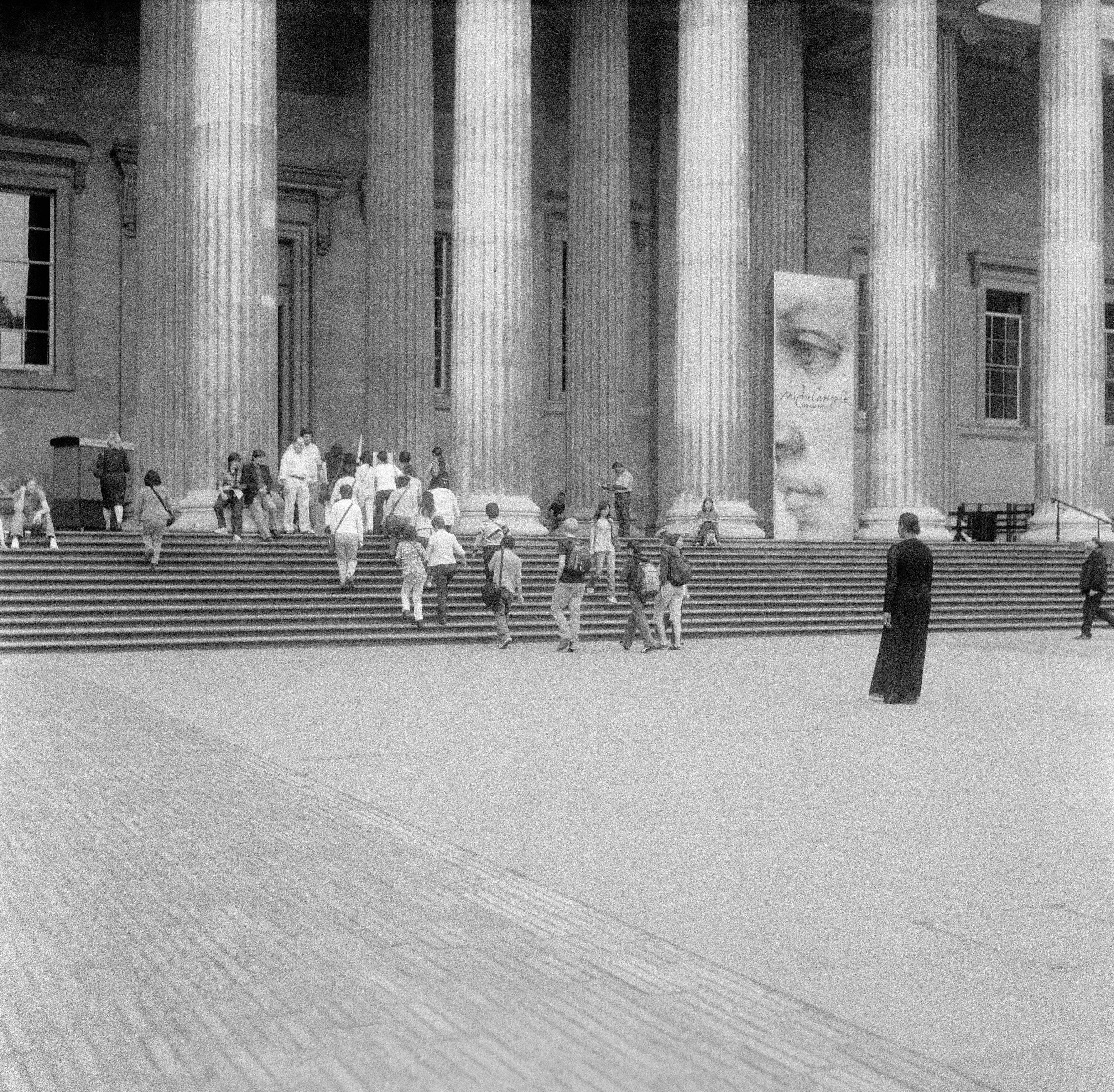
Currently at the small Studio Museum in Harlem, visitors will find several black-and-white photographs by Carrie Mae Weems, each of which captures the artist dressed in a simple, long black dress. Her pose—tall and regal, with strong shoulders and a long, straight spine—rhythmically repeats itself throughout the gallery. These photographs depict Weems standing outside some of art’s most celebrated institutions, including the Louvre, the Tate Modern, Project Row House in Houston, and the Galleria Nazionale d’Arte Moderna in Rome.

Carrie Mae Weems. British Museum, 2006; Digital Chromogenic Print; 72 x 60 inches. Courtesy of the artist and Jack Shainman Gallery

Carrie Mae Weems. British Museum, 2006; digital chromogenic print; 72 x 60 in. Courtesy of the Artist and Jack Shainman Gallery.

In each image, the positioning of Weems’ body conveys a stillness. She faces the museum buildings at a distance; the camera captures her small, placid-looking figure from far behind. This casts the structures as monstrous and impenetrable, and sets Weems apart from both the museums and the few tourists that flit through the photographs. Most often, the other visitors appear blurred, caught in the act of entering or leaving the museum. Most often, they are white.

Read More »

Share

San Francisco

Interview with Matt Lipps

Today from our friends at Kadist Art Foundation we bring you part one of a two-part video interview with artist Matt Lipps. Lipps has a solo show, The Populist Camera, at Jessica Silverman Gallery, now on view in San Francisco. In his talk with Kadist’s Director of Collections, Devon Bella, Lipps explains, “I effectively broke every rule of Photoshop that I have my students not do.”


Share

Hashtags

#Hashtags: Rebel Rebel

#transgender #LGBTQ #counterculture #scarcity #precarity #pop

As a young art-school graduate trying to understand the artist’s life that I had chosen, I could have had no better tutor than Leee Black Childers, who died April 6 at age 68. Childers, photographer and minder for rock stars and transgender icons, led the sort of life that the rest of us only read about. His generation, in the East Village and elsewhere, lived with a precarity and an immediacy that somehow produced enormous creativity. The rewards of that artistic output accrued unevenly to its creators, such that I came to know a man who had worked intimately with Andy Warhol, David Bowie, and Iggy and The Stooges as a colleague at what was, for me, a transitory job at a photography lab while I worked out bigger plans. Reflecting, I am reluctant to romanticize an era that left such crucial participants a hair’s breadth from mainstream celebrity yet financially destitute, but I’m awed by the tenacity and fearlessness that they brought to their art and to their lives.

Leee Black Childers. Andy Warhol Interviews Jackie Curtis at the Factory, New York, 1970. Digital C-print.

Leee Black Childers. Andy Warhol Interviews Jackie Curtis at the Factory, New York, 1970. Digital C-print.

Childers stage-managed and documented performers at the start of the 1970s who would shape the coming punk-rock revolution, including Warhol superstar Jackie Curtis and underground rock star Jayne County, in productions at the Theater of the Ridiculous that pioneered a model of sexual-revolution-as-Grand-Guignol performance art. This mode of performance, which was deeply rooted in the burgeoning LGBTQ visibility of the 1970s, was copied by Andy Warhol, who absorbed Childers et al into his stage play PORK and into his orbit. Speaking of this time, when superstars Curtis, Candy Darling, Holly Woodlawn, and County all lived at his tiny one-bedroom apartment, Childers told me the hardest part was that he could never get a chance to use his own bathroom, which had the only mirror. His combination of lightheartedness and insight is undoubtedly what carried him through nearly seven decades of glamour and excess as well as poverty, homophobia, and the AIDS crisis. Read More »

Share