Shotgun Reviews

Jumana Manna: Menace of Origins at SculptureCenter

Shotgun Reviews are an open forum where we invite the international art community to contribute timely, short-format responses to an exhibition or event. If you are interested in submitting a Shotgun Review, please click this link for more information. In this Shotgun Review, Vanessa Thill reviews Jumana Manna: Menace of Origins at SculptureCenter in Long Island City, New York. 

Installation view, Jumana Manna: Menace of Origins, SculptureCenter, 2014. Photo: Jason Mandella.

Installation view, Jumana Manna: Menace of Origins, SculptureCenter, 2014. Photo: Jason Mandella.


At SculptureCenter, a single strange object made from egg cartons encased in waxy white plaster greets the visitor at shoe level. Farther ahead are stone blocks and a hollow plexiglass form filled with seatbelts. These scattered pieces lead toward the main room of Jumana Manna’s Menace of Origins, where a group of new sculptures surrounds a monitor playing the video Blessed Blessed Oblivion (2010). Influenced by Kenneth Anger’s experimental short film Scorpio Rising (1963), which explores masculinity and neofascism through footage of biker bravado, Manna’s video also shows men demonstrating manliness in unnerving ways. Arab men in East Jerusalem smoke in auto shops and dance around bonfires, and the camera seems to mock the bulging jeans of these brutish men who brag about betrayal and abuse or smugly explain the concept of a car wash. Yet Manna’s nuanced treatment of her subjects ultimately avoids condemnation. Their exuberant dancing is contrasted with images of hard labor, languorous smoking, and lines of poetry. The grimy, destroyed hands of a mechanic take on a tragically lyrical aspect—despite, or perhaps because of, their timeless oblivion—like the crumbling objects in the room.

Read More »

Share

Interviews

Interview with Josh Short

I’ve recently been introduced to the term prairie madness. It’s fictional—not founded in medicine—but it captured my imagination all the same. Artist Josh Short laughed as he explained it to me: The gist is that one can be driven to psychosis by the far-flung expansiveness of the Midwest. Characters in novels have been driven to tears by the isolation, the seemingly never-ending wind, and their homesickness for the coasts. Currently the Artist in Residence at the Salina Art Center in Salina, Kansas—one in a long string of residencies—Short has adopted the phrase as a new favorite joke, but in reality Salina has been a welcome oasis for discovering next steps in his practice. On April 16, 2014, we talked it over in his studio.

Josh Short. In-progress  view of Going to Church, 2014; installation view, The Warehouse, Salina Art Center. Courtesy of the artist. Photo: April Engstrom.

Josh Short. In-progress view of Going to Church, 2014; installation view, The Warehouse, Salina Art Center. Courtesy of the Artist. Photo: April Engstrom.

Ashley Stull: What’s the impulse to continuously be in residency?

Josh Short: I decided to do the residencies because I felt my production was getting stale. I needed to reclaim what my work was supposed to be about. I was having a lot of shows, which was cool, until I started only making work for shows. I was relying a lot on things that were familiar, and after a while I started to feel disconnected. I was working a lot with the Cardboard Institute, a collective started by Scott Falkowski and I. But it got to a place where we were getting super-specific requests about what to make, and I started to feel like I needed to put up some boundaries there. I wasn’t happy and I wasn’t sure the work was still good.

AS: You felt like you were running a factory?

JS: Exactly. I wasn’t prepared to make it a business in that way. The residencies have definitely been a vehicle for reconnecting with the things I like to make, and it’s been fruitful. There’s no pressure, no anxiety.

AS:  How many residencies do you think you’ve done in the past year?

JS: Six; I’ve been to Kansas, Vermont, Virginia, Italy, Joshua Tree, and Ojai, and every one of them was such a different experience. It’s impacted me in cool ways. I never know what’s going to come out of it, and I’ve been pleasantly surprised with the results.

Read More »

Share

San Francisco

Public Intimacy: Art and Other Ordinary Acts in South Africa at Yerba Buena Center for the Arts

From our partners at Art Practical, today we bring you Larissa Archer‘s review of Public Intimacy: Art and Other Ordinary Acts in South Africa, currently on view at the Yerba Buena Center for the Arts in San Francisco. The review highlights the work of photographers Mikhael Subotzky and Patrick Waterhouse, whose portraits, video projects, and zines reveal the lives of the residents living in a famous Brutalist building in Johannesburg. This article was originally published on April 29, 2014.

Mikhael Subotzky and Patrick Waterhouse, Ponte City, 2008-ongoing; installation view, Yerba Buena Center for the Arts, San Francisco. Courtesy of Yerba Buena Center for the Arts and San Francisco Museum of Modern Art. Photo: Ian Reeves.

Mikhael Subotzky and Patrick Waterhouse. Ponte City, 2008-ongoing; installation view, Yerba Buena Center for the Arts, San Francisco. Courtesy of Yerba Buena Center for the Arts and San Francisco Museum of Modern Art. Photo: Ian Reeves.

“It was a place where the wave crashed inwards upon itself, with the seething violence of delayed hope. It was Africa coming back, but with nowhere yet to go…. It was fifty-four floors of people in between other places.”—Denis Hirson, Perec/Ponte

In the late ’60s, designers Mannie Feldman, Manfred Hermer, and Rodney Grosskopf began work on what was to be the tallest residential building in the Southern Hemisphere. The massive Brutalist structure was intended for the white well-heeled to live closer to the center of Johannesburg, rather than their suburban retreats. But in 1976, as the building neared completion, the Soweto uprisings brought violence and opprobrium to the region and its recalcitrant apartheid-era laws and mores. The property market tanked and the developers’ dream of affluent white South Africans living in a tower of luxury flats and duplexes vanished. Throughout the late ’70s and ’80s, Ponte City’s population went from low-income and racially mixed, to predominantly black foreigners (Nigerians, Zimbabweans, and the Congolese), while the already troubled building fell further into disrepair. In 2007 a new pair of developers envisioned a rebirth of the iconic building as, again, housing for the affluent. Many tenants found themselves evicted, and apartments were redesigned with décor themes like “Old Money” and “Glam Rock.” When the 2008 economic crisis hit, the banks pulled their money and the remaining tenants continued to live among the empty apartments and crumbling concrete.

Read the full article here.

Share

Elsewhere

Leslie Shows: Surfacing at the Scottsdale Museum of Contemporary Art

Landscape painting does not garner a lot of excitement these days, but the work of California-based Leslie Shows keeps viewers’ eyes and minds engaged. Her large-scale paintings—which also veer into sculptural forms—are meticulously and thoughtfully crafted, layering material and form into otherworldly interpretations of natural and synthetic landscapes.

Leslie Shows. Face B, 2012; Ink, acrylic, mylar, plexiglass, crushed glass and engraving on aluminum; 60 X 48 in. Courtesy of the artist and Haines Gallery, San Francisco, CA. © Leslie Shows

Leslie Shows. Face B, 2012; ink, acrylic, mylar, plexiglass, crushed glass, and engraving on aluminum; 60 X 48 in. Courtesy of the Artist and Haines Gallery, San Francisco, CA. © Leslie Shows.

A survey of Shows’ recent works is currently on view at the Scottsdale Museum of Contemporary Art—the artist’s first museum solo exhibition—and it provides a snapshot of Shows’ nascent oeuvre. A drawing titled Black Iceberg (2008) greets visitors with the representation of a rare dark-colored iceberg—a nod to the artist’s Alaskan roots and a childhood spent on the glacial tundra. The black iceberg rests somewhat uneasily on the top third of the white paper; the small triangular shape is reflected in water, all of which is rendered in warm, black ink. The color of the iceberg, along with the great expanse of empty space underneath it, creates a foreboding presence.

Read More »

Share

Chicago

Evan Gruzis: Shell Game at The Suburban

Located more than nine miles west of Chicago’s city center, The Suburban is one of a number of alternative spaces that have caught on in the bordering village of Oak Park. It’s quiet, affluent, and easily accessed by public transit, yet Oak Park is an unlikely host to such alternative spaces as Terrain Exhibitions, The Franklin, and The Suburban, all of which locate innovative art within domestic settings. Terrain Exhibitions hosts its installations on artist Sabina Ott’s front porch and yard, while artists Dan Sullivan and Edra Soto present The Franklin in a backyard gallery. Pioneering this microscene since its founding in 1997, The Suburban currently occupies two outbuildings in the backyard of artist, educator, and curator Michelle Grabner, with her husband, the artist Brad Killam.

Evan Gruzis. Shell Game, 2014; Acrylic, wood panel, spray paint, readymade objects; dimensions variable. Courtesy of the artist.

Evan Gruzis. Shell Game, 2014; acrylic, wood panel, spray paint, readymade objects; dimensions variable. Courtesy of the Artist.

This month’s trio of exhibitions at the Suburban includes an inaugural exhibition of art guest-curated by Green Gallery directors Richard Galling and John Riepenhoff (of Milwaukee, Wisconsin), along with a performative/restorative work by Seth Hunter (who is repairing structural damage done to The Suburban’s main gallery in an earlier performative car wreck). At the Suburban’s second space, Grabner presents an exhibition of new works by painter Evan Gruzis.

Read More »

Share

New York

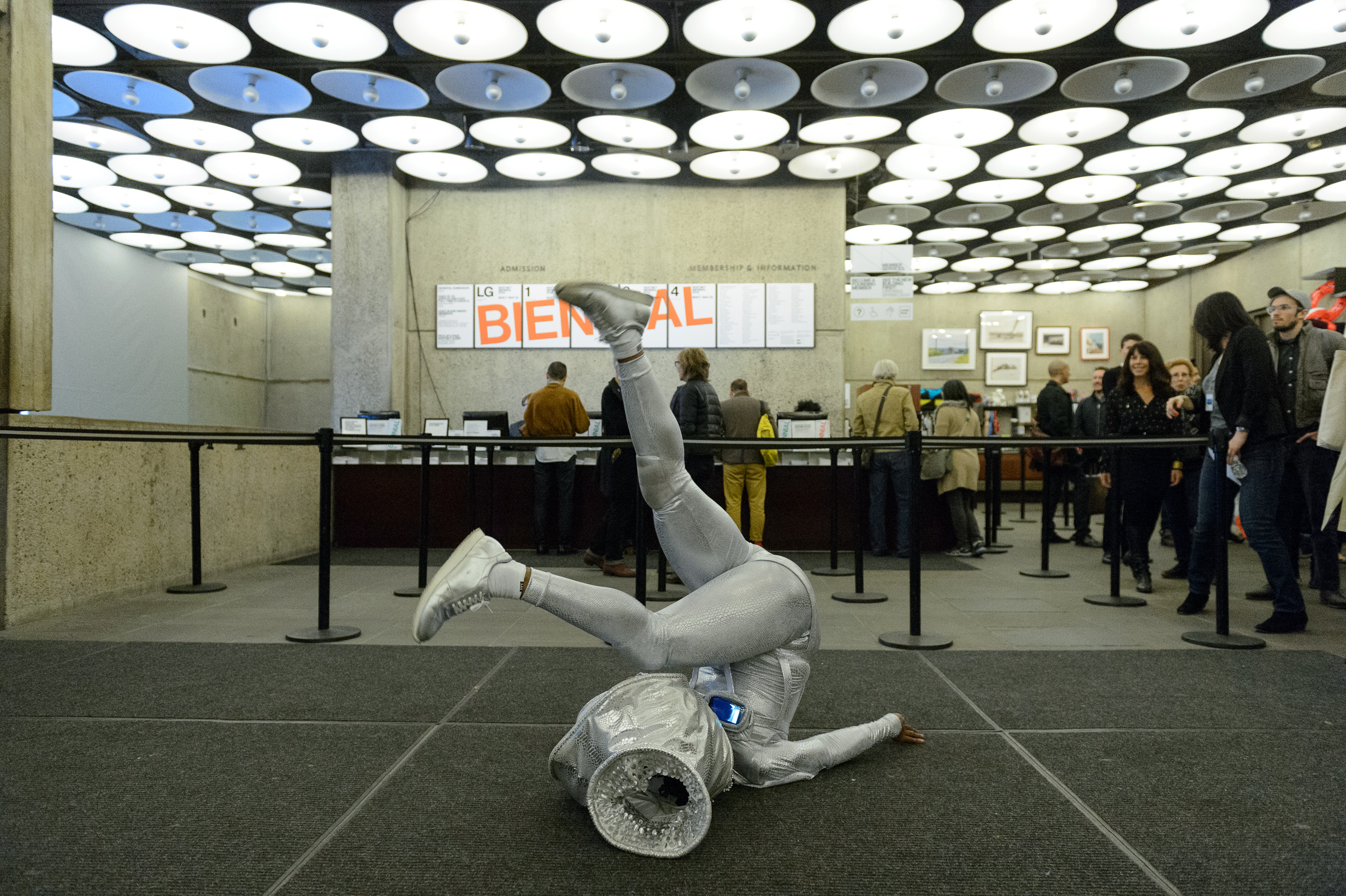
Take Ecstasy With Me at The Whitney Biennial

“It would deeply heal me,” artist Jorge Cortiñas urged, “if we all sang this song together.” The ensuing karaoke-like moment was the climax of Cortiñas’ performance, Back Room, which re-told the contentious story of meeting a future lover during an orgy in the dark rear of a now-extinct East Village bar—a story that none of Cortiñas’ straight friends ever wanted to hear. Such tongue-in-cheek emotional self-indulgence invigorated the atmosphere of Take Ecstasy With Me, a night of performances organized by 2014 Whitney Biennial artists Miguel Gutierrez and Alexandro Segade in memory of late queer theorist José Esteban Muñoz. Playing out more as symposium than “event,” Take Ecstasy With Me (taken from the final chapter of Muñoz’s seminal text Cruising Utopia referencing the 1994 Magnetic Fields song of the same name) leaned slightly into the potential for queer community. Muñoz’ challenge to envision spaces that would compel participants to symbiotically consume the drug, however, remained unmet.

Jacolby Satterwhite, Reifying Desire 5, 2014 (performance still); duration varied. Courtesy of the artist and The Whitney Museum, New York. Photo: Filip Wolak.

Jacolby Satterwhite, 2014 (performance still); duration varied. Courtesy of the artist and The Whitney Museum, New York. Photo: Filip Wolak.

At NYU, I knew Muñoz within the fairly rigid context of the Performance Studies lectures he often officiated. Take Ecstasy With Me in many ways reproduced this academic setting. Rows of chairs stacked to the back of the museum’s cafe space formalized the event so that it felt more like church, or a wedding. “Welcome to art in a converted museum restaurant,” joked a member of performance collective My Barbarian while waiting for one of the night’s many tech glitches to be resolved.

Read More »

Share

Help Desk

Help Desk: A Man’s World?

Help Desk is where I answer your queries about making, exhibiting, finding, marketing, buying, selling–or any other activity related to contemporary art. Submit your questions anonymously here: http://bit.ly/132VchD. All submissions become the property of Daily Serving.

Recently I was invited to join an artists’ group that meets about once a month. These meetings have no particular agenda outside of socializing and conversation, and so I didn’t think much of the fact that they seemed to be attended only by men. However, this trend has continued, and it’s beginning to feel as if the gender makeup of the group is a matter of policy rather than happenstance. Additionally, there has been talk of putting together a group exhibition of work with these guys, and I am uncomfortable participating in an art exhibition founded on a group that might be excluding women categorically. Where does one draw the line between social activity and professional activity in the arts? And what responsibility does an artist have to hold his or her social contacts to the same standards as their professional ones? And, lastly, what should I say to these fellows?

Cosima von Bonin. Internationales Wollsekretariat, 2003; wool, cotton, loden; 108.27 x 112.99 in.

Cosima von Bonin. Internationales Wollsekretariat, 2003; wool, cotton, loden; 108.27 x 112.99 in.

Dear Sir, thank you for your question. I’m glad you’re both aware of and uncomfortable with participating in an exclusionary group. Welcome to 2014, where people of all genders can make extraordinary contributions to society! Of course, not everyone has caught on to this revolutionary notion yet, and often the opportunity to address these systematic evils can be found on the small scale, in our own houses—or studios, as the case may be.

To answer your first question, a social group of professional artists is also, by default, a professional group of social artists; good luck finding the exact place where mere entertaining turns into career networking. In many professions, including the arts, social groups are how ideas are generated, work gets made, people are hired, and commodities are sold. The art world runs on the same casual nepotism as many fields, and quite a few folks prefer—unconsciously I’m sure—to work with people that they have met. Your particular social club is organizing an exhibition, and that’s a professional activity, so there’s your answer.

Read More »

Share