







Interviews
Interview with Wendy Red Star
Wendy Red Star produces photographs, textile-based works, and performances that situate her womanhood and Crow heritage as ontologically intertwined. Collaborating with fellow Indigenous artists, performers of other disciplines, and her daughter, Red Star documents her various achievements in the contemporary art world through strategies that have historical ties.
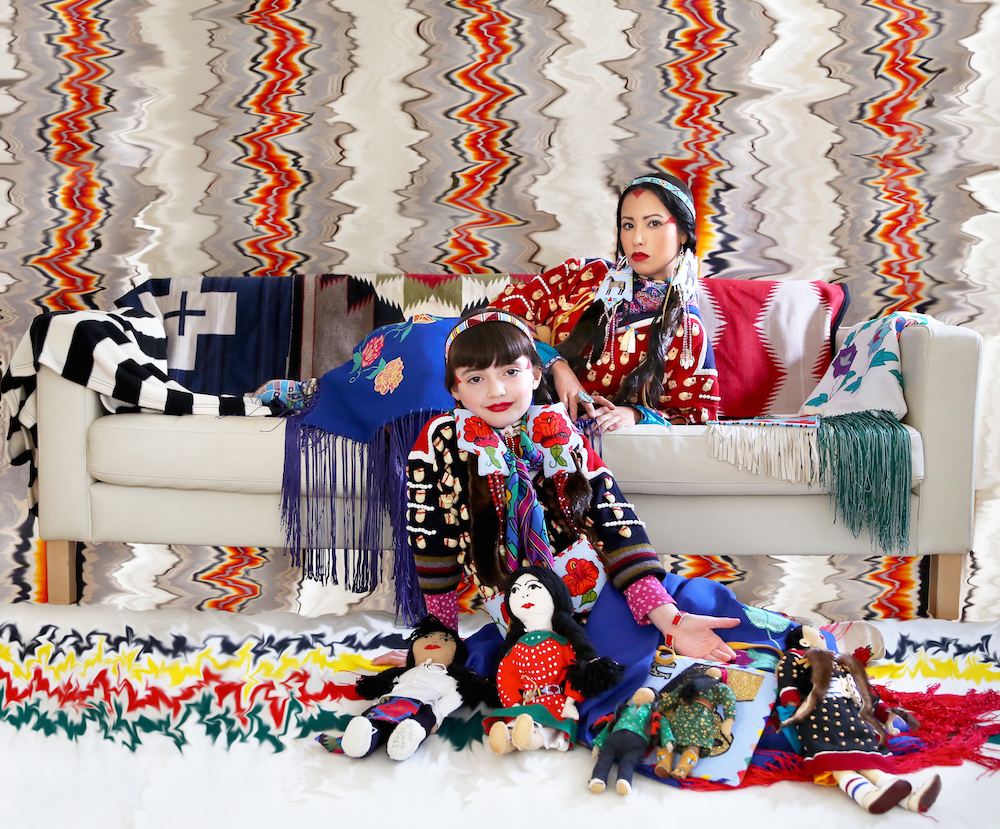
Beatrice Red Star Fletcher and Wendy Red Star. Apsáalooke Feminist #3, 2016. Press image. Courtesy of the Artist.
Ashley Stull Meyers: You have roots in Montana and Colorado. What influenced you to settle in Portland, Oregon, and why do you stay?
Wendy Red Star: I get up on the Crow Indian Reservation in southeastern Montana. My paternal side, the Red Star side, still lives there. My mother’s side resides in Colorado. I visit both quite frequently, and in this moment I’m splitting my time between Portland and a residency at the Denver Art Museum. I graduated from UCLA in 2006, and I arrived in Portland with my then-husband, who practices and teaches here. I stay because I feel like I’ve been really supported here. Most of my exhibitions and lectures take place outside of Portland, but it’s been a really fruitful studio base. You don’t have to live in a major art hub to sustain a career anymore, and I think that’s really important as “fine art” diversifies.
ASM: Being an artist or arts worker of color in Portland comes with a particular set of challenges. That the audience is overwhelmingly white here can be a consideration in deciding whether or not to engage that in the work you make. Do you acknowledge that in any explicit terms? Can it be a stumbling block to address Indigenous histories in a place with a troubling relationship to Indigenous populations?
WRS: I think it’s really interesting to be a Native artist within the conditions of Indigeneity as a sort of “invisible race” to many. In a way, I’m used to being the only Indigenous artist within my immediate context. It was that way in undergraduate as well as at UCLA. There are small pockets of Indigenous people in urban communities, but that feeling of isolation isn’t a new thing. I’ve always wanted to use my work as a vehicle for visibility and the Indigenous voice in such contexts. One of the messed-up questions you always get from audiences and critics alike is, “Do you ever think about making work that has nothing to do with Indigenous culture, and what would that look like?” It’s insulting because that’s who I am. It’s my experience of the world. It can feel like I’m an island, but that’s partially why I make the work. It’s also why I use social media the way I do—to connect with other Indigenous artists. If I can’t find or keep community here, I’ll do what I need to in order to keep it in other ways.

![Juan Roberto Diago. Aché Pa’ Los Míos [Good Vibes for My People], 1999, mixed media on burlap. Courtesy of The Cooper Gallery.](/wp-content/uploads/2017/03/diago.jpg)






