





Hashtags

#Hashtags: On Disgust

#other #violence #misogyny #racism #Orientalism #hybridity

An act of senseless violence at UC Santa Barbara this past week has reignited an online conversation about the interrelationship between race, gender, discrimination, and violence. While the tweets and subsequent articles around #yesallwomen have drawn public attention to the gendered assumptions that underpin violent behavior, less visibility has accrued to the role that Orientalism played in dehumanizing and de-sexualizing both the perpetrator and the victims of the attack that left seven young adults dead on May 23. My interest here is not to revisit the particulars of the crime or to give the killer any more attention. Instead, I will use the productive conversations that have emerged from this horrid tragedy to consider how we are “socialized to reject,” as artist Rina Banerjee puts it in the context of her current solo exhibition Disgust at LA Louver.
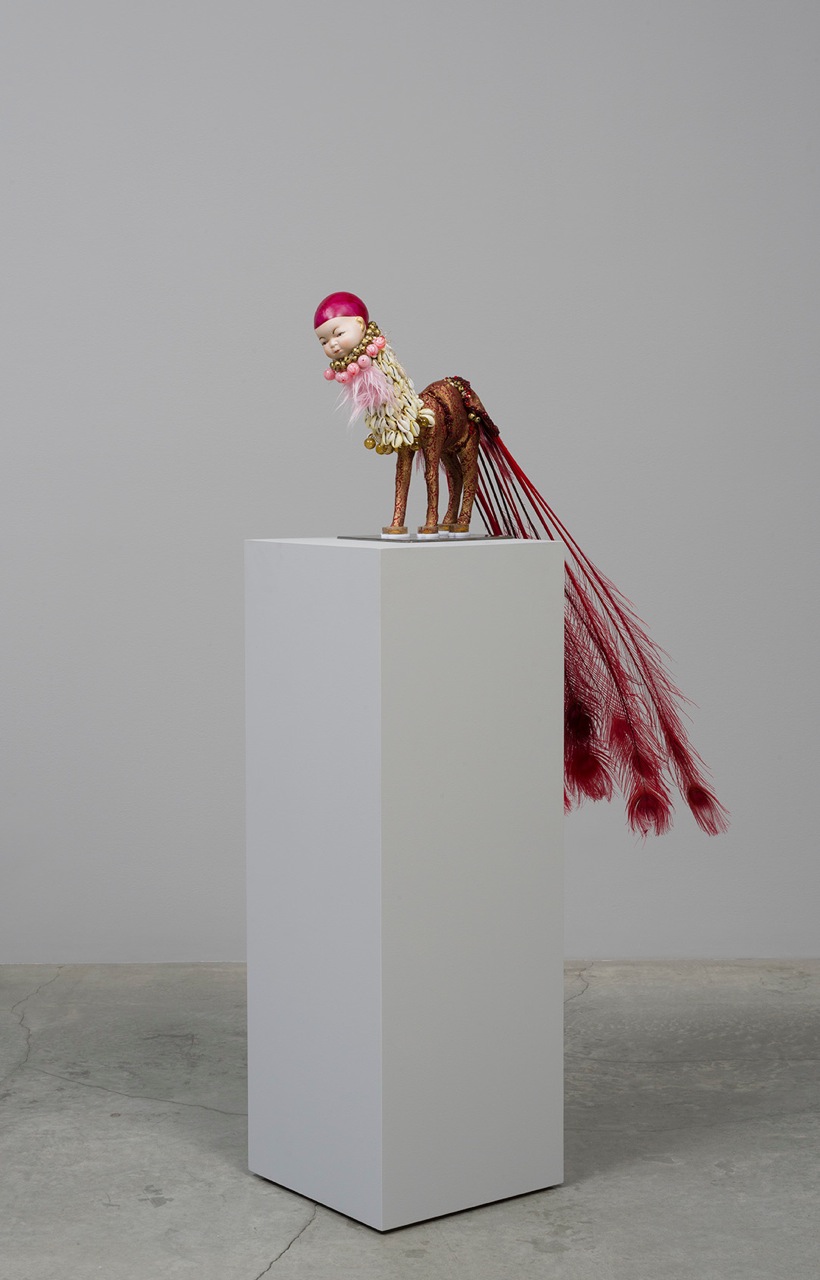
Rina Banerjee. Explorers not fortune tellers travel back and forth at last to tell you whats not and whats what, they may be made of every leather his head looks to too many paths curious of all that appears vast, whats remote and feathered and repulsive can, 2014. Glass beads, peacock feathers, knitted steel, acrylic, steel 43 x 14 x 35 in. (109.2 x 35.6 x 88.9 cm). Copyright Rina Banerjee. Courtesy L.A. Louver, Venice, CA.

Rina Banerjee. Explorers not fortune tellers travel back and forth at last to tell you whats not and whats what, they may be made of every leather his head looks to too many paths curious of all that appears vast, whats remote and feathered and repulsive can, 2014; glass beads, peacock feathers, knitted steel, acrylic, steel; 43 x 14 x 35 in. (109.2 x 35.6 x 88.9 cm). Copyright Rina Banerjee. Image courtesy of L.A. Louver, Venice, CA.

The effect of Banerjee’s installation of assemblage sculptures and small, surreal paintings is far from disgusting; rather, the works possess a strange and alien beauty. This dual attraction–revulsion is reflective of how both misogyny and Orientalism operate by simultaneously idealizing and dehumanizing the human object of acquisitive desire. Artists may experience a similar condition in the marketplace, which functions by idealizing their creative energies as “genius” while devaluing the labor they put into creating their work.

Read More »

Share

From the Archives

From the Archives – Post-Fordlândia: A Critical Look at a Failed Development

Today we bring you a look back at the videos and photographs of Tom Flanagan and Megs Morley, whose project Post-Fordlândia explored the famous village created by Henry Ford in 1928. Author Tori Bush draws parallels between this forsaken 20th-century urban planning project in the Amazon and its counterpart in present-day New Orleans. This article was originally published on September 6, 2012.

Megs Morley & Tom Flanagan. Interior American Village Fordlândia, 2011; Lamda print; 20 x 31 in.

Post-Fordlândia, the new exhibit at Good Children Gallery in New Orleans, is a palimpsest for modern times: It calls from faded pasts to warn us of an ill-advised future. A series of high-definition videos and large-format photographs by Irish artists Tom Flanagan and Megs Morley depict the now-defunct and abandoned town of Fordlândia, the mad brainchild of Henry Ford. This experiment in urban and cultural planning was built in 1928 in the Amazon jungle of Brazil in order to supply rubber to the Ford production plants in the United States. Riots and unrest left Fordlândia a barren, post-apocalyptic wasteland, and Flanagan and Morley’s photographs document the disaster.

Read More »

Share

Los Angeles

Kamau Patton: The Sky Above

Today from our friends at Machine Project in Los Angeles, we bring you a video excerpt of artist Kamau Patton’s project The Sky Above, part of Pacific Standard Time Presents: Modern Architecture in L.A. While flying above L.A. in a chartered helicopter, Patton performed a responsive sound piece; the visual and sonic experiences were streamed live to Machine Project’s storefront space and the web. The project was originally performed on May 26, 2013. 


Share

Interviews

Visual Markers: Interview with Dushko Petrovich

I first met Dushko Petrovich in 2013 at the “Painting Expanded” symposium at the California College of the Arts. In his brief presentation and in the panel discussion that followed, it was clear that Petrovich is a thoughtful artist not afraid to question his own and others’ artistic practices. This quality is also evident in the publications he co-produces with Roger White, the art journal Paper Monument and the books I Like Your Work: Art & Etiquette and Draw It With Your Eyes Closed: The Art of the Art Assignment. Petrovich also teaches at Boston University, RISD, and Yale. What follows is an excerpt from our conversation earlier this spring.

Dushko Petrovich. El Oso Carnal (in progress), 2012-present; acrylic on paper, 108 x 90 in.

Dushko Petrovich. El Oso Carnal, 2012-present (in progress); acrylic on paper; 108 x 90 in.

Bean Gilsdorf: I thought it would be interesting to begin this interview at the moment when I last saw you talking about your work, at the “Painting Expanded” symposium—but you had to break off because you ran out of time. You had just put up a slide of an Ecuadorian bus, and you were starting to talk about your heritage …

Dushko Petrovich: Yeah, I remember that! My cultural heritage is something I have a question mark around. My father was from the former Yugoslavia, my mother was half Ecuadorian and half German-American, so I was born to two foreigners in Ecuador. Then I moved to the U.S. when I was 5 or 6. I’m a U.S. citizen, and it’s probably easier to feel—with my background—that I’m an American more than any other nationality, but at the same time I never really felt at home in the U.S. either. At one point this question of heritage coincided with some of the questions I have about painting as a medium, and one of the things that I noticed is that I was attracted to a lot of vernacular painting that reminded me of being in Ecuador. I decided to make a life-size back of an Ecuadorian bus—a big trompe l’oeil bus—painted in a typical vibrant, heterogeneous style that mixes advertising with religious personal information. That’s something that I feel close to because I’m not into compartmentalizing, it’s all just there. The underlying structure is Ecuadorian, but all the information on it is stuff that I’ve experienced since I left: Americanisms, some Korean words from Zen Buddhism, some things from my experiences in Europe—this bus is carrying signs of the external world, of the foreign world.

Read More »

Share

New York

Ragnar Kjartansson: Me, My Mother, My Father, and I at the New Museum

Ragnar Kjartansson’s Take Me Here by the Dishwasher: Memorial for a Marriage, a mixture of live performance and film, transforms the New Museum’s fourth floor into something like a college movie night sent adrift. The darkened gallery, one wall of which serves as projector screen, becomes a makeshift den—modestly furnished but amply stocked with beer—for ten shaggy troubadours with acoustic guitars. Their ambling, unbroken melody effectively scores the repeating film scene in their midst, suturing its abrupt beginning and end together in a hypnotic loop.

Ragnar Kjartansson. Take Me Here by the Dishwasher (Memorial for a Marraige), 2011. Installation view, Ragnar Kjartansson: Me, My Mother, My Father, and I, 2014. Courtesy New Museum, New York. Photo: Benoit Pailley

Ragnar Kjartansson. Take Me Here by the Dishwasher (Memorial for a Marriage), 2011, 2014; installation view, Ragnar Kjartansson: Me, My Mother, My Father, and I, 2014. Image courtesy of New Museum, New York. Photo: Benoit Pailley.

Such an ambiance fits easily within the oeuvre of the Icelandic artist, who has recently made the figure of the moody musician and the aesthetic of the hangover his principle subjects. New Yorkers may remember The Visitors (2012–2013), a multichannel film capturing the artist and several close friends jamming in the romantic milieu of an upstate farmhouse, or A Lot of Sorrow (2013), in which acclaimed indie rockers The National performed the titular tune over and over for six straight hours at Kjartansson’s behest. Then there was S. S. Hangover (2013), the artist’s warmly received submission to the 55th Venice Biennale, in which a six-piece brass band sailed circles around the Arsenale’s shipyard in a small boat, serenading viewers with a subdued, melancholic melody until dusk fell.

Read More »

Share

Chicago

David Schutter: What Is Not Clear Is Not French at Rhona Hoffman Gallery

At first appearance, David Schutter’s paintings appear almost blank, somewhere between painterly gray monochromes, awfully dry and dead, and overwrought images obliterated into neutral tones. Closer up, the grays separate into more grays—a brighter golden, a deeper charcoal, a greenish dead-moss, and so on—while the seemingly uniform surface opens into a surprising depth of layered brushwork. Like his drawings, Schutter’s paintings are intense accumulations of curling touches, brushy attacks, and bits and clips of painting’s language of flourish. Describing only space, these expressive marks convey meaning abstractly, like gray and black nods without context.

David Schutter, AIC G, 2014; oil on linen; 16 x 14.5 inches. Courtesy Rhona Hoffman Gallery.

David Schutter. AIC G, 2014; oil on linen; 16 x 14.5 in. Image courtesy of Rhona Hoffman Gallery.

Appreciating these somber works requires a little knowledge of their history. The title of this exhibition, What Is Not Clear Is Not French, is drawn from an essay written by the royalist writer Antoine de Rivarol (1753–1801). His famous essay, The Universality of the French Language, proudly presented French as a language epitomizing Enlightenment values while avoiding the pitfalls of other European languages: It lacked the hardness of German, the weakness of a polluted Italian, and the baseness and superfluity of English. The infallible French, meanwhile, embodied clarity, structure, and order, while yet preserving a lyrical grace. Typically of the time, and parallel to developments in French academic painting, de Rivarol was anxious to rationalize the beauty and effect of the French language, to measure and describe the logic of its romance, and to celebrate it within the charged arena of competing nationalisms.

Read More »

Share

Help Desk

Help Desk: Stop, Thief!

Help Desk is where I answer your queries about making, exhibiting, finding, marketing, buying, selling–or any other activity related to contemporary art. Submit your questions anonymously here. All submissions become the property of Daily Serving.

Last year I made a sculpture that was technically rather challenging but resulted in something I thought was a successful piece, which I displayed in a small group show. It’s a concept I’ve recently returned to in numerous exhibition proposals, though none have yet been accepted by the galleries I’ve contacted. Today I discovered that an acquaintance of mine is copying this technique in a sculpture for an upcoming exhibition. I know this individual is aware of my own work because this artist “liked” the picture I posted of my sculpture on Facebook over a year ago. Of course it’s entirely possible this artist has forgotten seeing the piece, but the resemblance is unsettling. Normally I would just shrug it off and say that imitation is the sincerest form of flattery—but it’s not terribly flattering when your imitator has the advantage of a significant solo exhibition wherein to display the work. I don’t know if I have any real right to be upset, but I am. Do I say something? Or do I just carry on making my own (I believe superior, if admittedly little-exhibited) work and let that speak for itself?

Raymond Pettibon. No Title (That fact of), 2003; ink on paper.

Raymond Pettibon. No Title (That Fact Of), 2003; ink on paper.

The phrase “there’s nothing new under the sun” goes all the way back to the Bible, but somehow when we have an innovative notion, it seems like it is ours and ours alone. Your dilemma gets right to the heart of artistic practices and the mystique that concepts and techniques still hold for artists. Sacred, slippery, jealously guarded…sometimes it feels like our good ideas are all we have. I don’t blame you for feeling upset; you’ve been dealt a swift karate chop straight to the Achilles heel of your current practice—but you must allow the force of emotion to kick you into high gear instead of getting depressed or debilitated. Above all, you should absolutely keep on making your work, because studio time will help you maintain your sanity. Remember that this technique is relatively new to you and will evolve over time and become something different—provided that you keep working.

Try to put this moment into perspective. Even though this artist is going to have a “significant” solo show of the work, remember that it is only one exhibition, probably open for only one month; it will eventually disappear under the cumulative accretion of all the other shows in the world as time marches inexorably onward toward our eventual deaths.

Read More »

Share




