





Hashtags

#Hashtags: The Politics of Rehearsal

#institutions #revision #making #access #nostalgia

The second Made in L.A. biennial at the UCLA Hammer Museum indicates both the scope and diversity of the city’s many emerging and early-mid-career artists, and the pull that the art academy continues to exert on artists long after the completion of their degrees. The biennial’s emergence in 2012 marked a milestone in the evolution of Los Angeles as an art capital, no longer content to wait for New York to eventually anoint its hottest up-and-comers. Working from, and against, the example of the Whitney Biennial, which launches many international careers each year (but really should be subtitled “Made (Mostly) in NYC”), Made in L.A. 2014 further develops its predecessor’s approach of surveying Los Angeles artists with an eye to the broad ethnic, gender, and medium diversity that is apparent throughout the city’s artistic landscape. Even so, there is a conceptual through line to much of the work on view, which seems to be in rapture to an absent past or an unknown future.

On initial viewing, it would appear that being present in the moment is difficult to achieve in Los Angeles, as artists’ works fluctuate between unarticulated malaise and utopian ambition. At times the v0ice of an influential senior artist comes across more strongly than that of the exhibiting artist. I perceived the euphoria of youth, but also the collective malaise of young people who have been disempowered to make change by being inundated with the revolutionary nostalgia of previous generations.
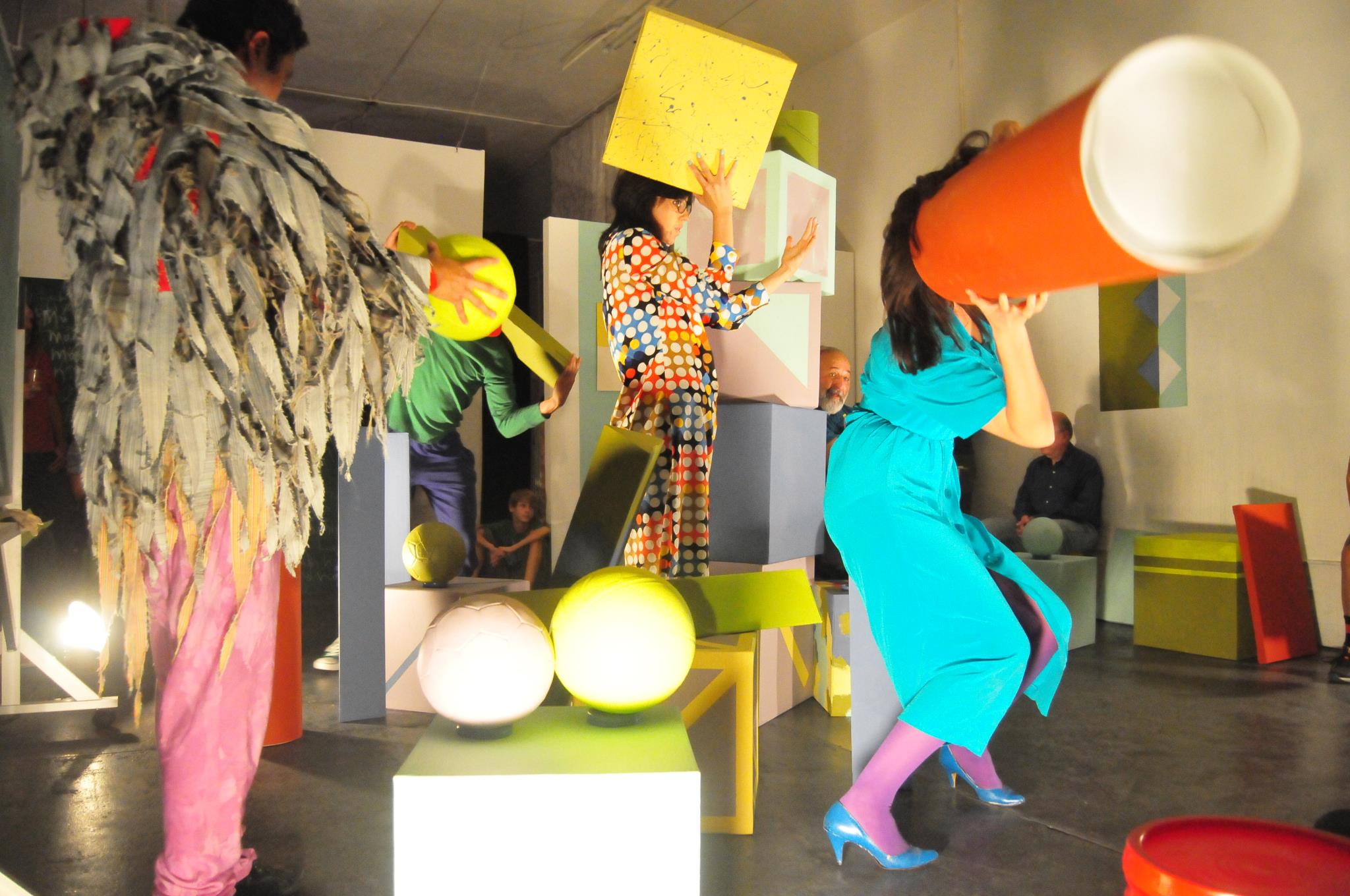
Emily Mast. B!RDBRA!N (Epilogue), 2012. Exhibition and performance as part of Public Fiction’s  Theatricality and Sets series. Photographer: Anitra Haendel.

Emily Mast. B!RDBRA!N (Epilogue), 2012; exhibition and performance as part of Public Fiction’s
Theatricality and Sets series. Photographer: Anitra Haendel.

From the start, I was struck with a sense of perpetual rehearsal for a performance that never comes. Installations by KCHUNG and Public Fiction were the first I encountered, and both were primed for potential action that had either already passed or not yet begun. KCHUNG, an indie radio station run by an artist collective, had set up a broadcast booth, but no information about programming was made available. Public Fiction had locked their space and labeled the outside, leading visitors to fumble in surprise when the normally accessible gallery space refused them entry. While such hiccups may be characteristic of large institutions’ difficulties in interpreting performative practices for audiences, this initial experience set an antagonistic tone.

Read More »

Share

From the Archives

From the Archives – Enrique Metinides: Chronicling Catastrophe

Today from the DS archives, we bring you Allegra Kirkland’s review of Chronicling Catastrophe. Originally published on February 26, 2013, this article is a consideration of Enrique Metinides‘ fifty-year-long career in chronicling disasters that are, in Kirkland’s words, “anonymous crime [scenes] and hauntingly specific [tragedies].” Unfortunately, these images, and ones like them, are ever-relevant in our violent, modern world.

Enrique Metinides. Mexico City, September 19, 1985; photograph. Courtesy 212berlin

The journalistic expression “If it bleeds, it leads” is particularly resonant in Mexico, where an entire subgenre of daily tabloids, devoted to crime and disaster, cover train wrecks and murders in lurid detail. Enrique Metinides made a career as a crime photographer for these nota roja (“bloody news”), earning the sobriquet the “Mexican Weegee” for his obsessive chronicling of accidents and crime scenes throughout Mexico City from the early 1940s through the 1990s.

In 101 Tragedies of Enrique Metinides, currently on view at Chelsea’s Aperture Gallery, Metinides selects his favorite images from his fifty-year career, drawn from an eponymous book made in collaboration with filmmaker Tricia Ziff. The photographs are gruesome and disturbing, but also beautifully composed and compelling in their narrative complexity. In the introduction, Metinides remarks, “I would try to capture the whole scene in a single frame—not just the corpse or the weapon, but the entire story.” His self-contained photos, which resemble film stills, make the case that the horrors of daily life are both stranger and darker than fiction.

Read More »

Share

Los Angeles

Odyssey Odyssey

Today we bring you Machine Project’s video documentation of Odyssey Odyssey, a play by artist and writer Johanna KozmaOdyssey Odyssey is a contemporary take on Homer’s Odyssey, performed for an audience of two in a Honda Odyssey. This work was included in The Machine Project Field Guide to L.A. Architecture, as part of Pacific Standard Time Presents: Modern Architecture in L.A., and originally performed from July 10–22, 2013.


Share

San Francisco

Artist Project: Live Radio Auction

From our partners at Art Practical, today we bring you Live Radio Auction, a project by Wonderment Consortium—the artist team of Packard Jennings, Steuart Pittman, and Scott Vermeire. This essay was commissioned by guest editor Jonn Herschend as part of Issue 5.5, Slapstick and the Sublime, and originally published on July 10, 2014.

Live Radio Auction appropriates a format from rural American radio stations in which the DJ auctions items over the airwaves and the public calls in to bid on the objects as a way of raising funds for the radio station. In rural America, the items auctioned are usually intended to be desirable and are donated by local businesses. Live Radio Auction bends that idea by harvesting the auction items from a local thrift store, the East Bay Depot for Creative Reuse, with a keen eye set to the ordinary, the obsolete, and the nearly valueless objects one might find, like used shoes, damaged cookware, or a fire extinguisher in need of a refill—the detritus of our long-forgotten yesterday. All proceeds from the auction go to the thrift store.

The auction is a slow burn. Sitting in a booth, the DJs look at a pile of objects and slowly, endlessly describe them over the airwaves to their audience. Sometimes people call and bid; sometimes they don’t. Either way, the DJs are left to describe a rug as best as they can: its feel, its color, its shape, its size, its application. They might discuss suitable placements or purposes for the object, or times and experiences in their lives in which a similar object might have been an accessory to a memory, just filling time with words, seemingly endless words, describing something the audience can see only in their mind’s eye, much like a very boring baseball game heard over the air. Except that instead of a game, it’s a desk lamp, lightly used, with a starting bid of two dollars.

Read the full article and listen to Live Radio Auction here.

Share

Toronto

Francis Bacon and Henry Moore: Terror and Beauty at the Art Gallery of Ontario

Francis Bacon and Henry Moore are known for producing curvilinear compositions and contorted human forms that often double back upon and swoop around themselves. In contrast, the Art Gallery of Ontario’s dual retrospective of the artists, titled Terror and Beauty, takes a distinctly linear approach. Passing over divergent biographical information about the artists (such as that Henry Moore was the son of a coal miner from northern England, while Francis Bacon was born to prosperous English parents living in Ireland), the exhibition aims above all to illuminate how a shared historical and cultural context, which included the World Wars and the milieu of economic austerity that followed, proved formative to the development of the artists’ signature styles. In doing so, the show highlights similarities in Moore’s and Bacon’s works that are often overlooked by accounts that dwell on the fact that Moore worked in sculpture and Bacon in painting.

Francis Bacon. Lying Figure in a Mirror, 1971; 
oil on canvas; 
198.5 x 147.5 cm
. Museo de Bellas Artes Bilbao 
© Estate of Francis Bacon / SODRAC (2013)

Francis Bacon. Lying Figure in a Mirror, 1971; 
oil on canvas; 
198.5 x 147.5 cm
. Museo de Bellas Artes Bilbao 
© Estate of Francis Bacon / SODRAC (2013).

Many of the works in Terror and Beauty were on view earlier this year at the Ashmolean Museum of Art and Archaeology at the University of Oxford as part of an exhibition titled Francis Bacon/Henry Moore: Flesh and Bone. While the collaboration between the British institution and the Art Gallery of Ontario (AGO) indicates a shared interest in underscoring the links between these two artists, the two museums seem to project slightly different narratives. Whereas the Ashmolean exhibition begins with the characterization “…these two great figurative artists whose careers have rarely been linked until now,” positioning the exhibition as a novel curatorial statement, the AGO forthrightly undercuts such an assertion with a large-scale timeline on the wall of the first gallery that maps when and where the artists were born, trained, exhibited, and died. At a glance, this timeline may seem to chart more divergence than overlap between the artists. Yet, as a viewer wades through the copious information on display, points of convergence and interlock emerge—some in the form of major global events like the Blitz in London, which both artists endured, and others more intimate, like group exhibitions that happened to include works by both artists. Indeed, the number of times that Bacon’s and Moore’s works have been exhibited together reinforces the notion that the two were in fact involved in a longstanding artistic conversation, of which this exhibition is only the latest and most explicit chapter.

Read More »

Share

Los Angeles

Yvonne Rainer: Dances and Films at the Getty Center

Contained within two rooms at the Getty Center is a lifetime’s work by conceptual art, dance, and film pioneer Yvonne Rainer. Dances and Films showcases the Getty’s complete archive of Rainer’s work—with journals, photographs, sketches, choreographic notation, films of performances, and a complete retrospective of her avant-garde films. In our contemporary world, where performance art (and art in general) is dominated by celebrity and personality, it is a welcome change to see that there are other ways of making art that do not rely so heavily on self-consciously contrived personae or the artist as celebrity. If anything, Rainer’s works strive to erase individual personality and her own charisma in favor of communication about a humanity that lies deeper than ego.

Yvonne Rainer. Rehearsal for Parts of Some Sextets, 1965, Gelatin silver print, 23.5 x 20.5 cm. The Getty Research Institute. Photo: Al Giese.

Yvonne Rainer. Rehearsal for Parts of Some Sextets, 1965; gelatin silver print; 23.5 x 20.5 cm. The Getty Research Institute. Photo: Al Giese.

Rainer studied under Martha Graham and Merce Cunningham before creating her own choreography, and was a founding member of the experimental and influential Judson Dance Theater in New York in the early 1960s. The show begins with a 1966 article on Rainer from the New York Post titled “Rebellion in the Arts,” published after her Parts of Some Sextets (1965), a performance that involved ten dancers and mattresses and a lot of “pedestrian” movements, or movements that come very naturally to a human being: running, jumping, falling, and walking. The Getty presents photographs of rehearsals and the performance, as well as Rainer’s own writings on the piece that include complicated lists and movement diagrams. The dancers did not have music to guide their rhythms, and learning the dance was incredibly difficult—Rainer wrote that some dancers “ended up memorizing [the steps] by rote, like multiplication tables or dates in history.” Of the piece, she said she “wanted it to remain undynamic movement, no rhythm, no emphasis, no tension, no relaxation. You just do it, with the coordination of a pro and the non-definition of an amateur.” She was trying to remove all personal affectation or theatricality from the work and let the human body move on its own. The next year she created her most famous work, Trio A (The Mind Is a Muscle, Part II) (1966), of which there is a looped video of Rainer performing the entire piece, one steady flow of movements.

Read More »

Share

New York

Daughter of Bad Girls at Klaus von Nichtssagend

When asked why she had sculpted such pronounced, sugar-coated labia on A Subtlety, the mammy-sphinx recently on view at the Domino Sugar Factory in Brooklyn, Kara Walker answered, “[It’s about] ownership of the voluptuousness of an ass”; “a 10-foot vagina…is not something that happens in art often enough”; and “[It was] a fuck-you, I’m gonna do that because this is what I have…there are enough phallic symbols in the world…” Visitors to Daughter of Bad Girls—a new exhibition at Klaus von Nichtssagend Gallery that positions seven contemporary artists as heirs to the fierce femmes that appeared in Marcia Tucker’s 1994 exhibition, Bad Girls, at the New Museum and Bad Girls West, its sister exhibition at the Hammer Museum in L.A. (then UCLA’s Wight Art Gallery)—are, a little disappointingly, greeted not by the vagina but by two phallic lacquer-and-ceramic sculptures of genetically manipulated Roma tomatoes by Jessica Rath. As glossy and fecund-looking as they are, these two sleek red forms give the male part undue emphasis in the small gallery space. Not all of the works in Daughter of Bad Girls go so far astray, but on the whole the exhibition cannot help but pale in comparison to the potent era of third-wave feminist art that it invokes.

Ridykeulous. The Advantages of Being a Lesbian Woman Artist, 2007; silkscreen on newsprint. Courtesy of Klaus Von Nichtssagend Gallery

Ridykeulous. The Advantages of Being a Lesbian Woman Artist, 2007; silkscreen on newsprint. Courtesy of Klaus von Nichtssagend Gallery.

Turning polite, palatable “feminine” behavior on its head with rebellious, even anarchist abandon, Daughter of Bad Girls aims to pick up where predecessors like Riot Grrrls and Kathe Burkhart left off. Xaviera Simmons, in a large-scale photographic self-portrait, presents herself sprawled horizontally on a striped picnic rug, masturbating in broad daylight. The noisy collaborative duo Ridykeulous, made up of A.L. Steiner and Nicole Eisenman, defaces a printed copy of the Guerrilla Girls’ famous poster The Advantages of Being a Woman Artist (1989), which laid out in stark terms the appalling state of female representation in the visual arts. Eighteen years on, Ridykeulous’s brazen revision of this key text, The Advantages of Being a Lesbian Woman Artist (2007), suggests feminist offspring unafraid of cannibalizing their revolutionary forebears. According to Ridykeulous’ vandalizing scribbles, “Working without the pressure of success” becomes “Working without the pressure of sucking dick.” Read More »

Share




