From the Archives
From the Archives – #Hashtags: Georgia Sagri is otherwise occupied
Three years ago this week, Occupy protests had spread to over 851 cities in 82 countries. Today from our archives we bring you a look back at Carol Cheh’s consideration of Georgia Sagri’s practice in relation to the Occupy movement. Cheh reminds us: “The real point of Occupy, after all, was to occupy oneself and one’s own actions, to keep seeking ways out of the status quo, and to find solidarity in community, in momentary interactions, and in history.” This article was originally published on May 6, 2013.

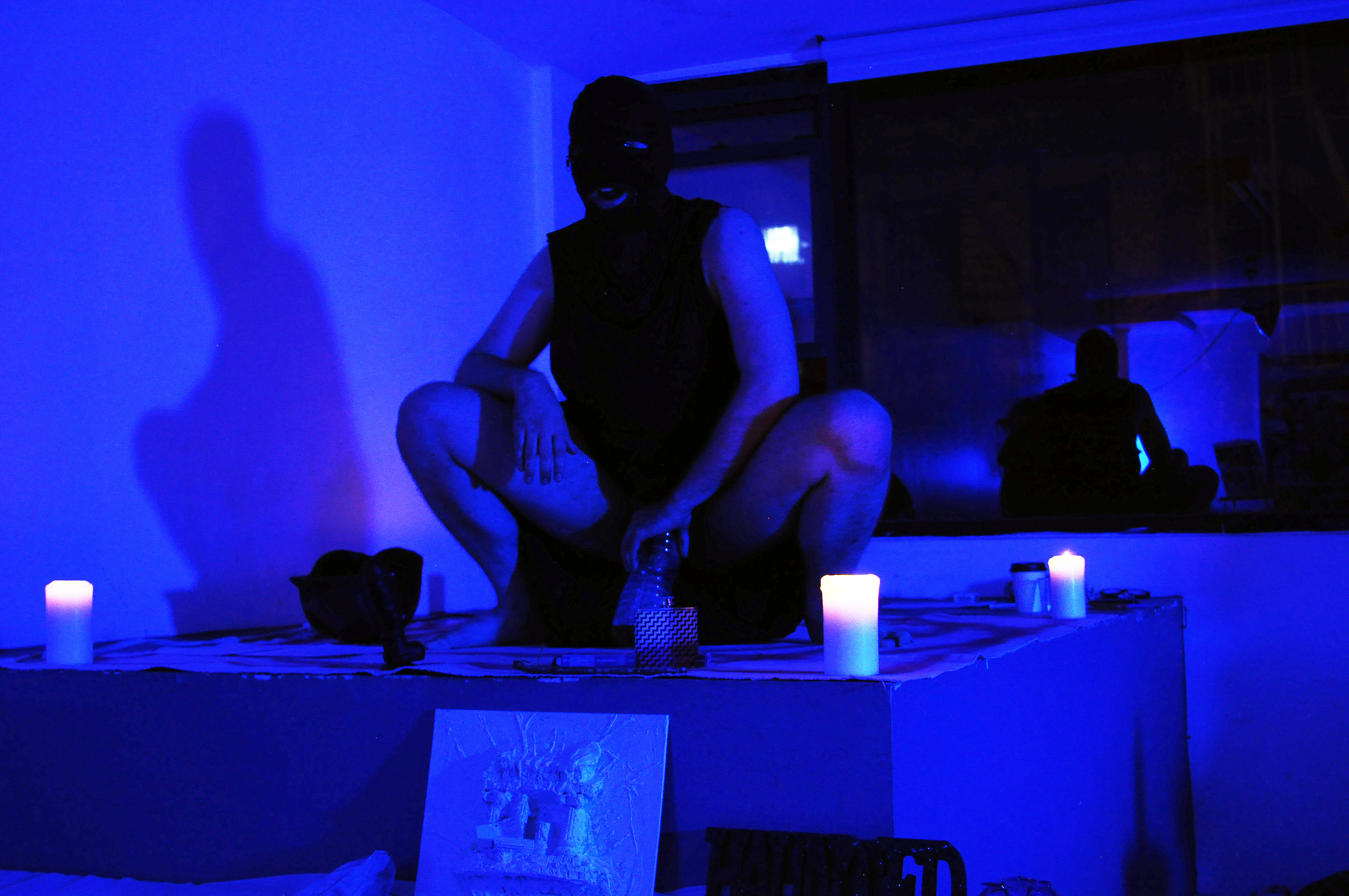
Georgia Sagri. Working the no work/Travaillez je ne travaille pas/Δουλεύοντας τη μη δουλειά, 2012; performance at the Whitney Museum of American Art, New York. Courtesy of the Artist and Melas Papadopoulos, Athens. Copyright Georgia Sagri. Photo: Paula Court.
In the prelude to his book The Triumph of Anti-Art, Thomas McEvilley held up the Greek philosopher Diogenes of Sinope, founder of the School of Cynics, as a prototypical conceptual and performance artist who strove to break down the barriers separating philosophy and life. Through numerous absurdist gestures and lifestyle choices, passed down to us as fragmentary anecdotes (such as the one that has him giving an entire public speech in the form of laughter), Diogenes performed his philosophy daily in an effort to “[reverse] all familiar values” and “[lay] bare a dimension of hidden possibilities which he thought might constitute personal freedom.” According to legend, Diogenes even lived inside of a large jar in the Athenian marketplace and ate onions and figs that he picked himself.
The Greek-born artist Georgia Sagri—an early participant in the Occupy Wall Street movement who was cited by Time magazine as playing an influential role in shaping its philosophy—often mentions Diogenes when discussing her own work. “He represented a rupture of the academy, of the official language of thought,” she reflected in a recent phone interview I conducted with her. “To him, there was no inside or outside—he simply lived everywhere. And the Cynics didn’t just talk, they activated their philosophy. This territory of thought was abandoned in favor of the dominant rational discourse of Plato and Aristotle, whose dialectic we still live with today.”