Help Desk
Help Desk: Ghost in the Art Writing Machine
Help Desk is an arts-advice column that demystifies practices for artists, writers, curators, collectors, patrons, and the general public. Submit your questions anonymously here. All submissions become the property of Daily Serving.
I’m a young curator and an arts writer with a museum job, but like everyone in the world, I can always use extra money. I’ve been approached before about “ghostwriting” for more established curators who get asked to write catalog essays for galleries and small exhibition projects. In general, I feel weird but not too weird about this—after all, I like the practice and the opportunity to think about an artist’s work that I might not otherwise consider or know of. Oftentimes, it’s not work I’ve seen, and my main point of contact with it is via the internet and whatever the gallery can send, which is in and of itself a problem. I guess my question is two-pronged. On the one hand it’s an ethical quandry: I’ve done a few of these now, and I appreciate the practice and the cash, but sometimes I feel odd about the whole masquerade (though not as odd as other people seem to; I guess that’s the money talking). On the other hand, it’s practical: as someone building a writing career, I would like to indicate these projects somehow on my CV, but of course if someone wanted to actually look, they wouldn’t find my name associated in the subsequent print publications, etc. What are your thoughts?

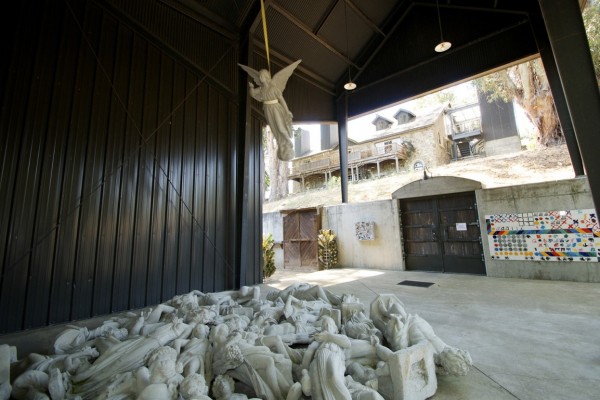
Pierre Huyghe. The Host and the Cloud, 2009-2010. Museum Ludwig, Cologne.
Let me run this down very simply: Your questions are, “Is this practice unethical?” and “Can I find a way to claim this on my CV?” My answers are a correspondingly straightforward yes and no, respectively. But let’s explore this matter, and its potential consequences, in more detail.
To be honest, I was shocked by your dilemma—fifteen years in the art world, and I’d never heard of such a thing! To me, a curator is someone who loves art and artists so much that he or she would not perpetrate a fraud in order to avoid writing about them. Wide-eyed and scandalized, I emailed quite a few friends and acquaintances to see if they shared my amazement; most respondents did. One of them, a curator who has had a long career with many institutional appointments, told me, “Your email makes me feel naïve, as I’ve never heard of such a practice. The honorarium for a catalog essay is so modest I can’t imagine how this could be lucrative for both the curator and the ghost, but that’s a different question. Taking inspiration from “The Ethicist” in the New York Times, I’d say your writer is a professional cheat and liar who is asking for your blessing to deceive the commissioner of the writing, and the public that reads the piece believing it to be the work of a noted writer, and to get paid for it, and to get credit for it. To use a word that has migrated from Yiddish to English, that’s chutzpah.” These are perhaps stronger words than I would have used, but the basic sentiment is the same: You can have the money, or you can have a clean conscience and a decent CV, but not both.