Help Desk

Help Desk: Participatory Project

Help Desk is an arts-advice column that demystifies practices for artists, writers, curators, collectors, patrons, and the general public. Submit your questions anonymously here. All submissions become the property of Daily Serving.

I’m an artist working with a poor family on a participatory project at a local museum. They are Latino. The project is about their perceptions of art. Who might I talk to or where might I look for similar projects, or even guidance on working with this population? I’m not Latino or poor (or low-income, opinions vary widely on terminology).

Joav BarEl. Installation view of Center of the World, 2014 at Tempo Rubato Gallery, Tel Aviv.

Joav BarEl. Center of the World, 2014; installation view, Tempo Rubato Gallery, Tel Aviv.

The Thanksgiving holiday is just behind us, but I want to begin by stating my sincere appreciation for this question, because it supplied me with the opportunity to contact some of the most generous people in the Western Hemisphere. Given the events of the last few weeks, the following warm and thoughtful responses are especially welcome right now, and it’s the right time (is there ever a wrong time?) to be talking about socially aware art projects and communication between groups of people.

Because of his extensive practice and his knowledge of working within institutions, it seemed only right to reach out to Pablo Helguera first. This is his response:

“I think this artist would be best served by working with the education department of that museum—usually people in the education department are professionally trained to work with various groups of people, and regularly do outreach and other programs that involve them in a conversation about art. But first the artist perhaps needs to define the goals for this project, and exactly the kind of participation he/she is aspiring to get. Second, if the project is about [the family’s] perceptions of art, there are an infinite amount of programs that involve communities in that. The artist would need to determine why or how this is not an education program versus a socially engaged art project (i.e., Is the family going to learn something about the museum, or is this artist going to work with them to develop a new project?). Depending on what this artist is hoping to achieve, there are many successful programs at other museums that may be of interest, such as SFMOMA, Queens Museum, etc. Not being ‘Latino or poor,’ as this artist says, should not be a limitation if one is working as a professional in the field. It is more about the recognition of difference and how this is communicated that matters.”

Read More »

Share

Shotgun Reviews

José León Cerrillo and Ilja Karilampi at Kiria Koula

Shotgun Reviews are an open forum where we invite the international art community to contribute timely, short-format responses to an exhibition or event. If you are interested in submitting a Shotgun Review, please click this link for more information. In this Shotgun Review, Marion Cousin reviews  José León Cerrillo and Ilja Karilampi at Kiria Koula in San Francisco.

José León Cerrillo and Ilja Karilampi, 2014; installation view, Kiria Koula, San Francisco. Courtesy of the Artists and Kiria Koula.

José León Cerrillo and Ilja Karilampi, 2014; installation view, Kiria Koula, San Francisco. Courtesy of the Artists and Kiria Koula.

Founded by Colombian curator Juana Berrío and Mexican duo Leticia Vilalta and Rodrigo Peñafiel, the new Mission district art space Kiria Koula is both a gallery and bookstore. With two distinct platforms, Kiria Koula’s focus on contemporary art and critical research charts new territory. Kiria Koula’s debut exhibition features works by Mexican artist José León Cerrillo and Swedish artist Ilja Karilampi.

Read More »

Share

Interviews

Interview with Asha Schechter

From our friends at Kadist Art Foundation in San Francisco, today we bring you a conversation between artist Asha Schechter and Kadist’s director of collections, Devon Bella. This unique interview also features an animation by Yashar Tabari underscoring Schechter’s discussion of “the simultaneity of images… You can’t really see one image without seeing another.”

Share

Seattle

Ann Hamilton: The Common S E N S E at Henry Art Gallery

I was instantly drawn to the Siberian Rubythroat. It must have been the vibrant red flash of exposed underbelly that first caught my eye, but it was the bird’s placement that focused my attention, a diminutive creature adrift in a mauve fog. The Rubythroat is just one of 200 animal specimens that have been scanned, printed in multiple, and hung in a mosaic of thick newsprint pads covering the Henry Art Gallery’s walls. Amid the mashed fur pelts and abstracted hoofs, claws, and beaks of the unruly ecosystem on view, something about the Rubythroat’s smallness—a ghostly thing to be cradled in hand—compelled me to reach up, take tentative hold, and slowly tear the bird’s portrait down from the wall.

Ann Hamilton, the common S E N S E, 2014, courtesy of Henry Art Gallery, Seattle. Photo: Jonathan Vanderweit.

Ann Hamilton. The Common S E N S E, 2014. Courtesy of Henry Art Gallery, Seattle. Photo: Jonathan Vanderweit.

This exhibition by Ann Hamilton, The Common S E N S E, is a constellation of objects, images, textures, and sounds—a multisensory splendor that invites visitors to look, touch, and listen as they wind circuitously through the museum’s galleries and halls. The menagerie is just a single component to Hamilton’s multifaceted production. The exhibition weaves text and textile, fur and fashion, in a way that facilitates new encounters with common things. The installation plays with the conventions of museum display, going beyond simply upending expected narratives to address the audience and promote tactile participation as a generative aspect of the work. Hamilton explores the intimacy achieved through collectivity, provoking viewers to reexamine the familiar and question how it feels—how we feel—to exist in the world.

Read More »

Share

New York

Ayana V. Jackson: Archival Impulse at 33 Orchard

Ayana V. Jackson’s exhibition An Archival Impulse claims to take inspiration from Hal Foster’s idea that, through confronting the archive, new systems of knowledge can be created. Jackson’s artistic interrogation targets representations of non-European bodies during the 19th and 20th centuries, a period of significant colonial expansion in Africa and the Americas. This history of representation comprises a vast field of imagery and thousands of individual archives with their own particular contexts, intentions, and circulations. Jackson specifically refers to the Duggan-Cronin collection in South Africa, a series of ethnographic photos by the Irish-born photographer Alfred Martin Duggan-Cronin, who first began documentation of native South Africans when they were laboring in a De Beers mine where he had taken a job as a security guard.[1] Other sources cited in the exhibition text include the imagery of nonwhite people who were forced to perform their so-called primitive lifestyles in the human zoos that toured Europe, as well as a more generalized body of images by anonymous photographers who pictured inhabitants of the global south.

Ayana V. Jackson. What will you tell them about me? / Do you feel pain?, 2013; archival pigment print; edition of 6 and 3 artist proofs; 39 x 65.6 in.

Ayana V. Jackson. What Will You Tell Them About Me?/Do You Feel Pain?, 2013; archival pigment print; edition of 6 and 3 artist proofs; 39 x 65.6 in.

From these wide-ranging provenances, Jackson selects recurring themes and reconstructs portraits with herself cast as every subject, enabling her black body to perform again the tropes and motifs that plague the broad history of depictions of people of color. One formal intervention that provides cohesion between the images is the refusal to integrate subject and setting. In some portraits, backgrounds are simply a white or gray tone, with no surrounding detail to ground the central figures. Other photographs layer an image of the artist’s body over a negative print of the environment, revealing the image’s inherent digital fabrication and invalidating any interpretation of it as truth or authentic record. This choice asserts a potent commonality among historical images that presumed to document nonwhite bodies: They were largely staged by white photographers to reinforce their own perceptions of people of color. The through line of Archival Impulse thus arises as an investigation into the fetishizations of otherness born from the white European psyche and how this outlook has shaped ethnographic photography, portraiture, and broader visual culture.

Read More »

Share

Los Angeles

Burning Down the House at Pasadena Museum of California Art

A woman in a long skirt spins dervishly against a mauve background while a wooden sculptural lamp in the shape of an embracing couple dominates the foreground. A man with two faces simultaneously laughs and cries behind a potted houseplant. The scene of a one-night stand is recorded in minute detail in the Polaroids left by a bed. Two clay women battle over a chintzy trophy. This is just the entryway of Burning Down the House at the Pasadena Museum of California Art, a show featuring the work of Ellen Brooks, Jo Ann Callis, and Eileen Cowin—three California artists active since the 1970s whose work combines photography, dramatic staging, and storytelling techniques in order to contemplate or deconstruct traditional narratives involving familial relationships and gender roles.

Jo Ann Callis. Salt, Pepper, Fire, 1980; dye transfer print; 22 ½ x 17 ½ in. Courtesy of the Artist.

Jo Ann Callis. Salt, Pepper, Fire, 1980; dye transfer print; 22 ½ x 17 ½ in. Courtesy of the Artist and Rose Gallery.

Jo Ann Callis’ work is both silent and violent. She sets a calm scene in a domestic space and upsets it with dramatic lighting or a blur of motion. In one alarming image, Hands on Ankles (1796–77), a woman stands on a dining-room chair in designer pumps—we can see her only from the knee down—as a man’s hands grab her ankles through the chair back, from behind. This may be the most literal of her photographs, a rare interaction between two figures depicting the power struggle inherent in domestic life and the complicated relationships between men and women. Salt, Pepper, Fire (1980) is an odd table setting with salt, pepper, black coffee, and a flaming plate. The salt and pepper shakers are our protagonists, lit to be the bystanders witnessing this inexplicable fire; the smoke rising from the fire resembles a bird in flight. Callis is a master of manipulating light for dramatic effect; her photographs use light so skillfully and unnaturally that they could be paintings.

Read More »

Share

Los Angeles

Saying Yes to Everything at Honor Fraser

Saying Yes to Everything, an exhibition featuring nineteen artists working in collage, recently opened at Honor Fraser Gallery in Los Angeles. On display are a range of works made between 1960 and the present day by both established and emerging artists. The title is a commentary on the essential inclusivity of collage. But understanding the medium’s place in art history can help the viewer appreciate the form. Collage surfaced with modernism in the 20th century, in the wake of the horrors of World War II—the Holocaust, strategic bombings, nuclear warfare—resulting in a fragmentation of consciousness and a loss of sense or meaning.

Anything is permissible in collage, and multiple mediums like paint, paper cutouts, and found objects collide on and with the surface plane. The very selection and composition of incongruous materials reveals an attempt at order and meaning. In Saying Yes to Everything, source materials include glitter dollar signs, gold chain, penciled math problems, a rusted comb, comic-book cutouts, and a vintage stamp booklet cover. The boundaries of the medium are limitless, and therefore democratizing.

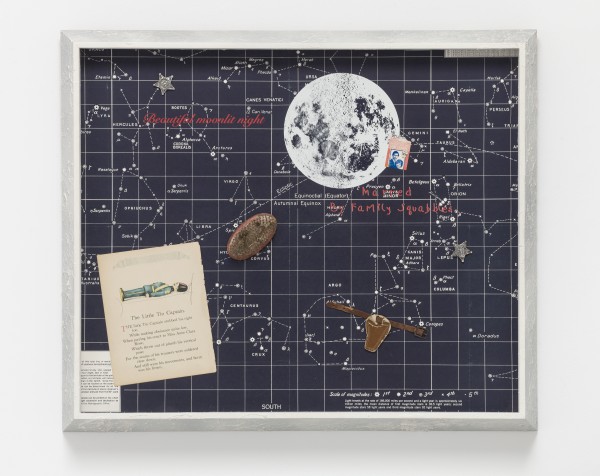
Alexis Smith. Kerouac Haiku, 1994; mixed media collage; 27 x 32 x 2 inches. Courtesy of Honor Fraser Gallery, Los Angeles. CA. Photo: Elon Schoenholz Photography.

Alexis Smith. Kerouac Haiku, 1994; mixed-media collage; 27 x 32 x 2 in. Courtesy of Honor Fraser Gallery, Los Angeles. CA. Photo: Elon Schoenholz Photography.

The exhibit opens with a narrative diorama by Alexis Smith titled Kerouac Haiku (1994), in which a chart of constellations is affixed with various childhood objects. Two deputy sheriff badges flank the moon, and with red paint, the artist complements the original title “Beautiful moonlit night” with “marred by family squabbles.” The map’s key notes the magnitude of the stars and brings attention to perhaps the distance of these memories or desires in relation to each other.

Read More »

Share