Shotgun Reviews

Raymond Pettibon: A Pen of All Work at New Museum

Shotgun Reviews are an open forum where we invite the international art community to contribute timely, short-format responses to an exhibition or event. If you are interested in submitting a Shotgun Review, please click this link for more information. In this Shotgun Review, Lux Yuting Bai reviews Raymond Pettibon: A Pen of All Work at New Museum in New York.

“Raymond Pettibon: A Pen of All Work,” 2017. New Museum, New York. Photo: Maris Hutchinson / EPW Studio

Raymond Pettibon: A Pen of All Work, 2017; installation view, New Museum, New York. Photo: Maris Hutchinson / EPW Studio.

Presenting approximately 800 drawings from the artist’s creative career since the 1970s, Raymond Pettibon: A Pen of All Work at New Museum demonstrates the artist’s obsessive relationship with language and literature in an ambivalent tone that is both darkly ironic and lovingly inspired. In his distinctive caricaturistic style, Pettibon juxtaposes figurative images with fragmented texts throughout all mediums and subject matters. The combination is consistent, despite his almost schizophrenic voices in different series, whether they are celebrating nature, mocking religions, or attacking political figures.

Pettibon’s surf drawings, the most visually captivating series in the exhibition, metaphorically embody his joyful literary fetish. The surfer, represented as a solitary hero exploring and challenging the natural sublime, evokes the Romantic ideal of a creative genius wrestling in the sea of inspiration. (Fittingly, the title of the show is a reference to a Byron poem.) Drawn in brilliant blue shades, the currents’ patterns have flowing, organic characteristics that suggest a visualization of one’s stream of consciousness, or even hints of the rhythms of poetic verse. The figures appear diminutive against the monumental waves engulfing them. The tides carry a sense of increasing velocity; the hero is nearly submerged into the swells and swirls of the blue water. The expansive images with texts allude to the artist’s cumulative, almost compulsive creative process. All of the 20,000 drawings Pettibon has made in his life are captioned; the sheer quantity and the variety of words seem to suggest a form of logorrhea.

Read More »

Share

From the Archives

From the Archives – Help Desk: Burning Bridges

Today, we bring you a Help Desk column from our archives about doing more harm than good. Bean Gilsdorf’s critique still rings true: “If your activism turns you into a celebrity but does nothing to change the brutality you supposedly decry, your innocent intentions become worse than worldly cynicism.” Submit your arts-related questions anonymously here. This article was originally published on April 30, 2012.

If an artist is attempting to call attention to a particular issue that in some way either oppresses a group of people or includes imagery of unethical actions, is their artwork also unethical if they intentionally include or use oppressive tactics or graphic images to do so?

Eva Lake. Judd Montage No. 13, 2007; photomontage; 5 ¾ x 8 in.

There is no permanent, fixed equation that we can apply to art—especially art that intends to become activism—and I’m not amenable to making an ultimate pronouncement on work that exists as a hypothetical. It’s better to be aware of the concerns surrounding art and activism in general and proffer judgments on a case-by-case basis. An artist who wishes to take an activist stance in regard to an issue must think very carefully through the problem at hand.

I contacted a few artists that are currently making work that intends to be activist, but for the first time in the brief history of this column, not one of them responded. Perhaps they were afraid to go on record regarding the conflicts and contradictions their work presents? In any case, Anuradha Vikram, Curator of the Worth Ryder Art Gallery at UC Berkeley, kindly shed some light on this matter. She asks would-be activist-artists to ponder some art-world assumptions: “When seeking to call attention to any troubling issue, one key maxim to consider is that of the physician: ‘First, do no harm.’ Too often, artists seem to mistake demonstrating a set of conditions for critiquing them. If the work is replicating unethical behaviors, what is the artist doing besides perpetuating those behaviors? Perhaps, if one assumes that the context for art is a neutral one (the proverbial ‘white cube’), then it could be argued that by isolating and framing such actions, the artist makes the critique implicitly. However, if the last forty years of art-world controversy have taught us anything, it is that ‘neutrality’ is often interchangeable with ‘privilege.’ Re-creating oppression within a space of privilege is simply oppressive. A critique needs to go farther than that, and a sophisticated critique does not need to replicate such dynamics in order to unpack them.”

Read More »

Share

Hashtags

#Hashtags: The Painting

#representation #WhitneyMuseum #EmmettTill #DanaSchutz #MartinBerger #race #civilrights

So much hinges on the question of audience. Who is presumed to engage with artwork, and on what terms? In the museum, people of color so often feel that we are not the intended audience. The hurt that we experience on realizing that disconnect—that we are here for art but art is not necessarily here for us—has now been made starkly evident by a clumsy gesture that instigated so much debate that it seems to overpower any other conversation. This is a feeling we expect to get at the Whitney Biennial on a regular basis, and it is why so many people were negatively affected simply by the image of the painting as it circulated around the internet. It’s all the more frustrating when one stands before the painting, feeling the weakness of its impact and the pull of the other artists’ works around it.

Installation view of Cauleen Smith, In the Wake, 2017. Whitney Biennial 2017, Whitney Museum of American Art, New York, March 17-June 11, 2017. Collection of the artist; courtesy Corbett vs. Dempsey, Chicago, and Kate Werble Gallery, New York. Photo by the author.

Installation view of Cauleen Smith, In the Wake, 2017. Whitney Biennial 2017, Whitney Museum of American Art, New York, March 17-June 11, 2017. Collection of the artist; courtesy Corbett vs. Dempsey, Chicago, and Kate Werble Gallery, New York. Photo by the author.

Perhaps what surprises most about seeing the painting in person is how small it is. Henry Taylor’s Ancestors of Genghis Khan with Black Man on Horse (2015–2017), on the sixth-floor landing, is many times its size. Nearly obscured in a back corner of a fifth-floor gallery, the now-infamous painting of Emmett Till does not scream for attention the way Dana Schutz’s other paintings on the fifth floor do. If anything, it is not sensational enough—not visceral enough, not cruel enough to do justice to its subject. On a large and busy floor, featuring a dizzying vortex by Samara Golden, Pope L.’s oozing bologna slices, a 3D film by Anicka Yi, and works using the institution to illustrate the operations of capital, from Occupy Museums and Cameron Rowland, the painting seems an ancillary work in the curatorial argument. This is perhaps the biggest indictment, this and its utter lack of resolution. Above these galleries hang several luxurious handmade banners by Cauleen Smith. “Rage blooms within me,” they proclaim. “I am holding my breath.” “We were never meant to survive.” Maya Stovall’s four videos of public performances in the streets of Detroit hang adjacent to the painting. In them, people of color talk about their experiences and their dreams. It is possible to hear their voices while looking directly at the painting of Emmett Till.

Looking at the painting is difficult. The obvious challenge is the subject matter, and how it clashes unnervingly with the candy-like color scheme. Neo-Expressionism’s blend of grotesque and provocative subject matter, combined with the media-saturated palette of Pop Art, makes a style particularly ill-suited for rendering an image of raw horror. Certainly the effect seems facile—if not exactly glib, then more ambivalent and anxious than the subject warrants. Critics of the painting have charged that it violates an innate truth carried in the original photograph. What is that truth, and is it inviolable? Or does it shift based on its framing, what is seen and what is unseen? What does a painting of Emmett Till in his casket need to show us?

Read More »

Share

New Orleans

Cecilia Vicuña: About to Happen at Contemporary Arts Center New Orleans

For the Chilean-born visual artist, poet, and filmmaker Cecilia Vicuña, the textual and the visual exist and function together in a familial relation, as if the making of objects and the shaping of words into images are knotted together like threads, binding and weaving themselves to form reified constellations that speak of the individual and collective simultaneously.[1] Vicuña’s work has a rich engagement with the materiality of art and life. A charged awareness of historically avant-garde strategies of dematerialization runs wide and deep within Vicuña’s practice, and is emphasized expansively in the artist’s recent exhibition at Contemporary Arts Center New Orleans (CACNO), Cecilia Vicuña: About to Happen. Co-organized by Andrea Andersson, Chief Curator of the Visual Arts at the CACNO, and Professor Julia Bryan-Wilson of the University of California, Berkeley, this unique presentation of Vicuña’s multidisciplinary work opens up a wide space of reflection on the role and power of ancestral memory and aesthetic creation to engage with the urgent economic and environmental crises of our contemporary moment.

Cecilia Vicuña. Quipu Visceral, 2017; site-specific wool installation; dimensions variable. Courtesy of the Artist and the Contemporary Arts Center New Orleans. Photo: Alex Marks.

Cecilia Vicuña. Quipu Visceral, 2017; site-specific wool installation; dimensions variable. Courtesy of the Artist and the Contemporary Arts Center New Orleans. Photo: Alex Marks.

Upon entering the tall, irregular gallery spaces of CACNO, the viewer is invited to read and view simultaneously—a curatorial decision enacted most powerfully in the first juxtaposition of visual and textual representation. The viewer is greeted with the compact elegance of Vicuña’s words: “The first precarious works were not documented, they existed only for the memories of a few citizens. History, a fabric of inclusion and exclusion, did not embrace them… In the void between the two, the precarious and its non-documentation established their non-place as another reality.”[2] The text finds a visual accompaniment in the vertical installation of richly dyed streams of woolen fabric, Quipu Visceral (2017). Made of colored cotton or camelid fibers, quipus (or “talking knots”) played a crucial role in ancient Andean South American cultures as record-keeping or data-collecting devices to gather census figures, monitor tax obligations and trade payments, and mark agricultural changes in seasons; thus, they stand as a form of writing before these regions and cultures were subsumed by Spanish colonial occupation and European systems of time and representation. Vicuña’s quipu transform this ancient practice into a visual metaphor for the collisions of two competing cultures and worldviews: the Andean universe of oral communication spatialized through an embodied, nonlinear encounter with time, and the Western mapping of time through the linear, teleological unfolding of the printed word. Investing herself as the reader–writer of the quipu—the quipucamayoc, or “one that animates or gives life to the knot”—and as a full participant within the Western poetic and visual tradition, Vicuña pleads with us to reimagine and recover our lost relationship to the spatial–temporal as a way to recast our awareness of and impact upon the ecological. Weaving and threading between and within ancient and Western systems, Vicuña preserves indigenous traditions, transforming these lost ways of being in the world into urgent political tools.

Read More »

Share

Odd Jobs

Odd Jobs: Amir H. Fallah

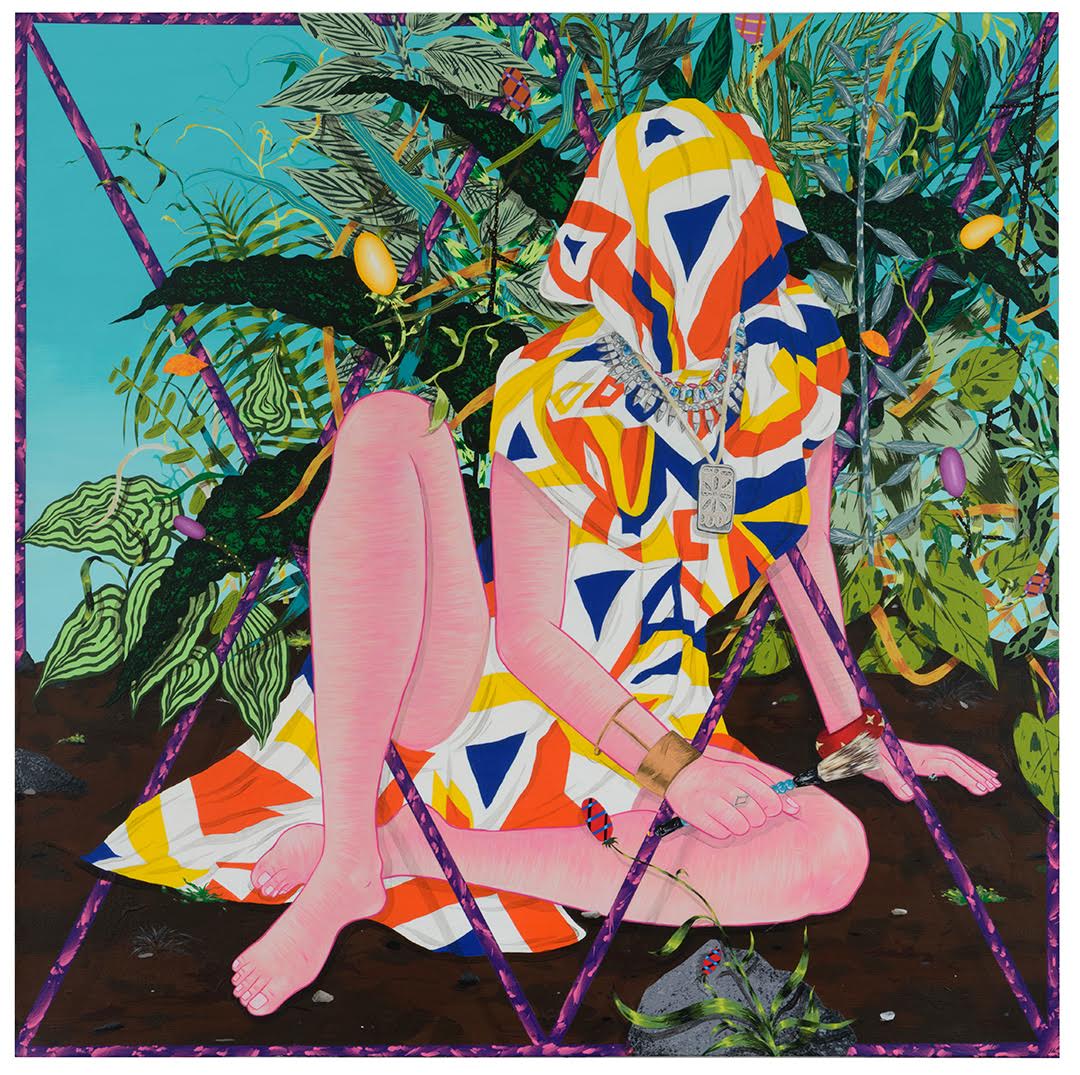
Welcome to Odd Jobs, where I interview artists about their varied and untraditional career arcs. For this installment I spoke on the telephone with Amir H. Fallah, whose work examines the conceits of portraiture, making its tropes the objects of manipulation and obfuscation. Born in Tehran, Iran, in 1979, he received his BFA from the Maryland Institute College of Art and his MFA in painting from the University of California, Los Angeles. In 2015 Fallah had a solo exhibition at the Norman Museum of Contemporary Art. He is a recipient of a Joan Mitchell Foundation Grant and was chosen to participate in the 9th Sharjah Biennial. 

Amir H. Fallah. Moment of reflection. 2016; acrylic and collage on paper mounted to canvas; 48"x48". Courtesy of the artist and Shulamit Nazarian Los Angeles.

Amir H. Fallah. Moment of Reflection, 2016; acrylic and collage on paper mounted to canvas; 48 x 48 in. Courtesy of the Artist and Shulamit Nazarian Los Angeles.

Amir H. Fallah: Being the son of immigrants, I was always interested in hustling, trying to make something out of nothing.

Calder Yates: Where did your father immigrate from?

AF: We came from Iran. We left in ’85 and got to America in ’87. We came here with $75. Now my parents live in a giant McMansion in the suburbs. I watched my dad work seventy hours a week during my childhood. People who know me know I’m a huge workaholic, and I think it’s from watching my dad. Sitting around idle… I don’t know how people do it. It’s crazy to me.

CY: I can hear you scratching something, or painting on a canvas right now in the background…?

AF: Yeah, I’m behind on a deadline.

CY: You went to MICA [Maryland Institute College of Art], right?

AF: Yeah, on the first day of orientation, they said there’s a career center with a binder that listed a bunch of jobs. I sat down with the binder and there were all these requests for murals. At first I painted all the murals myself and I was getting paid a lot. After a while I thought: Why don’t I hire my friends and bring them on to help me? It ended up working really well and it expanded. God knows if I even paid taxes on that stuff.

Read More »

Share

“No Need for Silence”: Art as Collective Address

From our sister publication Art Practical, today we bring you Deena Chalabi’s article in issue 8.3: Art Can’t Do Anything If We Don’t. This issue explores the role of art in times of crisis, and how it both succeeds and fails as a call to action and political tool. Chalabi states, “Art offers alternatives to ideas and images prepackaged for us by politicians or corporations (rarely are we encouraged to imagine new things, as a society). Art in all its forms allows the world in, and largely acts as a counter-argument to essentialist thinking.” This article was originally published on March 23, 2017.

Hank Willis Thomas. Black Righteous Space, 2012; multimedia, 01:57; dimensions variable. Courtesy of Hank Willis Thomas and Jack Shainman Gallery, New York.

Hank Willis Thomas. Black Righteous Space, 2012; multimedia; 01:57; dimensions variable. Courtesy of Hank Willis Thomas and Jack Shainman Gallery, New York.

Before I entered the world of the visual arts, I thought mostly about words. I documented what art—broadly defined to include literature, theater, and film—could do in societies all around the world where free expression was threatened.

Today I work at the intersection of contemporary art and the world beyond it, asking questions about the meaning and impact of art in public life. I consider art-making as both an imaginative practice and as a form of speech. In the current political climate, I spend even more time than usual mulling over the relationship between these two roles, wondering what art can do as public speech, and what role it can play in fostering our individual and collective imaginations. Yet, despite having the word “public” in my title, I am not always sure where my duty as a citizen of the world, and my role as a curator, intersect. On the one hand, I want to agree with those who think art shouldn’t have to be a tool for action; that art shouldn’t have to answer to anyone. On the other hand, I consider that position a luxury of those who can afford it. I need to believe art can do something.

Early last month, I went to see Raoul Peck’s documentary I Am Not Your Negro, about the work of one of my heroes, James Baldwin. The film is powerful in its entirety, both historically interesting and politically timely, but the footage of one speech struck me in particular: Baldwin is standing in a jacket and tie, surrounded by seated young White people, almost exclusively men, who listen to him politely as he delivers an eloquent and searing indictment of White supremacist thinking. Later, I scoured YouTube until I found the source: a debate from 1965 at the Cambridge Union in England with William F. Buckley, on the question: Is the American Dream at the Expense of the American Negro? “[One’s] response or reaction to that question has to depend, in effect, on where you find yourself in the world, what your sense of reality, or system of reality is,” begins Baldwin. “That is, it depends on assumptions which we hold so deeply so as to be scarcely aware of them. A White South African, or Mississippi sharecropper, or a French exile from Algeria, all have, at bottom, a system of reality… [in which] one civilization has the right to overtake and subjugate another.”[1]

Read the full article here.

Share

Shotgun Reviews

The Supreme Rifts… A Measured Propinquity at Marian Goodman Gallery

Shotgun Reviews are an open forum where we invite the international art community to contribute timely, short-format responses to an exhibition or event. If you are interested in submitting a Shotgun Review, please click this link for more information. In this Shotgun Review, Andreas Petrossiants reviews The Supreme Rifts… A Measured Propinquity at Marian Goodman Gallery in London.

Niele Toroni. Andata E Ritorno (orange), 1991; installation of four canvases, easels – imprints of No 50 brush repeated at regular distances 30 cm; 39 1/2 x 39 1/2 x 1 1/8 in (each). Courtesy  of the Artist and Marian Goodman Gallery, London. Photo: Thierry Bal.

Niele Toroni. Andata E Ritorno (Orange), 1991; installation of four canvases, easels, imprints of No. 50 brush repeated at regular distances; 39 1/2 x 39 1/2 x 1 1/8 in. each. Courtesy of the Artist and Marian Goodman Gallery, London. Photo: Thierry Bal.

In Michael Newman’s poetic text accompanying the exhibition The Supreme Rifts… A Measured Propinquity at London’s Marian Goodman Gallery, he attempts to justify the grouping of five (exclusively male) artists that, to this author, initially seemed based purely on art-world pragmatism and economic interest: Sol LeWitt, Gabriel Orozco, Gerhard Richter, Ettore Spalletti, and Niele Toroni. Might this layering of grids, cubes, and chromatic forms—displayed (for the umpteenth time) with plenty of prime white-cube space left for phenomenological shuffling—be supreme, an adjective that Newman borrows from a poem to describe the “rifts,” or spaces of discourse opened between the different works? Can it still be so, especially when so many of the works were produced last year?[1] Newman’s stream-of-consciousness explanation of the exhibition’s title does little to dissuade.

Read More »

Share