Beijing

Zhan Wang: Morph at Long March Space

Quiet, cool, and dimly lit, Long March Gallery is an ethereal sanctuary for the five sculptures of Zhan Wang’s Morph. A tall, abstract sculptural form perches on a marble pedestal in the first gallery; next to it is a large, shiny work from Zhan’s ongoing Artificial Rock series. Together they create an intriguing juxtaposition. Immediately it seems odd to view such a work inside a gallery, versus outside in a sculpture garden or in a public space (where many pieces from this series are indeed placed). Walking around the silvery polished-steel rock, my own figure morphed along with my environment, my body blurred together with the swirling grayish walls on the rock’s surface, creating a warped-looking figure whose form drew similarities to the abstract white sculpture next to me, and forming a bridge between Zhan’s two present bodies of work.

Zhan Wang. Morph, 2014-15; installation view, Long March Space, Beijing. Courtesy of the Artist and Long March Space.

Zhan Wang. Morph, 2014-15; installation view, Long March Space, Beijing. Courtesy of the Artist and Long March Space.

The environment also affected my experience of the works in the next gallery, a very spacious room so dim that the wall labels are barely legible. Track lights focus solely on three additional Morph sculptures and cast shadows on the glazed concrete floor and walls. The forms are remarkable: Their size commands veneration, the way an altar might, and each piece is an aqueous pile of abstract shapes that evokes human and animal forms, like drooping flesh blanketing bones. The smooth marble plinths beneath the sculptures evince opulence as the seductive milky material of the forms draws the viewer into their fecund folds and gatherings. Like the work of the renowned ancient Greek sculptor Polykleitos, Zhan executes marvelous, meticulous statues for Morph, the ideal beauty of which one has never seen before.

Read More »

Share

Shotgun Reviews

LOSTBOY: CORE at Betti Ono Gallery

Shotgun Reviews are an open forum where we invite the international art community to contribute timely, short-format responses to an exhibition or event. If you are interested in submitting a Shotgun Review, please click this link for more information. In this Shotgun Review, Indira Allegra reviews LOSTBOY’s solo exhibition at Betti Ono Gallery in Oakland, California.

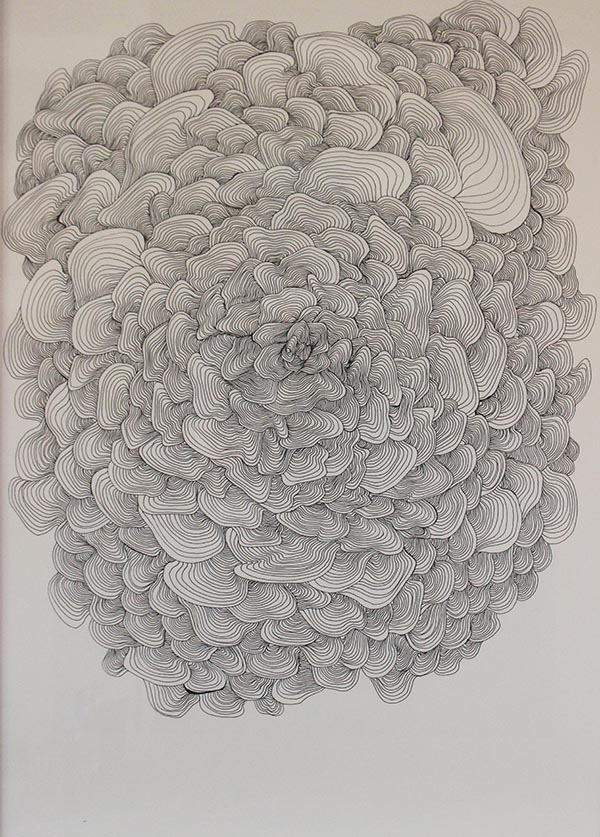
LOSTBOY. Clusters, 2014; pen on paper; 26 x 19.75 in. Courtesy of the Artist and Betti Ono Gallery, Oakland.

LOSTBOY. Clusters, 2014; pen on paper; 26 x 19.75 in. Courtesy of the Artist and Betti Ono Gallery, Oakland.

LOSTBOY’s ink-drawn organisms multiply, sometimes expressed as rhizomes across the border of the page and sometimes caught in mid-bloom around a central core. The artist returns to these strategies obsessively in drawing after drawing, with a proliferation of miniature circles, sagging topographies, marrow and lash-like figures that swell outwardly toward the viewer in the strongest works, like Clusters (2014). Where the exhibition loses its power, however, is in the installation of the drawings.

The generic black frames chosen for the works act as a blunt punctuation to the organic energies of the illustrations. The frames are heavy-handed, linear gestures in what is otherwise an organic world with nuanced line quality, creating alternating areas of excess and rupture of form. LOSTBOY misses the opportunity to let the ecosystems growing in each work merge or overtake one another. Instead of curating the tensions of nonlinear growth within each drawing, the artist seems most concerned with communicating a sense of formality about the work though the use of the frame. LOSTBOY’s linework, however, has much more to offer the viewer than this sense of formality. Read More »

Share

San Francisco

On Collecting: Building a Better Me

From our partners at Art Practical, today we bring you a look back at Christina Catherine Martinez’s essay on collections, which she calls “an arrangement of language and objects toward a social purpose… the work of fencing off some discernible patch of belonging amid the wild landscape of existence.” This article was originally published on February 6, 2014.

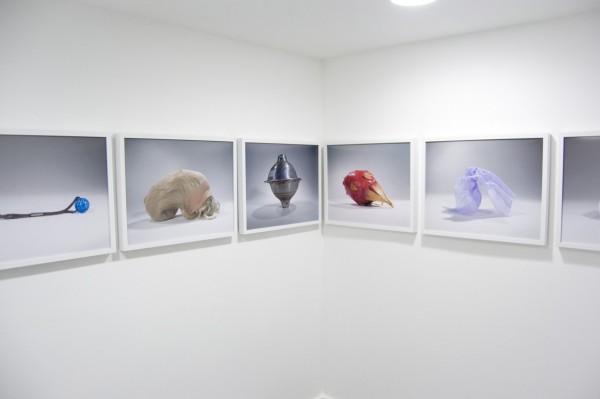
Aurora Crispin, A Selection of Everything, 2012; installation view, Important Projects, Oakland. Courtesy of Important Projects. Photo: Important Projects.

Aurora Crispin. A Selection of Everything, 2012; installation view, Important Projects, Oakland. Courtesy of Important Projects. Photo: Important Projects.

In 2005, Aurora Crispin set out to photograph every single one of her possessions, from boots to books to dust bunnies. There is a sweetness to the impossibility of her mission, even as the photos of the things themselves suggest some vague finality, like memento mori of an ever-receding present. Some things are photographed separately, some in random groups. The lighting is subdued and slightly beatific. The objects sit unperturbed in the middle of a white, seamless background like unlikely recipients of some newfound fame, rubbing their eyes in the glare of a flashbulb. There is a flaccid hair elastic, the kind with a ball at each end that guys never seem to understand how to work. Elsewhere is a used, and surprisingly beautiful, lavender-colored Kleenex, its corners splayed out azalea-like around a tight center knot concealing the dark heart of booger. The project’s title, A Selection of Everything, invites us to follow the logical thread surrounding the banality of such an arbitrary collection; anything is a selection of everything.

Read the full article here.

Share

Fan Mail

Fan Mail: Ben Bigelow

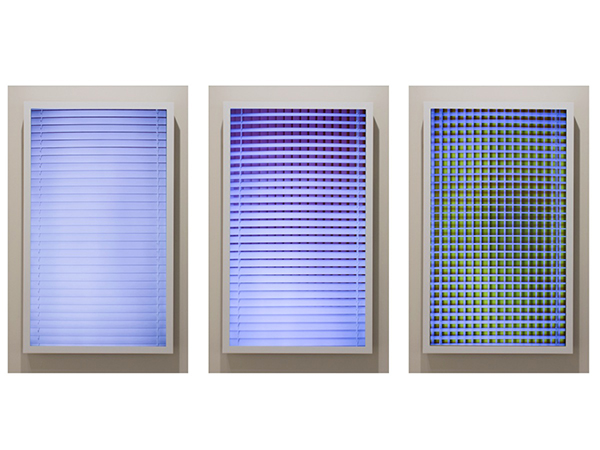
Two sets of blinds layered over each other—one horizontal, one vertical, both a brilliant clean white—open and close slowly with nearly imperceptible movement. Like a dancer spinning in an endlessly repeating circle with no clear beginning or end, they move without purpose. When fully open, they form a matrix-like grid of perfect, uniform squares with an infinite series of colors glowing beneath, shifting, chemical, and delicate. All of this takes place on a flat-panel monitor flipped on edge—a rectangle taller than it is wide, framed with white wood to hide the cold boundaries of the screen.

Ben Bigelow. Shift, 2014; generative video software, framed flat screen monitor, computer (three still images); 43 x 26 x 2.5 inches. Courtesy of the artist.

Ben Bigelow. Shift, 2014; generative video software, framed flat-screen monitor, computer (three still images); 43 x 26 x 2.5 in. Courtesy of the Artist.

In Shift (2014), a palpable tension exists among the pulsing matrix of endless colors, the shifting vertical and horizontal lines, and the flat yet sculptural qualities of the monitor. Throughout his work across media—including video, installation, sculpture, photography, and performance—artist Ben Bigelow often employs a measured tension that juxtaposes politics, humor, history, and an investigation of digital versus analog technologies.

Read More »

Share

London

Pipilotti Rist: Worry Will Vanish and Stay Stamina Stay at Hauser & Wirth

Worry Will Vanish and Stay Stamina Stay, parallel exhibitions by Pipilotti Rist at Hauser & Wirth in London and Somerset, respectively, feature footage generated during Rist’s recent residency at the gallery’s newest location in Somerset between summer 2012 and summer 2013. For material, Rist milks images from the plant life surrounding Durslade Farm, the historic Somerset compound that Hauser & Wirth has converted into gallery spaces, garden, farm, and café. Rist’s videos suggest the confluence of the micro- upon the macroscopic, like overlaid sheets of tracing paper revealing the similarities of the body, the natural world of plants, and the cosmos.

Pipilotti Rist. Worry Will Vanish Horizon, 2014 (video still); audio-video installation (video projection on two walls, carpet, blankets, with music by Heinz Rohrer); dimensions variable. Courtesy of the Artist and Hauser & Wirth London.

Pipilotti Rist. Worry Will Vanish Horizon, 2014 (video still); audio-video installation (video projection on two walls, carpet, blankets, with music by Heinz Rohrer); dimensions variable. Courtesy of the Artist and Hauser & Wirth London.

Both the works Worry Will Vanish Horizon (in London) and Mercy Garden (in Somerset) transform adjacent gallery walls into massive video theaters. In London, visitors remove their shoes before entering and are invited to lie down on soft, white floor pillows while they take in the projections. In Somerset, the invitation for a seated vista is presented in the form of locally produced sheepskin rugs.

In London, Worry Will Vanish Horizon is focused on the somatic experience. The video traces a path through what appears to be the interior of a human body lined with blood veins that morph into the veins on the backs of leaves and mapped constellations in a black sky. The vantage point of lying down lulls the viewer into a hypnotic relationship with the body in the work. Rist is informed here by autogenic training, a psychiatric technique developed by Johannes Heinrich Schultz in 1932 in which the participant views a series of images from a particular physical position in order to induce relaxation. Though this manipulation of the viewer’s body in order to produce emotional response to video is novel, the orchestration of viewing a video about the body’s arrangement in space (referencing both outer space and one’s surroundings) results in an intersection of body, flora, and nebula that comes across as didactic as it is psychedelic. It feels like a throwback to a kind of New Age awareness of one’s place in the universe: an aesthetic that is beautiful but overused, enough to seem devoid—and, indeed, it is not of the void of which it hopes to speak. The work, in its seeming eagerness to relax the viewer, oversimplifies its own ideas.

Read More »

Share

San Diego

Collective Restraint: Four Decades of Czech Photography at the Museum of Photographic Arts

Nazi Germany’s annexation of Czechoslovakian territory in 1938 ushered in five decades of nearly uninterrupted occupation and oppression for the central European country. Collective Restraint: Four Decades of Czech Photography at the Museum of Photographic Arts in San Diego features dozens of photographs from just prior to this period through the stormy 1960s. The works on display bear little immediate witness to this unstable period in the region’s history; Czech photographers from the time were often required to avoid overtly political subjects in their art, but the testimony of this history lies just beneath the surface.

Josef Sudek. Untitled, c. 1940-1954; gelatin silver print. Courtesy Jerry D. and Mary K. Gardner.

Josef Sudek. Untitled, c. 1940-1954; gelatin silver print. Courtesy of Jerry D. and Mary K. Gardner.

The photographs in the exhibition are beautiful, often eerie, and sometimes abstract. None seem to point directly to Nazi occupation and Soviet invasion. A turn toward abstract works and formal experimentation, however, represented a means of navigating censors. In this way, abstraction and the seeming lack of subject matter in many works are themselves a documentation of the political history of the time.

Photographer Josef Sudek reacted to the Nazi occupation by withdrawing from public life to the domestic sphere during World War II. One untitled photograph (dated 1940­–1954) presents a clothesline hung between two bare, wintry trees; it sags from the weight of several white garments. The photograph was taken behind a window, safely indoors, and condensation on the glass obscures the view. This pretty yet melancholic image is an indirect reference to the horrors of war and totalitarianism, which directly informed the work.

Read More »

Share

New York

The Self-Portraits of Samuel Fosso

From our friends at Guernica, today we bring you a feature on the self-portraits of artist Samuel Fosso. Author Emmanuel Iduma notes, “The self-portraits are intimate for what they allow to be imagined… [T]hese representations of our favorite black heroes ask viewers to think about the use of public images, and how they become objects of worship, and of control.” This article was originally published on November 17, 2014, but you can still catch the exhibition, which runs at the Walther Collection in New York through January 17, 2015.

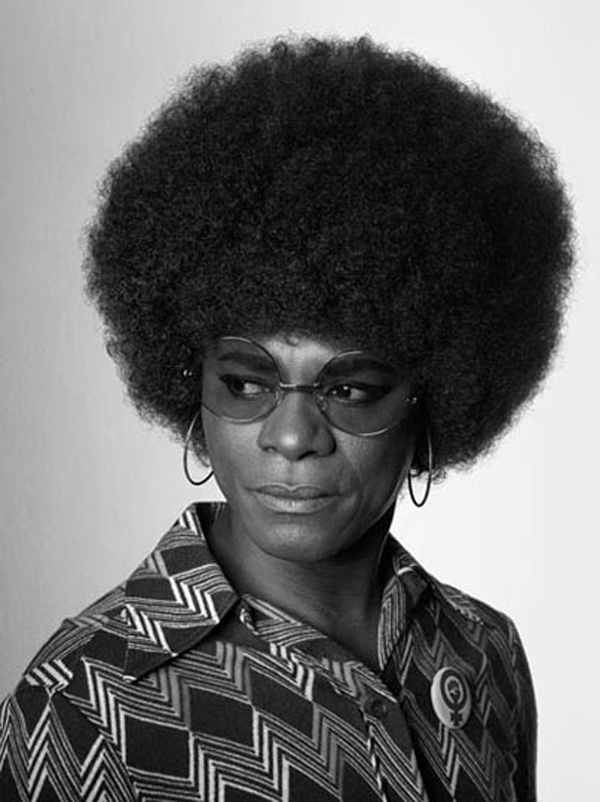
The artist as Angela Davis from African Spirits, 2008 © Samuel Fosso. Courtesy The Walther Collection and Jean Marc Patras / Galerie

Samuel Fosso. The artist as Angela Davis from African Spirits, 2008. Courtesy of the Walther Collection and Jean Marc Patras/Galerie, © Samuel Fosso.

The self-portraits of Samuel Fosso, a Cameroonian artist, are currently being exhibited at the Walther Collection in New York. Fosso began photographing himself soon after he opened his business, Studio Photo Nationale, in 1975 in Bangui, Central African Republic, at the age of thirteen. By day, he took portraits, passport photos, and wedding photographs for paying customers. By night, he experimented with self-portraiture, examining visual identity through costume, impersonation, and performance.

Entitled Samuel Fosso, the exhibition’s unspoken premise seems to be that the artist is due for a mid-career retrospective. Established by German-American collector Artur Walther, the nonprofit Walther Collection has only been public since 2010. It opened its headquarters in Neu-Ulm, Germany, adding an outpost in New York’s Chelsea district a year later. Walther has focused primarily on collecting contemporary Asian and African photography and video art, particularly around the subject of stereotype and selfhood. This exhibition is the first in the U.S. to combine Fosso’s past and present work in one show, with self-portraits alongside his studio work.

Read the full article here.

Share