Singapore

Justin Mortimer: Sevastopol at Future Perfect

Annexed by Russia in 1782 during the reign of Catherine the Great, Sevastopol became an important naval base to the Russian Black Sea Fleet only to fall decades later to allied British, French, and Turkish troops during the Crimean War (1853–56) after a long, protracted siege that lasted eleven months. During the existence of the Soviet Union, the famous fortress city was transferred to the Ukrainian Soviet Republic and remained under the control of independent Ukraine after the Soviet collapse in 1991.

Today, it is a federal city within the Crimean Federal District that has recently been the lynchpin of a struggle between Ukraine’s new leaders and those loyal to the Russian Federation. Its current political status as a de facto territory of Russia remains internationally unrecognized after a closed referendum. Often mired in territorial dispute since its founding, Sevastopol has a legacy of enduring conflict and violence.

Justin Mortimer. Nes Ziona, 2014; oil on canvas; 86 3/5 x 63 in. Photo courtesy Future Perfect Asia, Singapore, and the Artist.

It seems fitting that Sevastopol, by British artist Justin Mortimer at Future Perfect gallery, is a series of paintings examining the visual discourse of resistance where key ideas—such as dissent, protest, and the power of the individual against the state—are represented by forms that teeter between the abstract and the concrete. Mortimer’s canvases exhibit a contradictory aesthetic sensibility; they are elegant and painterly but also theatrical and distorted, driven by an unmistakable undercurrent of hostility and anger.

Read More »

Share

From the Archives

From the Archives – Archive State at the Museum of Contemporary Photography, Columbia College

Today from our archives, we bring you a (re)consideration of an exhibition about archives. Author Liz Glass analyzes the work that was on view at the Museum of Contemporary Photography in 2014 and notes, “By re-presenting these events from recent history through […] fragmentary views, the exhibition reaffirms the tension between the body politic and the individual body, while posturing toward a way of writing history that is aggregate, collective, and multi-vocal.” This article was originally published on February 27, 2014.

Akram Zaatari, Dance to the End of Love, 2011; four-channel video installation; 22 mins. Installation view at MUSAC. Courtesy the artist and Sfeir-Semler Gallery, Hamburg/Beirut.

Akram Zaatari. Dance to the End of Love, 2011; four-channel video installation; 22 mins. Installation view at MUSAC. Courtesy of the Artist and Sfeir-Semler Gallery, Hamburg/Beirut.

On view across three levels of the Museum of Contemporary Photography at Columbia College in Chicago, the exhibition Archive State presents five discrete bodies of work developed by six artists. (One of the installations is made by a duo.) Spatially expansive and ideologically packed, each of these five groups of works deserves individual attention. Likewise, the title of the exhibition itself is due some unpacking.

Using the term Archive—one that seems ever more fashionable in the contemporary art milieu—the title calls forth a ready image. We may imagine a dusty or orderly collection of papers, books, ephemera, and photographs, understanding the archive as a contained entity, one of history, knowledge, specialization, and significance; an institutional repository of the past. Archive State yanks the rug out from under this term—and us—quite quickly, however, developing an expanded notion of what “the archive” comprises within our digital culture. Here we find YouTube clips, spliced together into a tonal montage; found photographs, discarded by their originators, but now reclaimed and re-presented; and other anonymous images. The idea of the archive, as expressed through the majority of these projects, becomes nebulous. While our image of ordered knowledge quickly fades, it is replaced with a form of knowing and being that reflects our haphazard, messy, subjective, and contentious present.

Read More »

Share

San Francisco

Jean Conner: Collages at Gallery Paule Anglim

Today from our partners at Art Practical, we bring you a review of Jean Conner’s collages at Gallery Paule Anglim in San Francisco. Catch this show if you can! Author Genevieve Quick calls the artist’s work “strongly provocative” and notes, “[Conner’s] confidence and skill in selection, placement, and juxtaposition… create surprising amounts of visual play, leading to strong formal compositions and intriguing ideas.” This article was originally published on February 5, 2015.

Jean Conner. Untitled (Mother Daughter), 1980; paper collage; 13½ x 9¾ in. Courtesy of the Artist and Gallery Paule Anglim.

Jean Conner. Untitled (Mother Daughter), 1980; paper collage; 13½ x 9¾ in. Courtesy of the Artist and Gallery Paule Anglim.

At Gallery Paule Anglim, Jean Conner presents thirteen meticulously crafted collages created over an almost fifty-year period. While the world has dramatically changed in Conner’s lifetime, much remains the same: Global and spiritual themes remain relevant, as do the banality and mysteriousness of domestic spaces. Assembled from magazine pages, Conner’s collages demonstrate her striking skill in juxtaposing images in both maximalist compositions and quietly restrained works. In bringing together disparate imagery, Conner creates intriguingly enigmatic formal compositions and narratives.

In the late ‘60s and ‘70s, mass-media coverage of the first moonwalk, the Vietnam War, President Nixon’s trip to China, and more brought the world into the homes of the average Americans. Through television and magazines, the world became less distant as Americans witnessed both triumphant and horrific events. Reflective of this social context and subject matter, Conner’s Arrival of the Magi (1971) is a complex and ambitiously scaled collage. As with the biblical story of three wise men traveling with offerings to witness the birth of Jesus, Conner assembles an international range of dancing figures, gift offerings, camels, embellished royalty, religious figures, and peasants in a desert landscape. As a departure from conventional religious imagery, Conner refrains from depicting Jesus. This omission creates space for a more secular reading; magi also have historical and etymological roots in Zoroastrianism, mysticism, astrology, and magic. While the magi are typically depicted piously leaning, gesturing, or looking toward the infant Jesus, Conner uses frontally posed figures, many of which expectantly stare back at the viewer. As mass media allowed Americans to begin looking at the world, this very medium also allowed it to look back at us.

Read the full article here.

Share

Fan Mail

Fan Mail: Willie Stewart

Willie Stewart incorporates a broad range of complex, mundane, strange, and dark subject matter and cultural references into his work. His interests and references include extraterrestrials, biker gangs and punk rock groups, German artist Kurt Schwitters’s Merzbau (1931–33), Mike Kelley’s book The Uncanny, and cult films such as Lloyd Kaufman’s Toxic Avenger (1984).

Willie Stewart. The Love You Withhold is the Pain that You Carry, 2014. Installation view kijidome, Boston, MA. Courtesy of kijidome and the Artist.

Willie Stewart. The Love You Withhold is the Pain that You Carry, 2014. Installation view, kijidome, Boston. Courtesy  kijidome and the Artist.

Stewart’s sculptures, installations, videos, photographs, and photocollages are all individual works, but each piece is often part of a complex and whimsical, yet bizarre, constructed environment that spans multiple rooms and gallery spaces. Each installation feels like a film or theater set.

Stewart’s 2014 exhibition The Love You Withhold is the Pain that You Carry at kijidome (a gallery and project space in Boston) began with the image of a family posing for a portrait, the kind used for a greeting card. In the picture, an infant girl, a boy around five, and a girl of about ten are shown with their father and mother. The father has a thin beard and is wearing a ragged baseball cap over his long straight hair; the mother has a hint of a smile below the frames of her large circular glasses. As a group, they seem to be sincere in their emotions and behaviors; they appear to enact a true image of themselves as individuals and as a family.

Read More »

Share

New York

Tomi Ungerer: All in One at the Drawing Center

Tomi Ungerer: All in One, now on view at the Drawing Center, is a joyful retrospective of the artist’s career as children’s-book author, satirical cartoonist, political illustrator, and erotic artist. Sadly it’s also incredibly timely. Because though Ungerer was a beloved illustrator, he was also rejected for the explicit imagery in his political and erotic work. As we engage in a global conversation about shock and humor following the attacks on the French satirical journal Charlie Hebdo, Ungerer’s work stands out for its visual wit. But beyond his mastery as an image maker, Ungerer’s work has something to say about power—to poke fun, to take pleasure, to harm.

1.Tomi Ungerer. Eat, 1967; self‐published poster; 21 x 26-1/2 in. Courtesy of the collection of Jack Rennert, New York.

Tomi Ungerer. Eat, 1967; self‐published poster; 21 x 26-1/2 in. Courtesy of the collection of Jack Rennert, New York.

Among the most potent works on view is EAT, a 1967 poster commissioned as part of a series by Columbia University in protest of the Vietnam War. Ungerer eventually self-published the poster after it was rejected by the university for its provocative imagery, which may be no surprise: the poster depicts a caricature of an Asian man—with slanted eyes, porcine nose, and fluorescent yellow skin—force-fed by a disembodied white hand. The hand shoves a hollow-eyed Statue of Liberty into the man’s gaping mouth. Another poster, GIVE, depicts a military jet releasing bombs along with presents garnished with flamboyant pink bows. EAT is certainly the more haunting of the pair, but both hinge on the violent twist of a peacenik slogan. As is the case in many of Ungerer’s works, pleasure and pain run a parallel track.

As a visual argument, EAT is chillingly effective. Is it also racist? Or is it a critique of racism, of American colonialism in the guise of democracy? I lean toward the latter reading, but if nothing else, the work is a concise illustration of what Art Spiegelman, of Maus fame, describes as the cartoon’s unique power to, “put things in a high relief…functioning as Rorschach tests for what actually we [are] living through right now.”[1]

Read More »

Share

Room Full of Mirrors: The Dazzling Life And Legacy Of Monir Shahroudy Farmanfarmaian

Today from our friends at REORIENT, we bring you an excerpt from Nicola Baird‘s feature on the life and work of artist Monir Shahroudy Farmanfarmaian. Baird explains, “Monir’s works present a world wherein everything is moving to transformative effect.” This article was originally published on January 5, 2015; an exhibition of Monir’s works will open in New York at the Guggenheim on March 13, 2015.

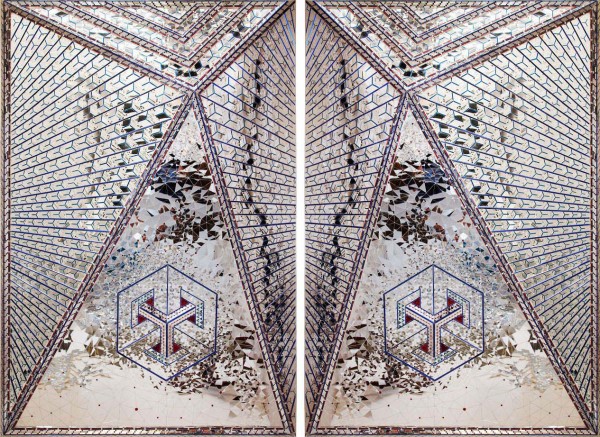
Monir. Lightning for Neda, 2009; Courtesy the Artist and The Third Line

Monir. Lightning for Neda, 2009; Courtesy the Artist and The Third Line

The artist who signs her work simply as “Monir” is a prolific and interdisciplinary figure whose 70-year-plus career is currently being celebrated in a retrospective exhibition curated by Suzanne Cotter at the Serralves Museum of Contemporary Art in Porto, Portugal. Infinite Possibility–Mirror Works and Drawings is the first museum survey of work produced by the nonagenarian between 1974 and 2014, which will also travel to other venues across the world, beginning with the Guggenheim in New York. Undoubtedly a pioneer, Monir is not only the most renowned, but perhaps also the only practitioner working today in the sphere of mirror mosaics.

Monir melds in her hypnotic hybrid creations the legacy of traditional Iranian architectural adornment with an awareness of the aesthetics of abstraction and minimalism made popular by her friends and contemporaries in New York in the 60s, such as Frank Stella and Robert Morris. The majority of the works selected have been drawn from the artist’s own collection, and have not been exhibited in public since the 70s. Included are early mirror reliefs on plaster and wood – spontaneous, energetic compositions accented with glimpses of nightingales nestling amid florid bouquets of flowers and fragments of broken Qajar paintings behind glass—and a series of large-scale geometric mirror works that formed part of a solo show organised by Denise René at her gallery in Paris in 1977. The exhibition also features previously unseen abstract arrangements on paper—many of which were made in exile in New York in the absence of a proper studio in the years following the 79 Iranian Revolution—a series of heptagonal works, four mirror balls (one of which famously lay atop Andy Warhol’s desk until his death in 1987), and a graduated ziggurat-shaped sculpture of particular architectural beauty.

Read the full article here.

Share

Los Angeles

William Binnie: Flame as Flag at Paul Loya Gallery

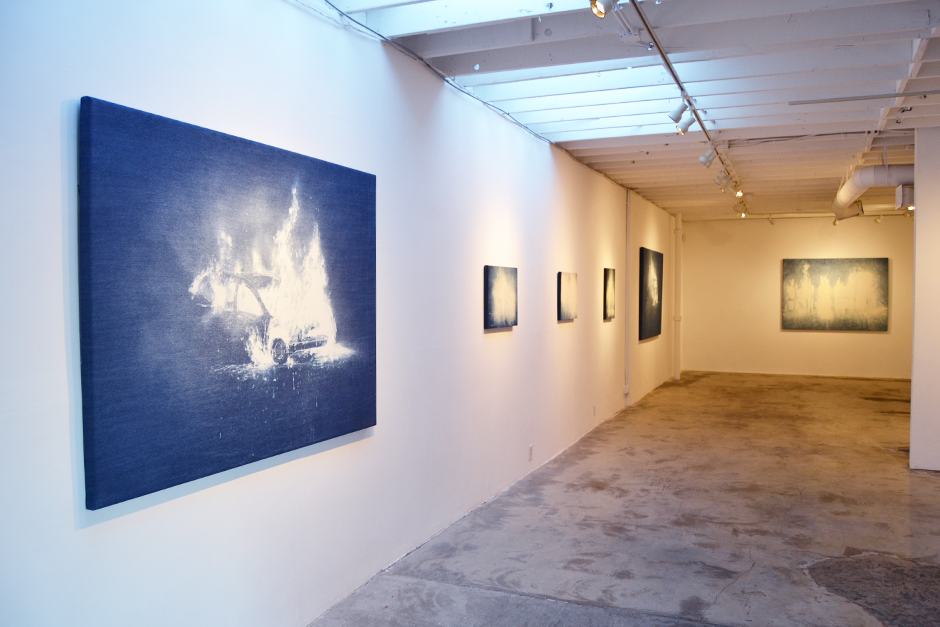
William Binnie’s exhibition at Paul Loya Gallery in Culver City emerged from a residency granted to the Dallas-based artist by the Rauschenberg Foundation in Captiva, Florida, this past summer. While there, the artist made a series of paintings in bleach on denim drawn from photographs of fires set by political radicals. Binnie’s paintings merge Rauschenberg’s photo-transfer aesthetic with Andy Warhol’s fascination with media spectacle—the grimmer, the better. Like Warhol did with his car crashes, Binnie represents destruction and death from an arm’s-length perspective. The intense fires that consume cars and buildings in his works take on a cool, ghostly affect.

William Binnie. Flame as Flag. installation view, Paul Loya Gallery.

William Binnie. Flame as Flag. installation view, Paul Loya Gallery.

Binnie draws his subject matter from documentary images of riots from around the world. His selections suggest equivalences between a car set alight by Islamists in Pakistan and a church burned by black metal enthusiasts from Sweden. If his interest is in “locating the social embedded in his chosen materials,” he seems to be identifying a global trend of disaffected subjects of all political stripes finding solidarity in acts of property destruction, rejecting both a culture of accumulation and the rule of law. The bleached cotton ranges from cool to warm tones, producing a surprisingly effective representation of the flames’ intense warmth. The materialistic architectures of the city dissolve in the glow. The best works, such as Untitled (Church) (2014), allow these structures to all but disappear. The weakest, such as A Flag (The Flag) (2012), suggest a teenage rebel’s denim jacket, long outgrown.

Read More »

Share