From the Archives

From the Archive – Help Desk: Making a Statement

Help Desk is an arts-advice column that demystifies practices for artists, writers, curators, collectors, and the general public. Submit your questions anonymously here. All submissions become the property of Daily ServingToday we’re revisiting an oldie-but-goodie; this article was originally published on July 9, 2012. 

I’m in the process of writing an artist statement for a gallery that has recently picked up my work. What makes for a really good artist statement? Ideally, I would like to write something that is approachable and easily understood by other artists, the gallery’s clientele, and the rednecks I grew up with. Any advice here would be greatly appreciated. I find myself in the position of having to write statements at least every few months, but each time it seems difficult to put into words what I’ve been trying to do, as my subject matter changes often, and I do not often write about my work.

David Hockney. A Bigger Splash, 1967; acrylic on canvas; 8 x 8 ft.

Oh, the artist statement, that reviled and maligned document! Artists loathe writing them, and it usually shows. But they’re not really that hard to create if you have a clear goal in mind. Let’s begin with your particular case. Even though your subject matter changes often, perhaps you can craft a basic short statement that fits your overall practice, and every time your subject changes you can swap out a couple of sentences as needed. That way you won’t have to start from scratch every time. If you’re not in the habit of writing regularly about your work, I encourage you to start. It doesn’t have to be anything grand, just jot the occasional phrase or sentence down in your sketchbook, or keep an “open thread” type document on your computer. That way you’ll have a grab bag of ideas to choose from when it comes time to put your work into words.

What makes a good statement? Well, it has to be readable and say something concrete and interesting about your work. When you tell me that you want your statement to be equally accessible to “other artists, the gallery’s clientele, and the rednecks I grew up with,” I worry that you’re trying to serve too many masters. Who is your audience? If your audience is mainly yokels, then by all means write a statement that will appeal to them, but otherwise, the hillbilly parlance will have to go. This statement is for the new gallery, so aim to connect their visitors and collectors to your work.

That’s not to say that you have resort to highfalutin opacity. Your statement is an introduction to your work, the what, why, and how of your practice, and pretentious language will only put your audience off. Here are some tips:

Read More »

Share

Shotgun Reviews

Jorge Méndez Blake: Topographic transferrals from the Biblioteca Nacional at MUAC

Shotgun Reviews are an open forum where we invite the international art community to contribute timely, short-format responses to an exhibition or event. If you are interested in submitting a Shotgun Review, please click this link for more information. For the next five Sundays, our Shotgun Reviews will come from the finalists for the Daily Serving/Kadist Art Foundation Writing Fellowship in Mexico City. In today’s edition, author Tania Puente reviews the work of Jorge Méndez Blake at the Museo Universitario de Arte Contemporáneo in Mexico City.

Jorge Méndez Blake. The Topographer. (Marking a Series of Points from the National Library to the University Museum of Contemporary Art), Still, 2015. Courtesy Museo Universitario de Arte Contemporáneo (MUAC).

Jorge Méndez Blake. The Topographer (Marking a Series of Points from the National Library to the University Museum of Contemporary Art), 2015 (still). Courtesy of Museo Universitario de Arte Contemporáneo (MUAC).

In this commissioned exhibition, Mexican artist Jorge Méndez Blake explores the intrinsic relationships of space, architecture, and meaning between the Museo Universitario de Arte Contemporáneo and the Biblioteca Nacional, the biggest library in Mexico, located just a few steps away. Eight artworks—including actions, books, drawings, poems, sculptures, an imaginary library model, and a video—trace a circular path with multiple outcomes. The artist plays with permanence and absence, highlights materiality, and enables metonymic processes that help the spectator grasp the importance of a 20th-century Mexican poetry collection as space, sound, and color. Unfortunately, the exhibition falls short.

Read More »

Share

Los Angeles

Matt Siegle: Eddie’s Gulch at Park View

From our friends at Contemporary Art Review Los Angeles, today we bring you a review of Matt Siegle’s solo show at Park View. Author Lindsay Preston Zappas notes, “Maybe this show would’ve been more successful as a book.” This article was originally published on May 26, 2015.

Matt Siegle. I wear denim and soiled ripstop. In the canyon I sport white athletic socks, hiking boots bought used from REI parking lot sale—no cheap Reeboks actually. My t-shirt shaded gray with lightly brassy pit stains. The sweat collects at my hairline at the top of my head. Drips the SPF 30 off the tip of my nose. Chem-UVA-UVB droplets collecting on my chest hair, slithering down my core and abdomen and each notch of my spine. With every passing sun-minute my cotton shirt clings to my torso, closely now. The shirt darkening with perspiration, through the weave of the belt and soaking the 501s, dampens my athletic compression shirts, quads, junk, grime, 2015. Acrylic on FSC-certified plasticized bags mounted to acrylic on linen; 43 x 43 in. Image courtesy of Park View and the Artist.

Matt Siegle. I wear denim and soiled ripstop. In the canyon I sport white athletic socks, hiking boots bought used from REI parking lot sale—no cheap Reeboks actually. My t-shirt shaded gray with lightly brassy pit stains. The sweat collects at my hairline at the top of my head. Drips the SPF 30 off the tip of my nose. Chem-UVA-UVB droplets collecting on my chest hair, slithering down my core and abdomen and each notch of my spine. With every passing sun-minute my cotton shirt clings to my torso, closely now. The shirt darkening with perspiration, through the weave of the belt and soaking the 501s, dampens my athletic compression shirts, quads, junk, grime, 2015; acrylic on FSC-certified plasticized bags mounted to acrylic on linen; 43 x 43 in. Courtesy of Park View and the Artist.

The wall pieces presented in Eddie’s Gulch, a new solo show by Matt Siegle at Park View, are very pretty. Crackling gray paint lies atop raw linen, evoking dried mud or creases in a palm. Floating above, sepia-toned paintings show fragments of landscape. Prop-like sculptures dot the room: a crumpled tarp, a milk crate, and a small and minimal tent structure. The works are quiet and studied.

And then you find the slide list.

Stashed in Park View’s kitchen next to sparking wine and empty cans of Tecate, the list of titles is key. Here, the reader is given a complex narration that the paintings alone could never provide. Paragraph-long titles are erotic novellas about modern-day gold miners working, sweating, and lusting. These stories, based on a group of men that Siegle has been photographing since 2013, focus on eroticism and wanton desire among its members. Ephemerality is central to Siegle’s writing: Scent of body and earth ooze from the text. They propose timelessness, where only references to REI and Reebok suggest otherwise.

Read the full article here.

Share

Seattle

Molly Dilworth: 2421 Miles at ALL RISE

“When I worked for the Seattle Times fifteen years ago, our building overlooked this lot,” remarked Molly Dilworth during a recent artist talk. Her project, 2421 Miles, is a 52,000-square-foot earthwork (organized in collaboration with ALL RISE) located on a vacant city block in the heart of downtown. Returning to the site this spring was a homecoming of sorts for the Brooklyn-based artist.

Molly Dilworth. 2421 Miles, 2015; Courtesy of ALL RISE. Photo: Max Cleary

Molly Dilworth. 2421 Miles, 2015. Courtesy of ALL RISE. Photo: Max Cleary.

The ALL RISE series explores a site’s iterative potential for residential, political, commercial, agricultural, spiritual, intellectual, and utopian use. Dilworth’s 2421 Miles is the most recent installation, and required over 400 cubic yards of dirt and 182 pounds of wildflower and grass seed to transform the site into an urban meadow. Arranged into fourteen individual garden beds, the work employs plants that, once blooming, evoke the colorways of corporate logos and civic flags found along the sea trade route between the East and West Coast. The entire composition, which can be viewed from a neighboring rooftop or via the ALL RISE webcam, is a large-scale tessellation with geometric swaths of vibrant green growth against slate gray gravel, joined together like pieces of a massive quilt.

2421 Miles is the product of many months of conversation and research, interspersed with experimentation and near failure. Curators Megan Atiyeh and Elizabeth Spavento joke that their resumes have expanded to include urban farming as a professional credential. Given that they studied soil composition, made sure the seedlings were properly irrigated, and negotiated the chaos of a derailed Bobcat, few would dispute the legitimacy of their claim. 2421 Miles takes its name from the distance between New York and Seattle—a commute the artist made as a contract employee in the tech industry just a few years ago. The installation is inspired by the transitory nature of labor. Conceiving of the piece, Dilworth meditated on the movement of the material and immaterial products of capitalism, considering the hybrid cultural formations that emerge from this global system.

Read More »

Share

Interviews

Interview with Judith Bernstein

Since 1967, Judith Bernstein has provided a swift undercurrent to painting in New York. Until recently, despite her storied history in the scene, the grit, tenacity, and technically precise rebel yell of Bernstein’s work has largely gone under-recognized. On the occasion of her current show at Mary Boone Gallery, I sat down with the artist to discuss her newest work, the fantastic threat of the looming vagina, feminist recourse to power, and perseverance.

Judith Bernstein. Voyeur, 2015; installation view, Mary Boone Gallery, New York. Courtesy of the Artist. Photo: John Reynolds. 

Judith Bernstein. Voyeur, 2015; installation view, Mary Boone Gallery, New York. Courtesy of the Artist. Photo: John Reynolds.

Elspeth Walker: When I first saw your actual paintings, I realized that I hope they upset men.

Judith Bernstein: Well, I do the work that I have to do. If the men are upset, if they’re not upset, if they love it, if they don’t love it—whatever. I don’t think about the reactions of other people. I am on my own trajectory. There are a lot of very angry women, but my work is about the continually changing dialogue between men and women and about women being much stronger, now.

EW: I feel the abrasiveness of your work is welcome and necessary.

JB: I think one has to be very direct, in all kinds of ways—in my case, genitalia and everything right in your face. I’ve found that directness is a metaphor for my life. My background was quite dysfunctional; I had to scream and yell to be heard. And for a long time I was not heard; I was not given a show in the New York gallery system for many years. I’m thrilled that now I can talk about what I want to say.

Read More »

Share

Sydney

Yang Zhichao: Chinese Bible at the Sherman Contemporary Art Foundation

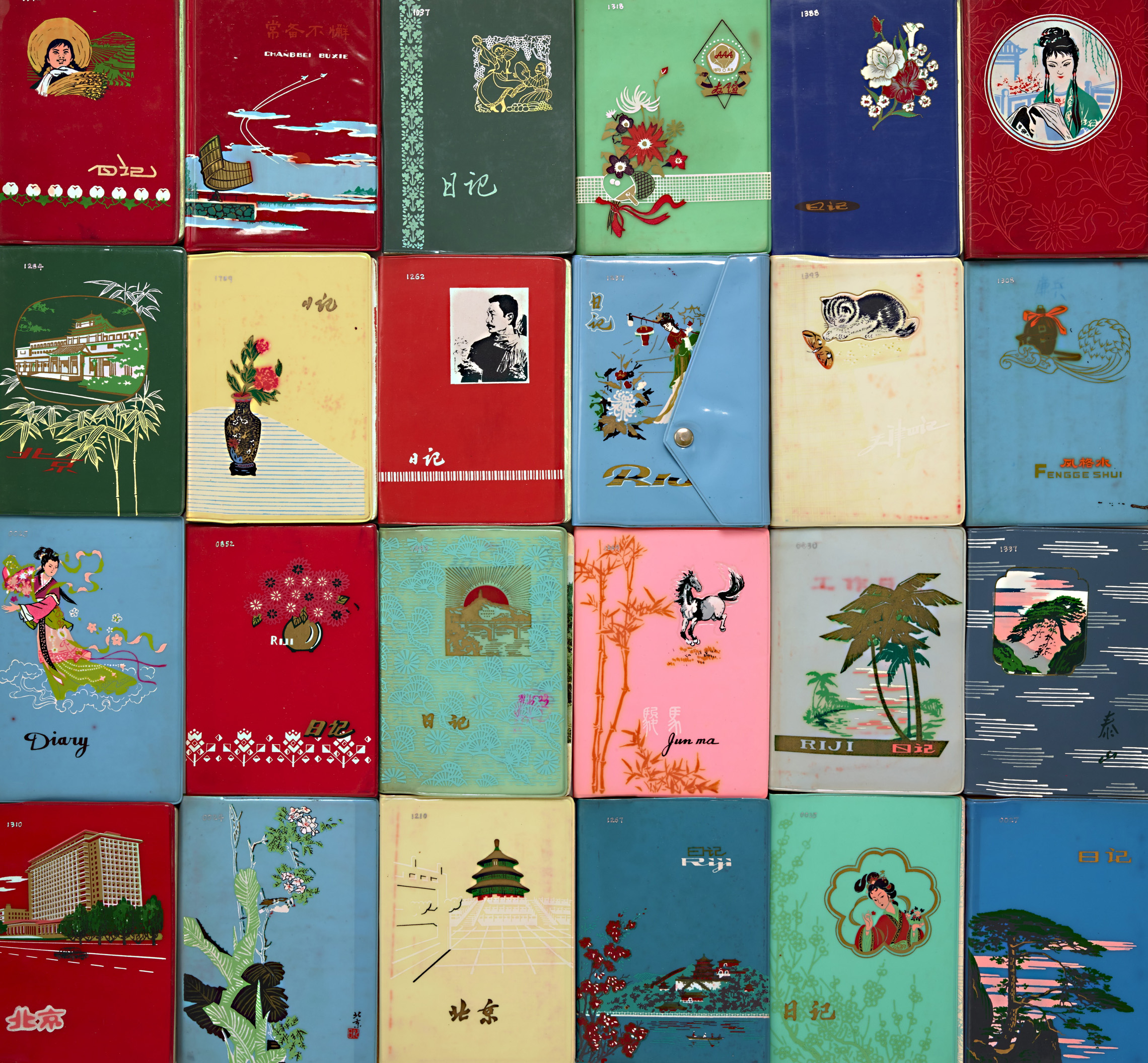
“Historical experience is written in iron and blood,” said Mao Zedong. In Yang Zhichao’s monumental performance/installation project Chinese Bible at Sydney’s Sherman Contemporary Art Foundation, historical experience is written in thousands of humble, mass-produced notebooks once owned by ordinary Chinese people, their worn covers testament to the weathering of time and the vicissitudes of social change. Ai Weiwei says, “Everything is art. Everything is politics,” and Chinese Bible reveals a similar approach to art as a form of social engagement.

Yang Zhichao. Chinese Bible, 2009 (detail) 3,000 found books Dimensions variable Image courtesy: The Gene & Brian Sherman Collection, and Sherman Contemporary Art Foundation, Sydney Photo: Jenni Carter, AGNSW

Yang Zhichao. Chinese Bible, 2009 (detail); 3,000 found books; dimensions variable.
Courtesy of the Gene & Brian Sherman Collection, and Sherman Contemporary Art Foundation, Sydney.
Photo: Jenni Carter, AGNSW.

From 3,000 personal notebooks and diaries amassed by the artist over a period of three years, purchased in Beijing’s Panjiayuan “Dirt Market” (a place where you can buy just about anything, from fake antiquities to genuine Mao memorabilia), Yang Zhichao has created a work that reveals a hidden history. Spanning 1949–1999, these collected diaries, saved for their value as recycled scrap paper, reveal the dramatic transformations that have convulsed China from the establishment of the People’s Republic in 1949 to the horrors of the Cultural Revolution, and later the impact of globalization under the Reform and Opening policies following Mao’s death in 1976.

Arranged in rows on a raised platform, the books’ first impression is a sea of revolutionary red. Early books covered in blue or green featuring pictures of traditional architecture, auspicious plum blossoms, or galloping horses give way to triumphant soldiers and peasants, factory chimneys billowing smoke, and Mao haloed by the rising sun. Books from the 1980s have plastic covers in bright pink or pea green with cute cartoon characters. We see only the covers, but pages have been photographed and displayed on iPads; with a slight frisson of voyeurism, we view the self-criticisms, dutifully copied out passages of “Mao Zedong thought,” and notes from meetings and political study sessions. Some contain more personal things—knitting patterns, song lyrics, and shopping lists. Others have keepsakes—photographs or pressed flowers—between their pages. One has a souvenir brochure for a 1979 exhibition of works by Kathe Kollwitz, one of the first international art exhibitions staged in China after the end of the Cultural Revolution. Part historiography, part sociology, and part anthropology, the work re-presents and reinterprets the quotidian.

Read More »

Share

San Francisco

How to Read with Other People

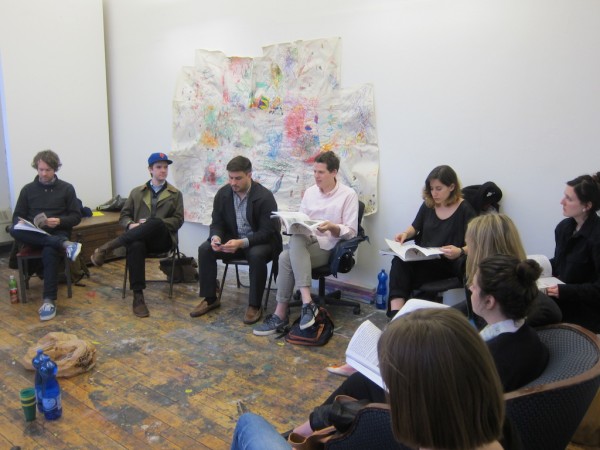
Today from our partner site Art Practical, we bring you an excerpt of Orit Gat’s essay on the art-magazine reading group she co-founded. The members of the group meet each month to evaluate every part of a single magazine, from cover to cover; Gat notes: “art magazines play a role in the way we all assess our place and opinions in regard to the art world.” This article was originally published on May 27, 2015.

Contemporary Art Magazines Critical Reading Group meeting, April 27, 2015. Courtesy of Triangle, New York. Photo: Elena Levi.

Contemporary Art Magazines Critical Reading Group meeting, April 27, 2015. Courtesy of Triangle, New York. Photo: Elena Levi.

A year and a half ago, my friend Clara and I emailed most people we knew in New York to see who may be interested in joining us in reading art magazines cover to cover. We called it the “Contemporary Art Magazines Critical Reading Group” (in hindsight, we should have named it something shorter, or at least have a better acronym than CAMCRG) and organized it via the Public School New York. The idea was to focus on a different art magazine at every session, and talk about the overall composition of any given issue, as well as specific articles, and the larger contribution a magazine makes or could make. We started with Artforum. It seemed like it would fit this methodology perfectly, since we all came to reading it cover to cover (for the first time, because really, who does that?) with a particular knowledge or opinion of the magazine, its history, its current status, and its style, and we all had certain expectations from it.

“Any surprises?” was the first thing we discussed in that initial meeting. I remember presuming that Artforum would be much more unequal and—sorry—boring than it was. The conversation very quickly veered from the lovely discovery that reading cover-to-cover is much more engaging than selective reading, to discussing the tone of writing in Artforum, the feeling that the magazine emphasizes a style and language that generates a sense of authority. Which brought about a discussion of how Artforum is actively writing the history of contemporary art—or at least, believes that’s what it does. That’s why the magazine opens with the obituaries, we laughed.

Read the full article here.

Share