Venice
#Hashtags: Liveness
#participation #politics #capital #religion #access #inclusion
At the center of All the World’s Futures—The 56th Venice Biennale is the ARENA. Designed by architect David Adjaye, it is meant to serve as a platform for “live art” throughout the exhibition’s run. The space is defined by a large, low platform, flanked by risers and backed with a projection screen. Above the stage, a mezzanine provides another vantage point. The whole space is bright red, with carpeting and colorful pillows in the seating areas. According to Okwui Enwezor, “Over the course of All the World’s Futures, artists, musicians, composers, actors, intellectuals, students, and members of the public have been invited to contribute to the program of readings and performances that will flood and suffuse surrounding galleries with voices in an epic display of orality.” He intends for the activities in the ARENA to spill over into the adjacent spaces of display. Enwezor suggests that “liveness and epic duration” expand the “spatial and temporal” boundaries of the exhibition beyond that which the exhibition can fully contain or describe, and that the ARENA serves as “a dramatization of the space of the exhibition as a continuous, unfolding, and unceasing live event.”[1] Such language casts contemporary art viewing as a marathon endurance challenge rather than the experience of leisure or aesthetics that many visitors to the Biennale may be expecting.
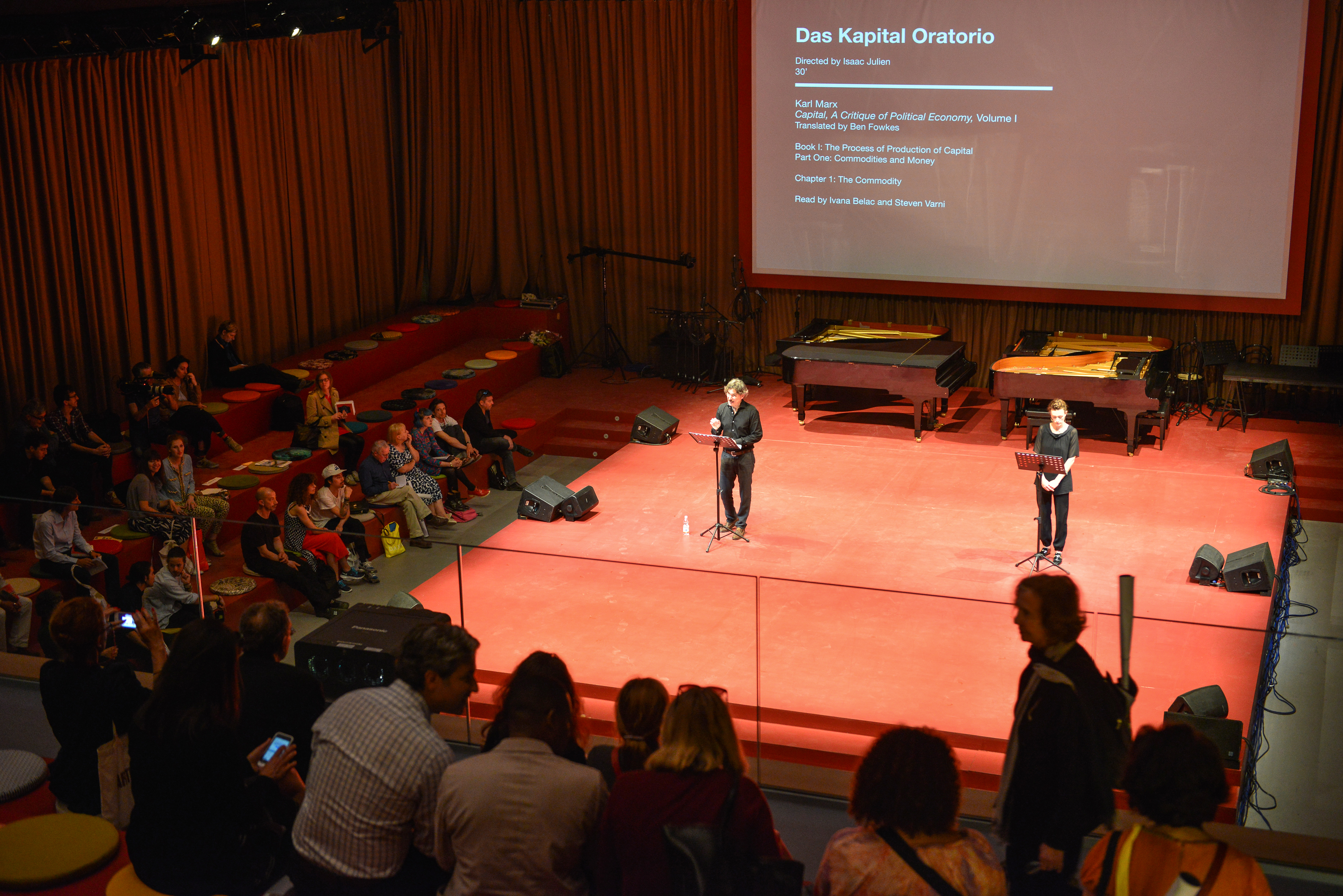
Isaac Julien. Das Kapital Oratorio, ARENA, Padiglione Centrale, Giardini. 56th International Art Exhibition – la Biennale di Venezia, All the World’s Futures. Courtesy of la Biennale di Venezia. Photo: Andrea Avezzù.
Manifestations of “epic duration” include Isaac Julien’s ongoing Das Kapital Oratorio, a series of staged readings of Marx’s foundational text read for thirty minutes each, at intervals, over the course of the exhibition’s seven-month run. This work has already generated widespread indignation from critics, many of whom misrepresent the reading as happening continuously, and some of whom fault Julien for taking up Marxist questions while simultaneously collaborating with Rolls-Royce on another project appearing elsewhere at the Biennale.[2] Others lament the concept as simply boring. After all, everyone or no one has read Das Kapital (depending on who you ask), and anyway, isn’t a contemporary text like Thomas Piketty’s Capital in the 21st Century more relevant? Julien cites the Sikh practice of the Akhand Path, a ritual reading of a holy text, as precedent. Is Das Kapital the holy text of contemporary art? Its recurring influence in art criticism and production would support this interpretation. As for being boring, the work invokes another spiritual element borrowed from South Asia, the drone, which stands in for the sound of the mechanism of the universe, and lulls us into a subconscious state.