Venice

#Hashtags: Liveness

#participation #politics #capital #religion #access #inclusion

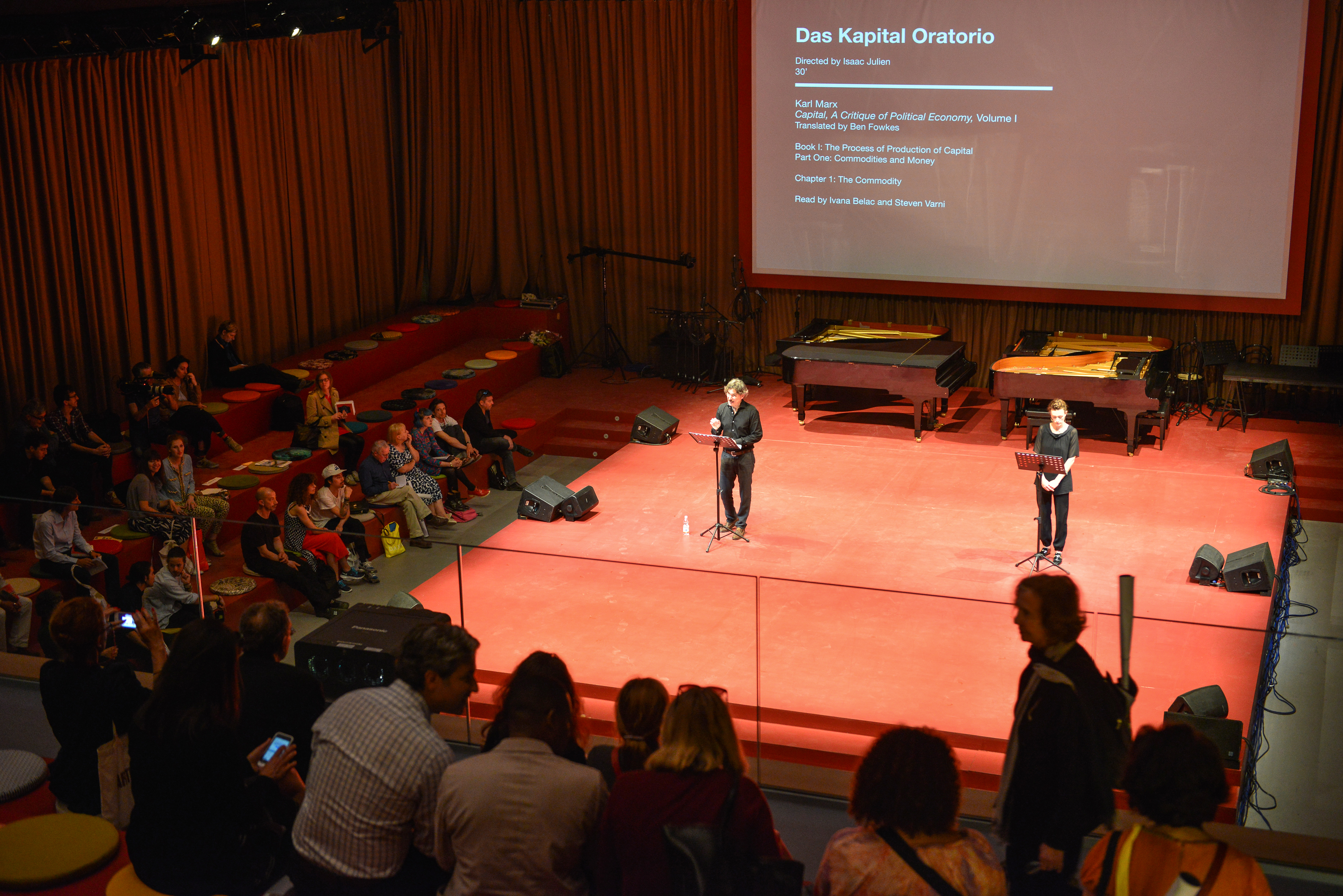
At the center of All the World’s Futures—The 56th Venice Biennale is the ARENA. Designed by architect David Adjaye, it is meant to serve as a platform for “live art” throughout the exhibition’s run. The space is defined by a large, low platform, flanked by risers and backed with a projection screen. Above the stage, a mezzanine provides another vantage point. The whole space is bright red, with carpeting and colorful pillows in the seating areas. According to Okwui Enwezor, “Over the course of All the World’s Futures, artists, musicians, composers, actors, intellectuals, students, and members of the public have been invited to contribute to the program of readings and performances that will flood and suffuse surrounding galleries with voices in an epic display of orality.” He intends for the activities in the ARENA to spill over into the adjacent spaces of display. Enwezor suggests that “liveness and epic duration” expand the “spatial and temporal” boundaries of the exhibition beyond that which the exhibition can fully contain or describe, and that the ARENA serves as “a dramatization of the space of the exhibition as a continuous, unfolding, and unceasing live event.”[1] Such language casts contemporary art viewing as a marathon endurance challenge rather than the experience of leisure or aesthetics that many visitors to the Biennale may be expecting.
AVZ_4227

Isaac Julien. Das Kapital Oratorio, ARENA, Padiglione Centrale, Giardini. 56th International Art Exhibition – la Biennale di Venezia, All the World’s Futures. Courtesy of la Biennale di Venezia. Photo: Andrea Avezzù.

Manifestations of “epic duration” include Isaac Julien’s ongoing Das Kapital Oratorio, a series of staged readings of Marx’s foundational text read for thirty minutes each, at intervals, over the course of the exhibition’s seven-month run. This work has already generated widespread indignation from critics, many of whom misrepresent the reading as happening continuously, and some of whom fault Julien for taking up Marxist questions while simultaneously collaborating with Rolls-Royce on another project appearing elsewhere at the Biennale.[2] Others lament the concept as simply boring. After all, everyone or no one has read Das Kapital (depending on who you ask), and anyway, isn’t a contemporary text like Thomas Piketty’s Capital in the 21st Century more relevant? Julien cites the Sikh practice of the Akhand Path, a ritual reading of a holy text, as precedent. Is Das Kapital the holy text of contemporary art? Its recurring influence in art criticism and production would support this interpretation. As for being boring, the work invokes another spiritual element borrowed from South Asia, the drone, which stands in for the sound of the mechanism of the universe, and lulls us into a subconscious state.

Read More »

Share

Shotgun Reviews

Ling Sepúlveda: Un Ciclo de Lavado en Vivo at Biquini Wax

Shotgun Reviews are an open forum where we invite the international art community to contribute timely, short-format responses to an exhibition or event. If you are interested in submitting a Shotgun Review, please click this link for more information. Today’s Shotgun Review is the fifth in a series of five written by the finalists for the Daily Serving/Kadist Art Foundation Writing Fellowship in Mexico City; author Dorothée Dupuis reviews the work of Ling Sepúlveda at Biquini Wax in Mexico City.

Ling Sepulveda. Un ciclo de lavado en vivo, 2015; Performance at Bikini Wax, Mexico City, May 16, 2015. Photo: Ramiro Chavez

Ling Sepulveda. Un Ciclo de Lavado en Vivo, 2015; performance at Biquini Wax, Mexico City, May 16, 2015. Photo: Ramiro Chavez.

Un Ciclo de Lavado en Vivo [A Live Wash Cycle] (2015) was a performance by Ling Sepúlveda on Saturday, May 16, 2015, at Biquini Wax in Mexico City. This laconic yet descriptive title created an anticipation for what was washed, why, and for whom. The sounds of the process were captured, distorted, and amplified by the artist, confirming the machine in action as a giant beast chewing and spitting, absorbed in its task, indifferent to the bewilderment of the audience. A hundred people, students and connoisseurs, were going up and down the stairs of the old house with clamors of surprise or disgust as inexplicably black water was expelled from the machine during spinning, splashing their clothes and sneakers and entering the other rooms of the house, where it damaged the belongings of both the artist and the Biquini Wax team.

The day of the performance, the artist washed a few pounds of earth as well as a one-peso coin. Sepúlveda is from Sinaloa, and he talks about the difficulty of making a living from a land that is “neglected,” descuidada—and nothing can render the audible violence of the term, the prefix “des” removing all hope from the next slamming syllables, like a care given and then removed. Sepúlveda also invokes the paradoxical infrastructure that has become narco-traffic, through its distorted but effective patriarchal solidarity. He then suggests the performance as an attempt to wash the “weight” (peso) constitutive of Mexican identity, a stereotype made of combined assumptions of cheapness and hard labor.

Read More »

Share

San Francisco

What Matters to Us?: A Reenactment of Anna Halprin’s Blank Placard Dance

Today from our partners at Art Practical, we bring you a review of What Matters to Us?, performed in San Francisco on May 16, 2015. Of her participation in the event, author Vanessa Kauffman notes, “The act of protest alone had absolved us of nothing. What matters to us is still out there, waiting.” This article was originally published on June 11, 2015

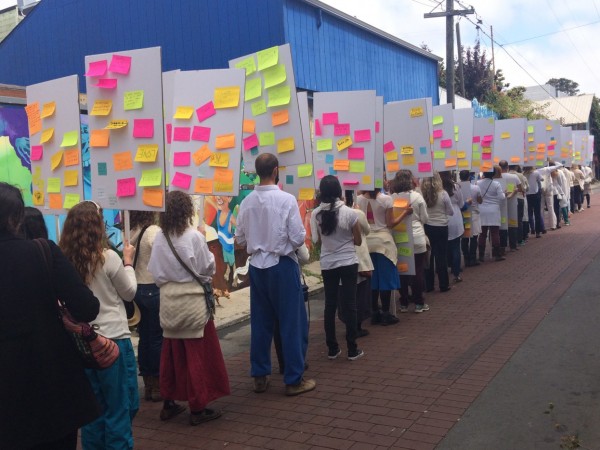
What Matters to Us?: A Reenactment of Anna Halprin’s Blank Placard Dance, Saturday, May 16, 2015, San Francisco. Photo: Emily Holmes.

What Matters to Us?: A Reenactment of Anna Halprin’s Blank Placard Dance, Saturday, May 16, 2015, San Francisco. Photo: Emily Holmes.

Emerging one by one from the doors of San Francisco’s Mission Cultural Center, thirty-six white-shirted performers nimbly and stoically perched between parking meters, ready for the opening beats of the performance that was about to unfold. Standing shoulder to shoulder in one long row, they silently gazed out onto the street’s two-way flux of traffic. The expressions on their faces mirrored the signs they held above their heads: Both were blank.

What Matters to Us? (May 16, 2015) was the inaugural event of Dances for Anna: A Worldwide Celebration of Anna Halprin’s 95th Year, a series of performances taking place over the next three months across sixteen countries. Organized by the Tamalpa Institute (the dance and expressive arts therapy nonprofit cofounded by Halprin and her daughter Daria), and directed by Associate Director Rosario Sammartino, Dances for Anna is a tribute to a choreographer whose work and teachings have rigorously challenged traditional definitions of dance, informing and influencing many threads of experimental movement since the late 1930s.

Read the full article here.

Share

Fan Mail

Fan Mail: Lorella Paleni

Lorella Paleni is always creating something that exists just over the horizon of awareness. Her works comprise a series of visual heuristics to nowhere, showing the viewer a picture plan filled with rich colors that simultaneously push into and out of each painting. But instead of resolving compositional elements into a defined image, the elements of her style culminate in a delicately constructed form of not knowing.

Lorella Paleni. In Reverse, 2014; acrylic and oil on canvas; 42 x 48 inches. Courtesy of private collector.

Lorella Paleni. In Reverse, 2014; acrylic and oil on canvas; 42 x 48 in. Courtesy of private collector.

Paleni’s works define the space where language eludes us—the moments where words fail and ideas aren’t quite graspable. Like slippery memories, these points in time are simultaneously otherworldly and very common. The experience Lorella Paleni cultivates through her paintings is one that is always just outside of certainty. Many of the works have a tremendous visual energy, such as Raw (2015): Two faceless figures wrestle, intertwined in an impossibly tight and intimate knot. Set atop a shallow pool of reflective water, the bodies vacillate between abstraction and hyperrealism as details like fingernails, toes, and the contour of a perfectly formed calf muscle emerge from the mess of limbs.

Read More »

Share

New York

Beverly Buchanan: And You May Find Yourself… at Andrew Edlin Gallery

Though certainly no stranger to the art world, Beverly Buchanan has followed an unusual trajectory in her career and public profile as an artist. Born in 1940 in North Carolina, and raised in South Carolina, she spent much of her childhood accompanying her father, an agricultural scientist, while he visited sharecroppers in far-flung locations throughout the rural South, observing the lives and structures they made for themselves in hardscrabble circumstances. After devoting herself to medical work while a young adult, Buchanan developed an individualistic creative practice focused on making images and sculptures representing provisional and idiosyncratic buildings in the form of scale models.

Beverly Buchanan. Old Colored School, 2010; wood and paint; 20.25 x 14.75 x 18.5 in (51.4 x 37.5 x 47 cm). Courtesy Andrew Edlin Gallery.

Beverly Buchanan. Old Colored School, 2010; wood and paint; 20.25 x 14.75 x 18.5 in. (51.4 x 37.5 x 47 cm). Courtesy of Andrew Edlin Gallery.

Buchanan’s unique perspective was nurtured through studies with Norman Lewis and Romare Bearden at the Art Students League, and her work has been shown and collected by some significant cultural institutions. Nonetheless, her work has been seen only sporadically in the past decade and a half, mostly in regional art centers. So her inclusion in a 2014 group show at the Studio Museum was in some way an unveiling to a larger public, and now a selection of her works, ranging in date from 1987 to 2012, is on view at Andrew Edlin Gallery.

Edlin has specialized in showing work by artists ranging from the classic position of outsider—socially isolated or low-functioning individuals, such as the now-celebrated Henry Darger and the less-known yet ineffable Charles Steffen—to highly educated and accomplished fine artists such as Victor Moscoso and Chris Doyle; in between are creative practitioners such as Brent Green and Buchanan, who work more roughly or idiosyncratically.

Read More »

Share

Houston

Teresa Hubbard/Alexander Birchler: Sound Speed Marker at Blaffer Art Museum

Teresa Hubbard and Alexander Birchler’s multidimensional practice is currently on view in their expansive Sound Speed Marker at the Blaffer Art Museum. The duo’s range of collaborative skills and cinematic investments is present in three video installations—Grand Paris Texas, Movie Mountain (Méliès), and Giant—and in the related photographs and an outdoor sculpture. Using as a backdrop the arid terrain of three Texas towns, Ryan, Paris, and Sierra Blanca, the films examine the deep impressions and absences left by the movie industry across the state. The work is propelled by the artists’ fascination with the open circuits of social life, memory, and history that sit just outside the frame of moving images.

Teresa Hubbard/Alexander Birchler. Production Still, Grand Paris Texas. 2009. Courtesy: The Artists, Tanya Bonakdar (New York), and Lora Reynolds Gallery (Austin).

Teresa Hubbard and Alexander Birchler. Grand Paris Texas, 2009 (production still). Courtesy of the Artists, Tanya Bonakdar (New York), and Lora Reynolds Gallery (Austin).

The first work in the trilogy, Grand Paris Texas (2009), opens up with the small town made famous in Wim Wenders‘ 1984 film to track the dynamic role of the city’s abandoned Grand Theatre cinema. Using reflections and testimony from nostalgic elderly residents, film professionals, former Grand Theatre employees, and students to fill in the complex narrative of events that led to the theatre’s demise, Hubbard and Birchler portray a touching emotional landscape of collected memories in order to underscore the profound effects film has had on the city’s politics, imaginations, and social life. A major contribution and response to the “archival turn” in contemporary art, Hubbard and Birchler’s film operates as a kind of cinematic archive—an expertly shaped yet radically open collection point of affective data, research, oral testimony, and geographical information that allows physical actualities and metaphorical consequences to bump against each other.[1] In Hubbard/Birchler’s hands, filmmaking is a form of social archeology or anthropological forensics, entwining the site specificity of installation with the documentary format, turning this film into a multilayered text of physical, psychological, temporal, and economic traces left by the cinema on the community and its inhabitants. [2]

Read More »

Share

Venice

Halka/Haiti: The Polish Pavilion at the 56th Venice Biennale

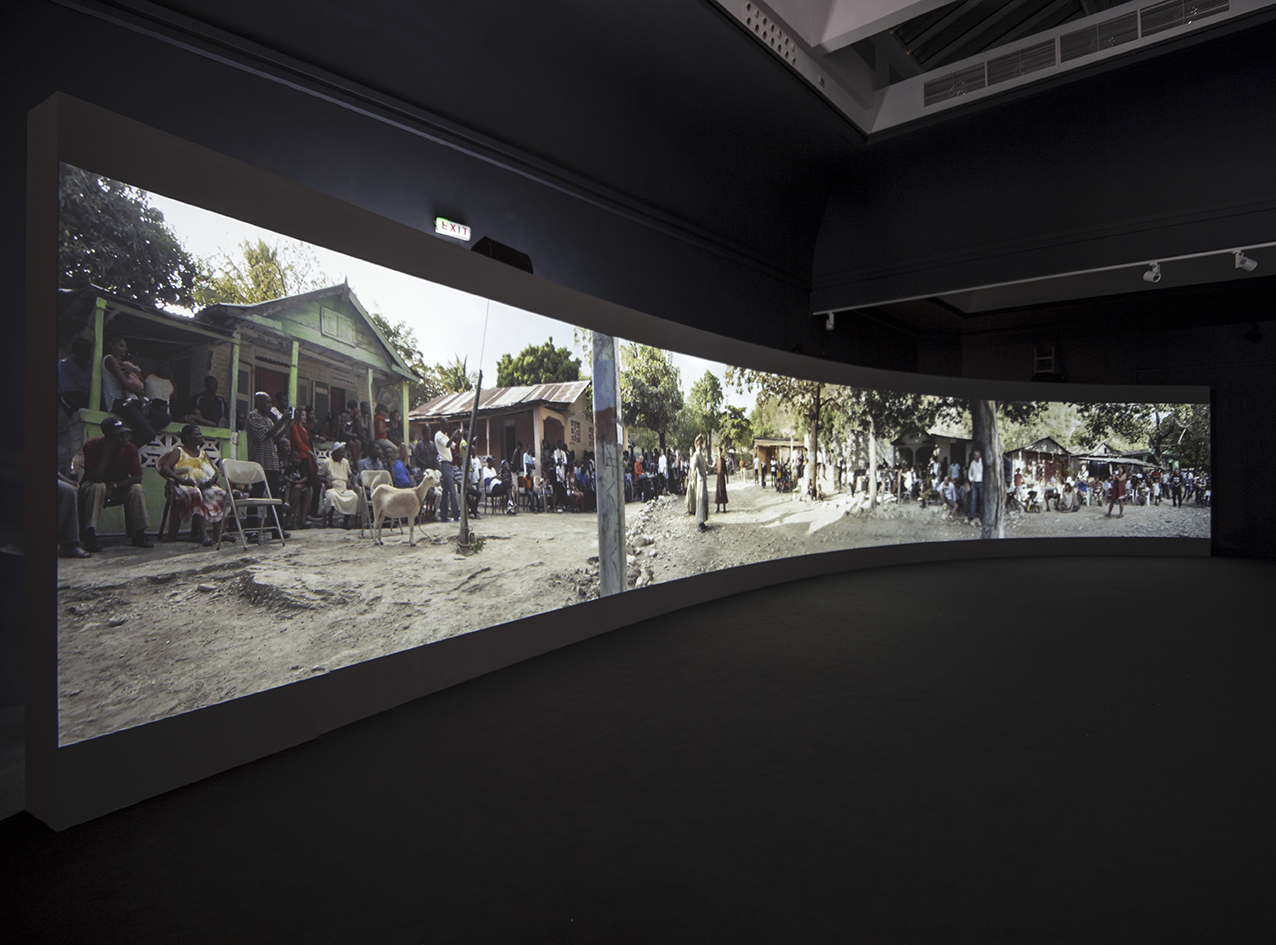
On a dirt road surrounded by low buildings, the inhabitants of a remote village in Haiti gather for an unusual purpose. A cohort of Haitian musicians with string and brass instruments sit on folding chairs, tuning their instruments. At the center of this panoramic view are three performers, incongruous for their obvious European-ness, and for their 18th-century period dress. The orchestra commences, and the performers begin to sing of a young peasant girl who is seduced and impregnated by her landlord; she interrupts his wedding to a noblewoman only to be rejected, contemplate mass murder, and ultimately commit suicide. The performance is Halka, a 19th-century opera by Stanislaw Moniuszko that is a hallmark of Polish nationalism. Scanning the scene again, another complication emerges: The audience gathered to watch this performance is local, but the people have a mix of African and central European features. This is Cazale, the home of La Pologne—the Polish Haitians.

C.T. Jasper, Joanna Malinowska. Halka/Haiti. 18°48’05”N 72°23’01”W. Polish Pavilion. 56th International Art Exhibition - la Biennale di Venezia, All the World’s Futures. Photo by Sara Sagui. Courtesy: la Biennale di Venezia.

C.T. Jasper, Joanna Malinowska. Halka/Haiti: 18°48’05”N 72°23’01”W, 2015. Polish Pavilion, 56th International Art Exhibition – la Biennale di Venezia, All the World’s Futures. Photo by Sara Sagui. Courtesy of la Biennale di Venezia.

C.T. Jasper and Joanna Malinowska’s Polish Pavilion at the Venice Biennale, Halka/Haiti: 18º 48’ 05” N 72º 23’ 01” W, considers the mythology surrounding the origins of this small but distinct community of Polish descent in the contexts of post-Communist Poland and post-dictatorship Haiti. Believed to be descendents of Polish soldiers recruited by Napoleon Bonaparte, the Pologne of Cazale have, for Poles, come to represent Polish resistance to despotism. The story of Poles in Haiti begins with the occupation of the independent Polish-Lithuanian Commonwealth by the joint seizures of territory by Russian, Prussian, and Habsburg forces between 1772 and 1795. Seeking to liberate themselves from their occupiers, some Polish partisans joined up with Napoleon’s army, whom they viewed as the enemy of their enemies. By 1802, a cohort of Poles had been sent to Haiti to help squash the nascent revolution led by Toussaint l’Ouverture. Some of these Polish fighters are believed to have switched sides, either fighting alongside the Haitian rebels or absconding to the remote mountain region known today as Cazale. Two hundred years later, Polish Haitians are credited with resisting the Haitian dictator François “Papa Doc” Duvalier, and lauded in Poland as evidence that the Polish national spirit is anti-authoritarian in any form. The pavilion, and the book published to accompany it, seek to problematize any such simple understanding.

Read More »

Share