Savannah

Monir Shahroudy Farmanfarmaian: Lineages

In a darkened hallway between two galleries in the Savannah College of Art and Design Museum of Art are several brightly lit works by Monir Shahroudy Farmanfarmaian. In this solo exhibition, titled Lineages, a series of Farmanfarmaian’s elaborate mirror sculptures are installed across from a number of her intricate geometric drawings, revealing an astute conflation of Western abstraction and traditional folk art of her native Iran.[1] While her examinations of geometric forms undoubtedly refer to elements of Islamic and Sufi design, the works go deeper to present an understanding of the universal building blocks of nature.

Monir Shahroudy Farmanfarmaian. Fourth Family: Hexagon, 2013; Installation view, mirror, oil painting behind glass and PVC; 48 x 48 x 12 inches. Courtesy of the SCAD Museum of Art. Photo: John McKinnon.

Monir Shahroudy Farmanfarmaian. Fourth Family: Hexagon, 2013; mirror, oil painting behind glass and PVC; 48 x 48 x 12 in.; installation view. Courtesy of the SCAD Museum of Art. Photo: John McKinnon.

The six ornate sculptures included in Lineages are pieced together from small slivers of cut mirror that Farmanfarmaian adheres to a complex geometric frame and pattern. The result is a three-dimensional relief that hangs on the wall—one that shimmers vigorously as it is lit and viewed from multiple angles. Farmanfarmaian has also carefully painted each line where different facets of the mirror meet. In this way, she further emphasizes her focus on geometric shapes and the edges that define them. The patterns in each form are quite dense, and they quickly recall the complex forms of muqarnas, which are the intricately decorated undersides of domes in Islamic architecture.

Because the sculptures are made out of reflective material, an interesting phenomenon arises as viewers engage them. Instead of possessing the gravitational effect of monuments, Farmanfarmaian’s sculptures expel everything, light and interpretation included. Due to this reflectivity, semblances of other gallery visitors and features momentarily appear and vanish; the sculptures eschew a static appearance and become ever-changing interpretations of the world around us. Furthermore, they take on several qualities of Op Art, as they similarly employ systems and lines to seemingly warp their own version of space. Despite the hard-edged geometric properties of the sculptures, stunningly expressive reflections are created on the gallery’s ceiling and floor, resembling the vivid, harried lines of Cy Twombly or Joan Mitchell.

Read More »

Share

Odd Jobs

Odd Jobs: Lenka Clayton

Welcome back to Odd Jobs, where I interview artists about their varied and non-traditional career arcs. For this installment I spoke with Lenka Clayton, whose works include hand-numbering 7,000 stones, searching for all 613 people mentioned in a single edition of a German newspaper, and reconstituting a lost museum from a sketch on the back of an envelope. Her practice exaggerates and alters the accepted rules of everyday life, extending the familiar into the realms of the poetic and absurd. Clayton received a BA in Fine Art from Central St. Martins, London, in 1999 and an MA in Documentary Direction from the National Film & Television School (UK) in 2006. Her work has been exhibited in Kunstmuseum Linz, the Carnegie Museum of Art, and MoMA, New York, among others. In 2012, Clayton founded An Artist Residency in Motherhood. She now oversees a public, open-source version of the work that has 275 registered current “artists-in-residence-in-motherhood” in thirty-one countries.

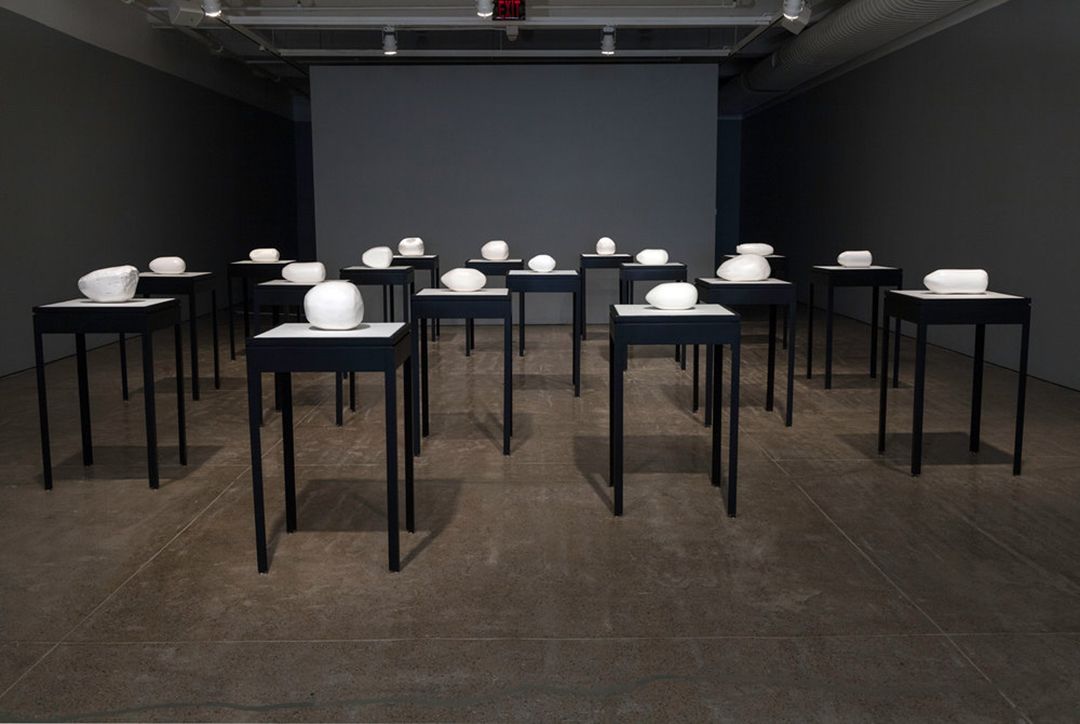
Lenka Clayton. Sculpture For The Blind, By The Blind, 2017; plaster, linen, wood, Braille sign, mounted digital photograph, portfolio of photographs. Courtesy of the artist. Photos: Carlos Avendano

Lenka Clayton. Sculpture for the Blind, by the Blind, 2017; plaster, linen, wood, Braille sign, mounted digital photograph, portfolio of photographs. Courtesy of the Artist. Photos: Carlos Avendano.

Lenka Clayton: I had a paper route when I was young, delivering newspapers. I was also waitressing. When I started undergrad, I worked in an artist’s paper shop. It’s pretty normal in England to work the whole time through undergrad, in the evenings and weekends and stuff. In the second year of undergrad—I guess here in the U.S. it’d be like an internship—I wrote to Jimmie Durham and Mark Dion and said, “I love your work, can I be your assistant?” and they both wrote back and said yes, really astonishingly. Jimmie at the time was working in Berlin. I went to live with him and his partner for a month and assisted them. It was the first time I met a professional artist. So I spent thirty days alongside them.

Calder Yates: Jimmie, just from his work, seems like a funny, great guy.

LC: Oh, he’s extraordinary. We tried to make money together. We made a little edition together and we tried to do this fundraising thing. It was great to see what the life of an artist looks like. I ended up working for Mark for quite a long time. He did a piece at the Tate Gallery in London and I was project manager on that. It was the first job I had out of undergrad and I was essentially paid to go beachcombing.

CY: This was during and after undergrad. What did you do after working for Mark?

LC: I lived in Berlin and became a projectionist. There were five screens and all the films on all the five screens started at the same time and there was one projectionist. So there was like nothing to do for an hour and a half and then it was the most stressful thing in the world, running up and down ladders, in and out of dark rooms, and starting the adverts. The whole time I was in Berlin I started to see a lot of parallels between the way that I worked and the way that a documentary filmmaker would work. I purposely decided not to go to art school but to go to the National Film and Television School. After I left film school, I worked as an independent filmmaker. I was also teaching at a university in London. My partner and I made several films for television. But in the end, I just felt the limitations a lot. I always knew I wanted to work in a more open way. After I met my partner, we moved to Pittsburgh.

Read More »

Share

Teaching and Talking about Art and Performance in Unpresidented Times

Today from our sister publication Art Practical, we bring you Thea Quiray Tagle’s article from issue 8.3: Art can’t do anything if we don’t. Quiray Tagle highlights the importance of teaching art in its most intersectional and inclusive forms and actively engaging with politics and current events. She states, “For those teaching art and social change in the ongoing aftermath of this election—thank you. For those joining political actions and using arts as a platform for the first time—fantastic. In all of these endeavors, consider your politics of citation: who you turn to and give credit for as sources of artistic and intellectual expertise.” This article was originally published March 23, 2017.

Johanna Poethig. Songs for Women Living With War, 2016. Courtesy of the Artist.

Johanna Poethig. Songs for Women Living With War, 2016. Courtesy of the Artist.

(some thoughts for other instructors and artists)

my sister
when will it come finally clear
in the rockets’ red glare
my sister
after the ceremonial guns salute the ceremonial rifles
saluting the ceremonial cannons that burst forth a choking
smoke to celebrate murder
will it be clear
in that red that bloody red glare
my sister
that glare of murder and atrocity/atrocities
of power
strangling every program
to protect and feed and educate and heal and house
the people

(talking about us/you and me talking
about us)

—June Jordan, “Poem to My Sister, Ethel Ennis, Who Sang ‘The Star-Spangled Banner’ at the Second Inauguration of Richard Milhous Nixon, January 20, 1973”

Listen to Black women. Listen to women of color. Listen to indigenous communities. Listen to queer and trans people, especially QTPOC. These are the things, above all else, that I want my students to learn, in the art schools where I’ve been one of the few instructors of color, in “diversity” classes at the public university I teach at now. Listen. Look. Learn.

Read the full article here.

Share

Shotgun Reviews

Unflinching Facades: New Work by Carolina Borja and Jesse Matthew Petersen at Soo Visual Arts Center

Shotgun Reviews are an open forum where we invite the international art community to contribute timely, short-format responses to an exhibition or event. If you are interested in submitting a Shotgun Review, please click this link for more information. In this Shotgun Review, Camille Erickson reviews Unflinching Facades: New Work by Carolina Borja and Jesse Matthew Petersen at Soo Visual Arts Center in Minneapolis.

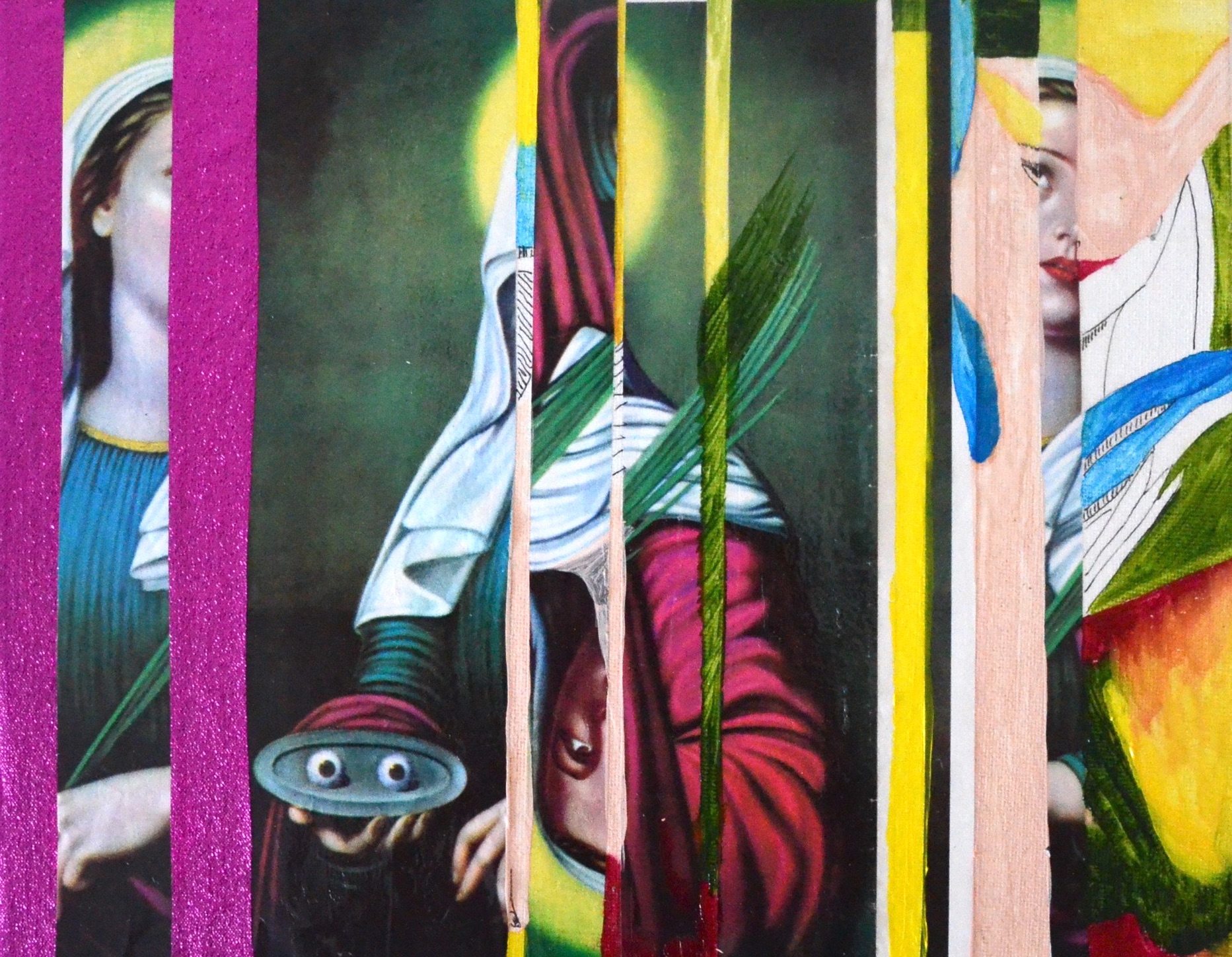
 Carolina Borja. Lucha, 2017; collage and acrylic; 12 x 10 in. Courtesy of Soo Visual Arts Center, Minneapolis.

Carolina Borja. Lucha, 2017; collage and acrylic; 12 x 10 in. Courtesy of Soo Visual Arts Center, Minneapolis.

In the exhibition Unflinching Facades at Soo Visual Arts Center, new collages by Carolina Borja and Jesse Matthew Peterson plunge into the amorphous archives of religious iconography and fashion. By employing mixed media and visual manipulation, Borja (the subject of this review) alters the concealed power structures beneath the sumptuous veneer of mass representation. In the series All of Them Us (2017), Borja injects appropriated images of saints to reconsider their importance outside of a prescribed religious order. Layered collages featuring Catholic saints with glowing, hand-painted halos, removed from their natural habitat, congregate on the wall. Borja prompts viewers to “choose a saint of inspiration,” and provides a table of accoutrements, including artificial branches, candles, and plastic crowns, inviting viewers to “search for symbols that pair well with their needs.” Against a lustrous blue backdrop in the gallery space, viewers can also strike a saintly pose while (as the wall texts suggests) “acknowledging the strengths you lack and empower yourself.”

In a corresponding video, Borja wears a crown of flowers and a red cloak, freezing her pose as if for a photograph. She breaks this arresting stillness with a smile, exposing the exaggerated nature of her actions. Typically, Catholicism maintains a stringent grasp on the tenets of tradition and guides many Mexican customs, but Borja envisions a renewed enactment of devotion by inserting her own body in a campy performance—and encourages viewers to do the same.

Read More »

Share

Fan Mail

Fan Mail: Molly Dierks

In her work, Molly Dierks forces together concepts of normative femininity and elements of industrial fabrication—sometimes uneasily, other times uncannily well. Using saturated and pastel hues typically associated with women’s products in combination with hard metals and unyielding forms, Dierks makes associations between femininity and fabrication that describe complicity rather than contrasts. Her sculptures do more than point out the labor intrinsic to the production of femininity; they implicate an unseen ecology of machine manufacturing behind it.

Molly Dierks. Parts, 2010 (installation view); car parts, paint, metal and wood bases; dimensions variable. Courtesy of the Artist.

Molly Dierks. Parts, 2010; car parts, paint, metal and wood bases; dimensions variable; installation view. Courtesy of the Artist.

In her installation Parts (2010), Dierks erects three metal objects with evocative but nonspecific shapes and details. Painted a warm coral hue like lipstick or rouge, the forms suggest sections of mass-produced, utilitarian objects. Strangely feminized by their shapes and color, they appear like hybrids of car parts and pantyhose, fenders and legs. But what is strangest about them is how surprisingly natural it feels to a viewer to see both a car door and lipstick in the same object. Parts goes beyond a mere feminizing of typically masculine objects—the maligned “shrink it and pink it” ethos applied to marketing products to women. The congruity of these readings reveals a deeper entanglement between them, of seeing the production of a concept of a woman in the production of a car.

Read More »

Share

Edward Krasiński: Two Retrospectives

László Beke’s essay in a 1999 exhibition catalog, Global Conceptualism: Points of Origin, 1950s–1980s, synthesizes broad Eastern and Central European conceptualist practices. Within the text, the Polish artist Edward Krasiński is mentioned only briefly in parenthesis as a “peculiar” artist.[1] This alone indicates Krasiński’s outlier status and exceptionality with regard to Eastern Bloc conceptualism. While Krasiński’s practice is clearly influenced by Minimalism’s phenomenological attention to space and simultaneously approaches the proverbially Conceptual “dematerialization” of the work of art, the idiosyncrasies and distinctive approaches found in his work have often been compartmentalized to fit within Western contexts.

Edward Krasiński. Intervention, Zalesie, 1969. ©Anka Ptaszkowska and archive of Museum of Modern Art Warsaw. Courtesy of Paulina Krasinska and Foksal Gallery Foundation, Warsaw. Photo: Eustachy Kossakowski.

Edward Krasiński. Intervention, Zalesie, 1969. © Anka Ptaszkowska and archive of Museum of Modern Art Warsaw. Courtesy of Paulina Krasinska and Foksal Gallery Foundation, Warsaw. Photo: Eustachy Kossakowski.

Krasiński’s large and multifaceted oeuvre, spanning five decades, encompasses painting, sculpture, installation, and performance. However, his use of blue Scotch tape remains his most identifying strategy in the West, perhaps because it most resonates with the dominant practices connoted by Conceptualism. Kasia Redzisz, Senior Curator at Tate Liverpool, amply took this point into consideration in curating Krasiński’s first UK retrospective at the institution, which will move to the Stedelijk Museum in Amsterdam this June. Redzisz did well to situate the diverse strategies that comprise his career, presenting a wide selection of the artist’s polyvalent work chronologically, and installed, where possible, as re-created installations—though clearly divorced from the historical and political context of their production.

Krasiński never ceased interrogating the artwork’s spatio-temporal positioning and how the viewer navigates through space, which inform his earlier paintings, quasi-Minimal sculptures, and later, his quite Conceptualist installations. Krasiński’s practice of site-specific installation, while firmly rooted in his Polish postwar context, was not produced in a vacuum; it was in dialogue with Conceptual art during the process of its theorization in the West.[2] While Krasiński co-founded and regularly exhibited at the Foksal Gallery in Warsaw—a pivotal alternative art space in state-socialist Poland—he also exhibited his work in the West. Given Poland’s somewhat mitigated artistic freedom—relatively expansive compared with other countries in the Eastern Bloc, such as Hungary—during the postwar period, Krasiński exhibited in New York, for example, as early as 1967. His sculpture, No. 7 (1966), was selected by curator Edward Fry as one of two Polish contributions to the Guggenheim International Exhibition 1967: Sculpture from Twenty Nations, and was likely received as an implicitly Minimalist work given the developing polemics within the New York art world at the time. The sculpture, however, gives the impression of vertical motion that contrasts with Minimal sculpture’s then-prominent convictions for “static” objects.

Read More »

Share

Interviews

Talking About 100 Days Action, Part 2

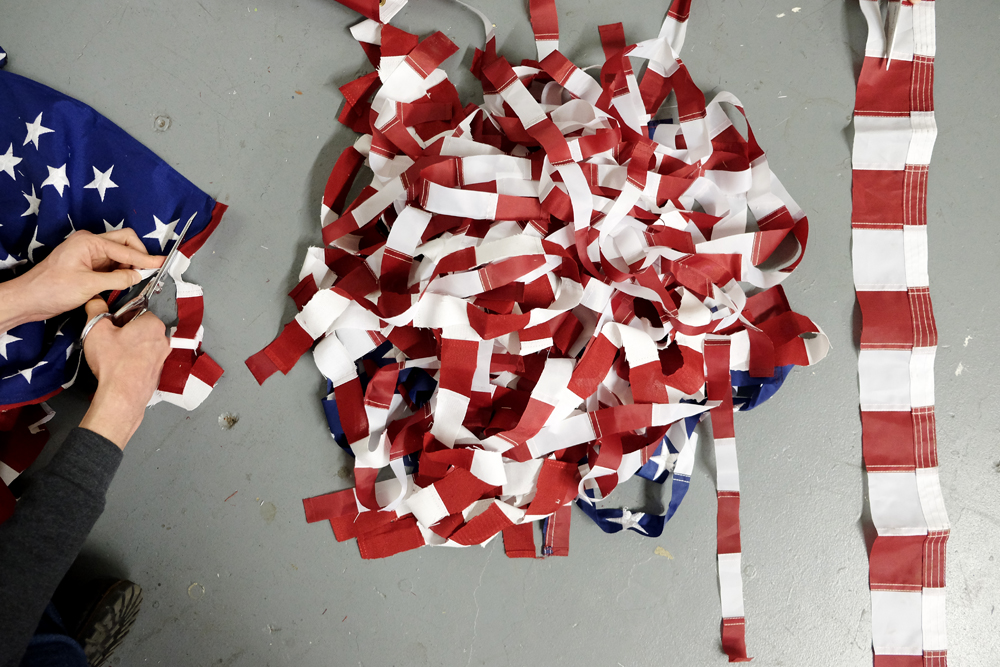
April 30 is the last of Donald Trump’s first 100 days in office. To mark that inauspicious event, I spoke with Kenneth Lo, artist and social media manager for 100 Days Action, and artist Ricki Dwyer, who contributed the intervention Shred and Re-weave the American Flag. Our discussion ranged from how resistance efforts have changed since the inauguration, to the role artist–activists play in those efforts either by choice or a sense of obligation.

Ricki Dwyer. Shred and Re-weave the American Flag, 2017; participatory action, performed on January 27, 2017, at Open Windows Cooperative in San Francisco, as part of "100 Days Action"

Ricki Dwyer. Shred and Re-weave the American Flag, 2017; participatory action, performed on January 27, 2017, at Open Windows Cooperative in San Francisco, as part of 100 Days Action. Courtesy of the Artist.

Roula Seikaly: Kenneth, you’re leading the social media charge for 100 Days Action. Have you noticed a change in the proposals? Are they responsive to proposed or realized executive orders, such as the Muslim travel ban, or defunding Planned Parenthood? Or are proposals more consistent in the sense that a general protest is mounted?

Kenneth Lo: I’d say both. Even before the travel ban was executed, there was the idea that Trump would do it. It happened to be timed almost perfectly that when the first travel ban was proposed, we featured Lizania Cruz’s project My Immigrant Route. That was a popular project that saw a lot of participation. But I’d say that for the first month, the submissions were more concerned with self-care.

RS: Self-care for the artists themselves, or self-care as a collective action?

KL: Both. Like, “We’re tired, we’re screaming. Let’s do some yoga. Let’s have some food.”

Read More »

Share