Reviews

Breaking News: Turning the Lens on Mass Media at the Getty Center

Catherine Opie. Terry Schiavo and Pope John Paul from the series Close to Home, 2004–2005; dye diffusion prints; 15 1/2 x 14 in. Courtesy of the Artist and Regen Projects, Los Angeles.

Journalism is experiencing a crisis of confidence as of late, with long-running mainstream sources being labeled “fake news,” while extremist propaganda mills are hailed as harbingers of the truth. Although this specific quandary may be unprecedented, the concept that the news should be viewed with a healthy skepticism—considering from where and whom it comes—is nothing new. People living under regimes that lack a free press[…..]
Japanese Photography from Postwar to Now at SFMOMA

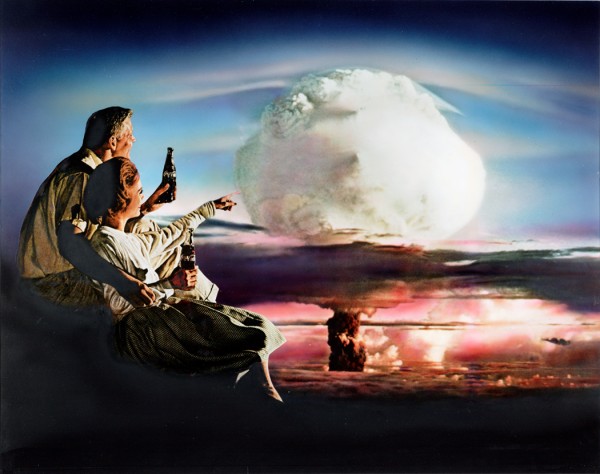
Tsunehisa Kimura, Americanism, 1982; photomontage; 15 1/4 x 19 1/4 in. (38.74 x 48.9 cm); promised gift of a private collection to the San Francisco Museum of Modern Art; © Estate of Tsunehisa Kimura

Shotgun Reviews are an open forum where we invite the international art community to contribute timely, short-format responses to an exhibition or event. If you are interested in submitting a Shotgun Review, please click this link for more information. In this Shotgun Review, Max Blue assesses Japanese Photography from Postwar to Now at SFMOMA. When viewing any retrospective of work, patterns emerge. Visiting Japanese Photography from[…..]

From the Archives – Vesna Pavlović: LOST ART at Zeitgeist Gallery

Vesna Pavlović. Video Still, May 25, 1979, Television, Belgrade. 2015. Endura metallic print. 20.5 x 14 inches. Image courtesy of the artist and Zeitgeist Gallery (Nashville, TN).

“Instability, fragmentation, and brokenness”—these words could easily refer to the current global political situation, yet here they specify the 20th-century regime of Josep Broz Tito, a Yugoslavian revolutionary whose later presidential reign was marked by repression and human-rights violations. In street protests, as in galleries and museums, citizens around the world are turning to imaginative expressions of their fears and objections, and we are reminded of the[…..]

#EVIDENCE: Anouk Kruithof at Casemore Kirkeby

Anouk Kruithof. #EVIDENCE; 2017. Exhibition installation. Courtesy of Casemore Kirkeby.

#EVIDENCE, the current solo exhibition by Dutch-born, Mexico City–based artist Anouk Kruithof at Casemore Kirkeby Gallery, presents a sprawling series of related bodies of work inspired by Larry Sultan and Mike Mandel’s 1977 book, Evidence. Kruithof’s range of photo-based works, made mostly in 2015, do not replicate or repeat Sultan and Mandel’s project, but rather carry it forward through strategies that are carefully calculated to[…..]

An Atlas of Mirrors: Singapore Biennale 2016

Titarubi. History Repeats Itself, 2016; Gold-plated nutmeg, copper-plated wood, nickel-plated wood, burnt wood, sampan, wood, aluminium, copper, soil, light and nutmeg perfume; Dimensions variable. Image courtesy of Singapore Art Museum.

There is no shortage of mirrors and maps in the fifth iteration of the Singapore Biennale. Glass mirrors in Harumi Yukutake’s Paracosmos (2016) curve around the main circular stairwell of the Singapore Art Museum, dazzling the eye as light hits their multiple reflective surfaces. Dozens of mirrors appear in their reflections; dozens more yet, to the power of infinity, show up in the reflections of their reflections. In[…..]

Coille Hooven: Tell it by Heart at the Museum of Arts and Design, New York

Installation view of Coille Hooven: Tell It By Heart.
Photo by Jenna Bascom. Courtesy of the Museum of Arts and Design.

Shotgun Reviews are an open forum where we invite the international art community to contribute timely, short-format responses to an exhibition or event. If you are interested in submitting a Shotgun Review, please click this link for more information. In this Shotgun Review, Lux Yuting Bai reviews Coille Hooven’s Tell It By Heart at the Museum of Arts and Design, New York. Focusing on material-based[…..]

La Ciudad Está Allá Afuera: Demolición, Ocupación y Utopía [The City Is Out There: Demolition, Occupation, and Utopia]

José Adrián Monroy López, Núcleo [Core], 2016; polypropylene weave. Courtesy of Centro Cultural Universitario Tlatelolco, UNAM. Photo: Tania Puente.

If we googled the word “megalopolis,” it is most likely that an image of Mexico City would appear in the search. The capital of Mexico has 9 million inhabitants, and a floating population of almost 2 million people who travel every day from the adjacent suburbs to study, work, and shop. This concentration of humans turns the city into a bustling social and cultural center,[…..]