Anuradha Vikram is a critic, curator, and educator based in the San Francisco Bay Area. She has been an Instructor in art history and theory at San Jose State University, College of Marin, and UC Berkeley. She has curated exhibitions for Craft and Folk Art Museum in Los Angeles, Mills College Art Museum in Oakland, as well as Kala Art Institute, ProArts, SOMArts and other Bay Area venues. Her writing has appeared in Artillery, Art Practical, Afterimage, LEONARDO, and OPEN SPACE: The SFMOMA Blog, as well as in books and catalogues on contemporary American artists including Sonya Rapoport and Chitra Ganesh. From 2009-2013, she was Curator at the Worth Ryder Art Gallery in the UC Berkeley Department of Art Practice. Previous positions include Gallery Director at Aicon Gallery, Palo Alto, CA; Program Director at Headlands Center for the Arts in Sausalito, CA; Associate Producer of ISEA2006 Symposium and concurrent Zero One San Jose: A Global Festival of Art on the Edge, San Jose, CA; and Exhibitions Director at the Richmond Art Center, Richmond, CA. Prior to relocating to the Bay Area from New York, she managed the studio of Claes Oldenburg and Coosje van Bruggen. She has an MA in Curatorial Practice from California College of the Arts and a BS in Studio Art from New York University.
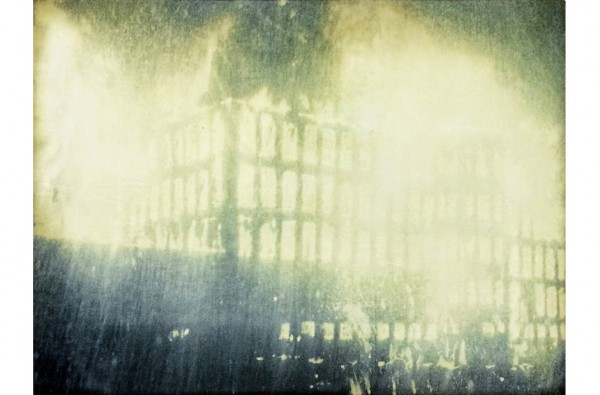
William Binnie’s exhibition at Paul Loya Gallery in Culver City emerged from a residency granted to the Dallas-based artist by the Rauschenberg Foundation in Captiva, Florida, this past summer. While there, the artist made a series of paintings in bleach on denim drawn from photographs of fires set by political radicals. Binnie’s paintings merge Rauschenberg’s photo-transfer aesthetic with Andy Warhol’s fascination with media spectacle—the grimmer, the better.[…..]
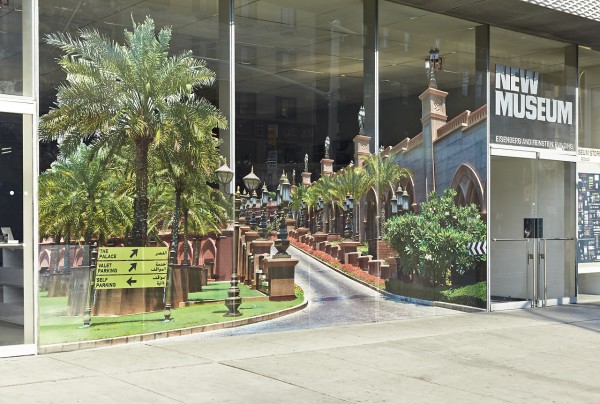
Here and Elsewhere, the New Museum’s colossal survey of contemporary art from the Arab world, sets for itself an impossible task. The curatorial strategy, as stated in the exhibition’s press release, is to work “against the notion of the Arab world as a homogenous or cohesive entity.” Though able to present a range of Arab identities, regionalisms, and geographies, the sprawling installation self-organizes and familiar tropes[…..]

#occupation #migration #civilrights #globalization #fundamentalism “Only crime and the criminal, it is true, confront us with the perplexity of radical evil; but only the hypocrite is really rotten to the core.”—Hannah Arendt “They were forced […] to condemn us without believing in our existence.”—Claude Cahun The horrific images emerging from Gaza in the past weeks have displaced any other visual reference in my mind, artistic[…..]

#institutions #revision #making #access #nostalgia The second Made in L.A. biennial at the UCLA Hammer Museum indicates both the scope and diversity of the city’s many emerging and early-mid-career artists, and the pull that the art academy continues to exert on artists long after the completion of their degrees. The biennial’s emergence in 2012 marked a milestone in the evolution of Los Angeles as an art capital, no[…..]

#race #gender #gentrification #access #development #labor Kara Walker’s massive sphinx at the Domino Sugar Factory in Brooklyn, titled At the behest of Creative Time Kara E. Walker has confected: A Subtlety, or the Marvelous Sugar Baby, an Homage to the unpaid and overworked Artisans who have refined our Sweet tastes from the cane fields to the Kitchens of the New World on the Occasion of[…..]

#other #violence #misogyny #racism #Orientalism #hybridity An act of senseless violence at UC Santa Barbara this past week has reignited an online conversation about the interrelationship between race, gender, discrimination, and violence. While the tweets and subsequent articles around #yesallwomen have drawn public attention to the gendered assumptions that underpin violent behavior, less visibility has accrued to the role that Orientalism played in dehumanizing and[…..]

#access #discrimination #appropriation #institutions #representation #re-performance Two important events transpired in the art world last week that have brought the complications of diversity and hierarchy into sharp focus. The first is the passing of artist Elaine Sturtevant, an artist who sublimated a critique of gendered inequity among artist peers into works that appropriated and re-created works deemed significant to the canon of contemporary art. The other[…..]












