Anuradha Vikram is a critic, curator, and educator based in the San Francisco Bay Area. She has been an Instructor in art history and theory at San Jose State University, College of Marin, and UC Berkeley. She has curated exhibitions for Craft and Folk Art Museum in Los Angeles, Mills College Art Museum in Oakland, as well as Kala Art Institute, ProArts, SOMArts and other Bay Area venues. Her writing has appeared in Artillery, Art Practical, Afterimage, LEONARDO, and OPEN SPACE: The SFMOMA Blog, as well as in books and catalogues on contemporary American artists including Sonya Rapoport and Chitra Ganesh. From 2009-2013, she was Curator at the Worth Ryder Art Gallery in the UC Berkeley Department of Art Practice. Previous positions include Gallery Director at Aicon Gallery, Palo Alto, CA; Program Director at Headlands Center for the Arts in Sausalito, CA; Associate Producer of ISEA2006 Symposium and concurrent Zero One San Jose: A Global Festival of Art on the Edge, San Jose, CA; and Exhibitions Director at the Richmond Art Center, Richmond, CA. Prior to relocating to the Bay Area from New York, she managed the studio of Claes Oldenburg and Coosje van Bruggen. She has an MA in Curatorial Practice from California College of the Arts and a BS in Studio Art from New York University.

#imperialism #appropriation #representation #environment #postcolonialism #revolution Throughout the 56th Venice Biennale, one finds national pavilions that have taken up the postcolonial mantle of Okwui Enwezor’s central exhibition within the contours of their own relationships to imperialist histories. Among the most successful of these are Vincent Meessen’s Belgian pavilion, Personne et les Autres, and Fiona Hall’s Australian pavilion, Wrong Way Time. Both pavilions consider how the[…..]

#participation #politics #capital #religion #access #inclusion At the center of All the World’s Futures—The 56th Venice Biennale is the ARENA. Designed by architect David Adjaye, it is meant to serve as a platform for “live art” throughout the exhibition’s run. The space is defined by a large, low platform, flanked by risers and backed with a projection screen. Above the stage, a mezzanine provides another vantage point. The[…..]
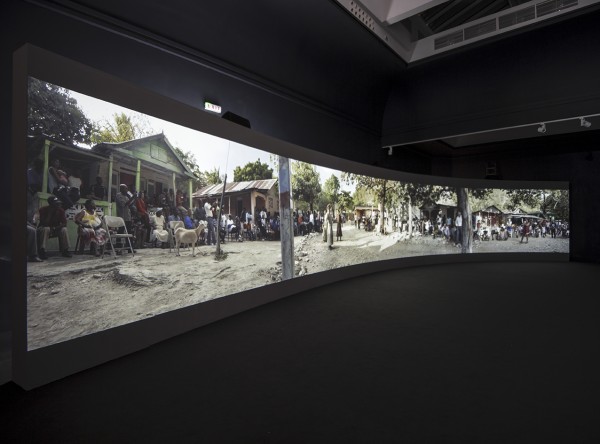
On a dirt road surrounded by low buildings, the inhabitants of a remote village in Haiti gather for an unusual purpose. A cohort of Haitian musicians with string and brass instruments sit on folding chairs, tuning their instruments. At the center of this panoramic view are three performers, incongruous for their obvious European-ness, and for their 18th-century period dress. The orchestra commences, and the performers[…..]

#nationalism #institutions #power #access #globalization #protest #labor #capital The 56th Venice Biennale, “All the World’s Futures,” has been hailed as the “political” Biennale both by its curator Okwui Enwezor and by the international art press. That designation has come in for significant criticism from some who feel that contemporary art either can not or should not address political concerns, given the commodity status of art objects[…..]

#institutions #race #conceptualism #access #appropriation A recent performance at Brown University by conceptual poet Kenneth Goldsmith has resurrected what had seemed to be a long-ago-settled debate. Goldsmith, whose poetic practice is based on appropriation, presented an adaptation of the autopsy report of Ferguson, Missouri, police shooting victim Michael Brown as a poetic reading during the Interrupt 3 arts festival in mid-March. The subsequent commentary has largely taken Goldsmith to task for what many perceive to have[…..]

#artmarket #creativeeconomy #collectors #entrepreneur #philanthropy #support As in nearly every field of commerce, it seems that the tension between old and new models of the business of art is coming to a head. Traditional galleries see that their established methods of selling selectively and covertly to buyers of high social standing are under threat. Museums, which once were beneficiaries of philanthropic largesse from those same[…..]

In a 2012 essay for e-flux, After OWS: Social Practice Art, Abstraction, and the Limits of the Social, Gregory Sholette asks whether there can be a role for abstraction within the flourishing new discipline of socially engaged post-conceptual art practice. This remains a valid question given that most activist art is still understood to be representational, based on precedents from the Civil Rights era such as[…..]












