A. Will Brown is the curatorial assistant of contemporary art at the Museum of Art, Rhode Island School of Design, in Providence, RI. He is a curator, writer, and a regular contributor to Daily Serving, Studio International and Art Practical. He has also written for San Francisco Arts Quarterly, California College of the Arts' Glance Magazine, Alternative Apparel and the RISD Museum’s Manual Journal. Brown has held positions at the Kadist Art Foundation, the Wattis Institute for Contemporary Arts, Triple Base Gallery, Crown Point Press, and the Aspen Art Museum. His curatorial work includes exhibitions, events, and performances for the RISD Museum, Wattis Institute for Contemporary Arts, Kadist Art Foundation, Alter Space Gallery, Triple Base Gallery, and The Luggage Store Gallery.

Two sets of blinds layered over each other—one horizontal, one vertical, both a brilliant clean white—open and close slowly with nearly imperceptible movement. Like a dancer spinning in an endlessly repeating circle with no clear beginning or end, they move without purpose. When fully open, they form a matrix-like grid of perfect, uniform squares with an infinite series of colors glowing beneath, shifting, chemical, and[…..]

The waning glow of the warm desert sun hangs in the air around a lone female figure. She sits nestled atop a rock formation amid yellow grasses and low, twisted trees. As she gazes lovingly toward the fading sun with trim arms folded over her legs, a sense of hard-earned and well-deserved calm settles in, as though this communication with the landscape has rejuvenated her[…..]

Dene Leigh paints, constructs, combines, and assembles his work using traditional and old-master techniques to confront the neurological conditions of human memory. With a mixture of found and trompe l’oeil representations of objects, Leigh creates works that push the boundaries of collage, painting, assemblage, and installation. Many of Leigh’s works deal specifically with the neuropsychological disorder called agnosia, which struck Leigh’s grandfather late in life[…..]

From the height of a pedestrian bridge over a railroad track in Toronto, artist Laura Moore saw the remains of a computer monitor gazing screen- or face-up at her from the tracks. The happenstance experience provoked a number of questions about contemporary society’s rapidly changing relationship and progressive entanglement with technology. Mainly the artist wondered: Why was this monitor marched up a steep set of[…..]

A kayak that goes only in circles, a disappearing art gallery, a film that begins and ends at the credit sequence, and a set of pure gold nails driven into a gallery wall are just some of Northern Italy-based artist Carlo Speranza’s deceptively clever projects. Speranza, as the previous list implies, works across an exceptionally broad range of mediums; his work is made using wood,[…..]

In Düsseldorf, West Germany, amid the tumultuous aftermath of the Second World War, two German artists—Heinz Mack and Otto Piene—founded Group Zero in 1957. Later joined by fellow German artist Günther Uecker in 1961, the three sought to reinvent art in the postwar era and create a vision toward a transformed future through myriad artistic forms: performance, painting, sculpture, exhibition, publication, film, and installation. In[…..]
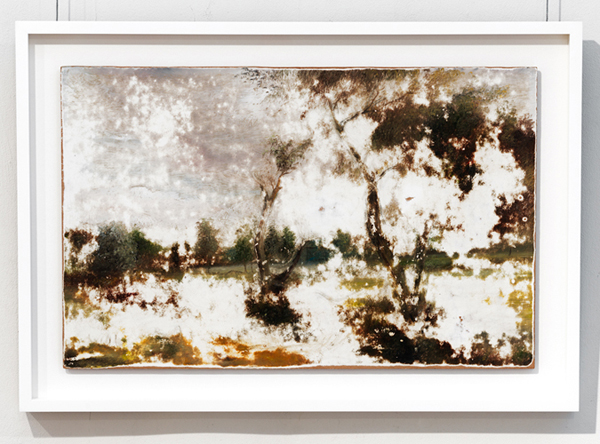
Richard Stone creates paintings, sculptures, and installations that form constellations of meaning. While the works are all distinct—for example, a series of bronze figurines half-covered in smooth, bulbous wax, or a carved white marble flag that ripples in an unseen wind—when exhibited together, they form a cohesive yet mysterious network. Stone is chiefly concerned with art and cultural history. He explores the past through the[…..]












