







Mexico City
G.T. Pellizzi: Yo Transporto at Sala de Arte Público Siqueiros
Art travels. Within the globalized art scene, its journey takes the many forms of traveling exhibitions, international art fairs, biennials, public contests, and loans from personal or institutional collections. Although this wandering condition may enrich the experience of different public spheres by bringing them closer to popular works and major exhibitions, the accelerated speed at which these movements and spectacles take place commands a huge effort at an expense that many public—and even private—institutions can’t sustain.
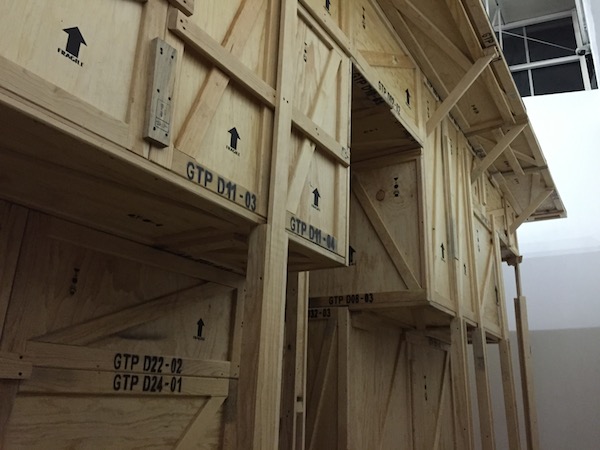
G.T. Pellizzi. Yo Transporto, 2016; wood, plywood, and Ethafoam. Courtesy of Sala de Arte Público Siqueiros.
At Sala de Arte Público Siqueiros (SAPS), G.T. Pellizzi presents Yo Transporto [“I Transport”], an immersive installation composed of one gigantic art shipping crate. The piece is composed of 171 different parts, with each single part possessing a sculptural value of its own. Yo Transporto poses several questions on the institutional politics of touring exhibitions and public funding, while also examining the way that artists contribute to the development of museums from an economic perspective.
Cultural audiences are familiar with traveling exhibitions, art fairs, and other similar events. Art tourism can seem like a viable alternative to increase economic stability for museums and art institutions by attracting more visitors with blockbuster shows. It also serves to capitalize on a specific collection or group of artists, while becoming part of the global sphere in the exchange of culture and knowledge. Nevertheless, in order to operate at a pace to meet these goals, big investments are required, and not every museum can afford it.
Institutions in developing countries, in particular, face many hinging factors. Insurance fees, specialized transportation costs, and professional packaging services are barely reachable. In many cases, conservation standards cannot be met, since the facilities are inadequate or lack the appropriate equipment. Budgets are for the most part limited, if not miserable, while the pressure to enter the global circuit continues to rise. In that sense, the expectations from museums and their exhibition schedules cannot be met, even for the sake of obtaining a more visible cultural stance for their collections.
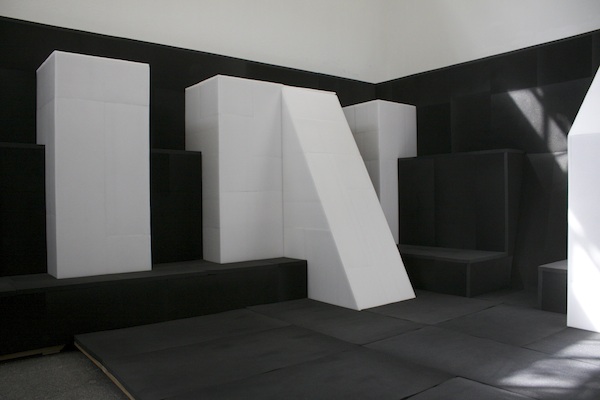
G.T. Pellizzi. Yo Transporto, 2016; wood, plywood, and Ethafoam. Courtesy of Sala de Arte Público Siqueiros.
In Yo Transporto, G. T. Pellizzi subverts the values of all the regulations that accompany artworks during their tours by appropriating an art shipping crate as a sculptural installation. The colossal package is made of wood, plywood, and Ethafoam, and complies with the international standards to safeguard and transport a work of art. Visitors can enter the crate, feel its materials, and walk on the Ethafoam panels. By standing in the middle of the installation, they can be enveloped in many of the otherwise hidden processes entailed in a museum exhibit.
On the day I visited the show, many people were taking pictures of themselves, as if they themselves were the artwork that the crate was protecting and transporting. Through this reenactment, Pellizzi’s installation invites viewers to approach art in an interactive way, while suggesting that even a crate can become a piece. In a separate room, spectators can explore the blueprints, scale models, and the component parts of Yo Transporto.

G.T. Pellizzi. Yo Transporto, 2016; wood, plywood, and Ethafoam; blueprint room view. Courtesy of Sala de Arte Público Siqueiros.
However, the experience of the installation is not the only important asset of the exhibition. Acting within an institutional critique framework, the artist donated the piece to the museum—not as a work to be incorporated into its collection, but to be sold in pieces to collectors. Pellizzi assigned each of the 171 components a unit price, calculating the total value of the production chain for Yo Transporto, which includes materials, builders, carpenters, art handlers, curators, museographers, designers, assistants, security, and museum staff, as well as the costs of insurance, transportation, and the opening cocktail reception.
Within this fundraising scheme, collectors that decide to acquire one of the parts will be helping to rebuild the museum’s “new economy,” as mentioned in the exhibition statement. Yo Transporto was curated by SAPS’s director, Tayiana Pimentel, in a bold move to catch some attention toward public economic politics within INBA—Mexico’s Fine Arts Institute, which is dependent on the state—where museums struggle to accomplish their exhibition projects, as assigned budgets become shorter every year.
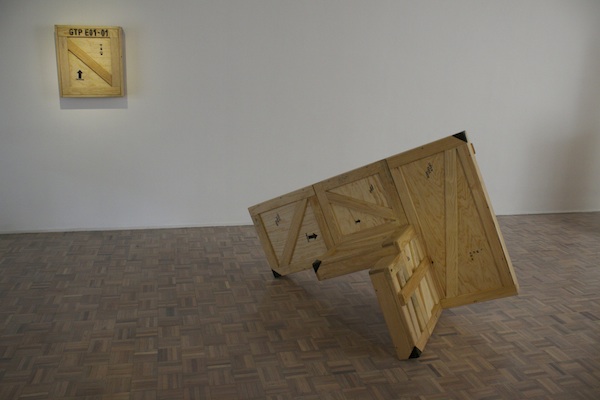
G.T. Pellizzi. Yo Transporto, 2016; wood, plywood, and Ethafoam. Courtesy of Sala de Arte Público Siqueiros.
Despite the effectiveness of this strategy, many questions still linger after visiting Yo Transporto: Is this the future of museum exhibition? Has art, as a public and cultural asset, become unsustainable? Is its importance and accessibility defined by its economic value and its capability of being toured? Will cultural policies that are dependent on the state collapse? G.T. Pellizzi’s exhibition serves to signal the problem and, simultaneously, offers one potential answer to this complex scenario.
G.T. Pellizzi: Yo Transporto at Sala de Arte Público Siqueiros is on view in Mexico City through May 15, 2016.





