







Fan Mail
Fan Mail: Karen Ostrom
Holiday in Hope is the name of the fictional fishing village created by Brooklyn-based, Canadian-born artist Karen Ostrom. Conceived in 2001 in the form of photographic tableaus, the village primarily exists through the depiction of various characters that inhabit it. Holiday in Hope is manifested in threads and series; it’s an implied space that harbors references to communities transformed by industrialization, the erosion of traditional craft-based roles, and historical images of violence.
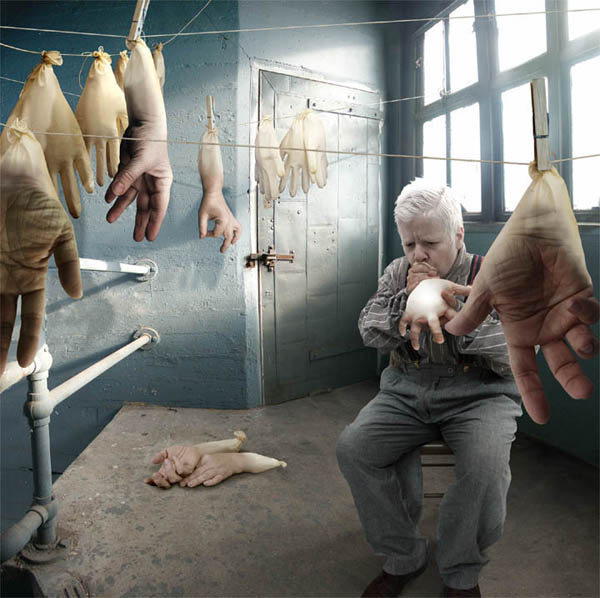
Karen Ostrom. Glovemaker, 2005; chromogenic print; 40 x 30 in. Courtesy of the Artist.
This ongoing project echoes Ostrom’s biography without becoming a strict interpretation of her life. Hailing from a family of Swedish immigrants who flocked to the northwest coast in the early 20th century, Ostrom imagined Holiday in Hope as a reference to the utopian dream many of the Scandinavian immigrants held in their quest for a new home. These immigrants, in search of idyllic landscapes in which to build new and experimental communities, are in some ways the forefathers of the residents of Holiday in Hope.

Karen Ostrom. The Execution, 2005; chromogenic print; 30 x 30 in. Courtesy of the Artist.
Ostrom stays true to her Scandinavian heritage, and her tableaus have a fairytale-like quality that teems with a sense of foreboding. Holiday in Hope is a place full of irony. One of Ostrom’s characters, Glovemaker (2005), embodies a sense of paradox; pictured in what looks like a cold cell or sterile factory space, the glovemaker appears out of place. Played by Ostrom (the artist acts out all her subjects), the figure is surrounded by an array of what Ostrom calls the handglove, which she describes as “a latex glove hybridized with a human hand.” There’s a sense of tragedy in this image—the glovemaker’s craft becomes obsolete when industry is mechanized and hand craftsmanship is lost.
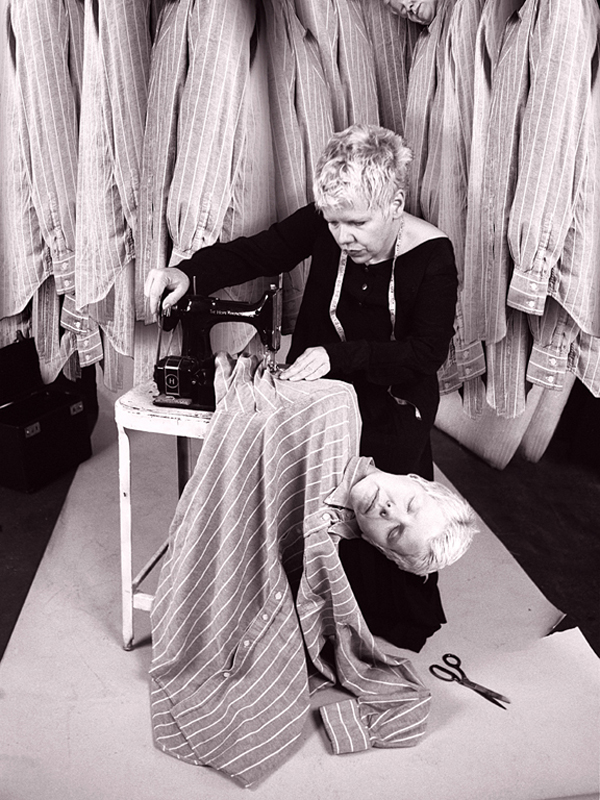
Karen Ostrom. Seamstress, 2005; chromogenic print; 40 x 30 in. Courtesy of the Artist.
In various depictions, there is also a latent sense of violence that varies in emphasis. The violence in Glovemaker takes the form of implied deterioration of the need for “skilled hands.” In The Execution (2005), however, the violence is more pronounced. It echoes one of the more brutal and iconic images of war in modern-day times: Eddie Adams’s Saigon Execution (1968). (Ostrom often uses well-known imagery as a basis for her photographs.) Perhaps this is an attempt to ground the imaginary in the real, but the positioning of the residents of Holiday in Hope in this emblematic composition also has its own peculiar quirks. Both figures in the photograph appear to be one and the same person, and the outfit is the same one that the Glovemaker owns, so is it a self-execution? There is much that is open to speculation. Even though the artist carefully constructs and layers the photographs—she shoots original images and then manipulates them in Photoshop—there is still an element of surprise. In The Execution, Ostrom reveals that the suspenders ominously spelling the word KILL was pure coincidence, but one that aptly captions the subject.
![Karen Ostrom. [The Third of May, 1808], 2012; chromogenic print; 42 x 50 in. Courtesy of the Artist.](/wp-content/uploads/2016/01/ostrom_goya3rdMay.jpg)
Karen Ostrom. [The Third of May, 1808], 2012; chromogenic print; 42 x 50 in. Courtesy of the Artist.
Karen Ostrom is a Canadian-born, Brooklyn-based artist working in photography, installation, video, and, most recently, animation. She is the recipient of MacDowell Colony Artist Fellowships, Canada Council for the Arts Grants, the Duke and Duchess of York Prize in Photography from the Canada Council, and a New York Foundation for the Arts Fellowship.





