







Fan Mail
Fan Mail: Jonas Holmer
A computer programmer by day and an artist and musician by night, Jonas Holmer has created a body of work shaped by multiple frames of reference and methodologies. The Stockholm-based artist produces digital and installation works that explore the play between technology, music, and aesthetics.
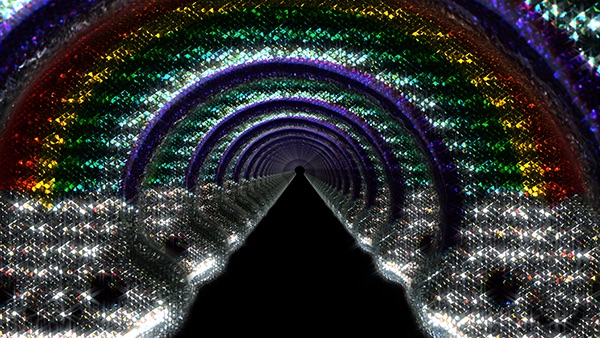
Jonas Holmer. Endless Rainbows, 2012 (video still); looping video installation. Courtesy of the Artist.
Holmer has an eye for creating illusions of depth. Endless Rainbows (2012) is one example of how the artist utilizes graphic and installation techniques aimed at engaging viewers in an immersive sensory experience. In one iteration, the looping video was installed in a small room with a sloping ceiling. To enter, visitors had to crawl through an entrance a little more than three feet high, and sit in a space illuminated only by the spiraling rainbow before their eyes. The recurring circular motion and reverberating sound create an entrancing atmosphere, drawing viewers into a space of contemplation.
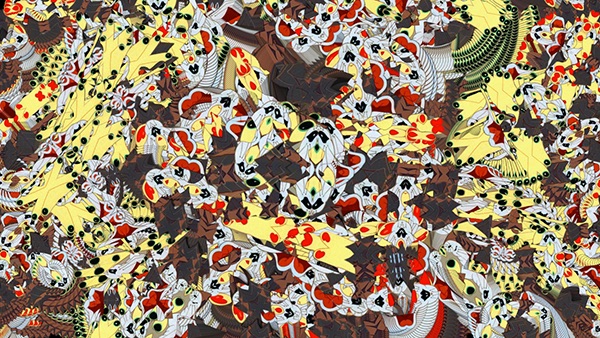
Jonas Holmer. LOVE, 2013 (video still); video animation with sound; 5:55. Courtesy of the Artist.
Holmer’s occupation as a programmer informs his practice as an artist. Evident in works such as LOVE (2013), many of Holmer’s videos are digital manipulations of simple imagery repeated endlessly to create a kaleidoscopic effect. In LOVE, the artist uses one second of footage (24 frames) from an old Tom & Jerry cartoon as input for a program he developed specifically for his art practice. The program operates on a generative system that repeats and mutates the visual elements until the initial input is unrecognizable. The result is an amalgamation of abstract forms and shapes combined with a hybrid of mechanical and natural sounds. LOVE was commissioned for an animation festival in Fredrikstad, Norway, and the film was projected onto various buildings in the city.
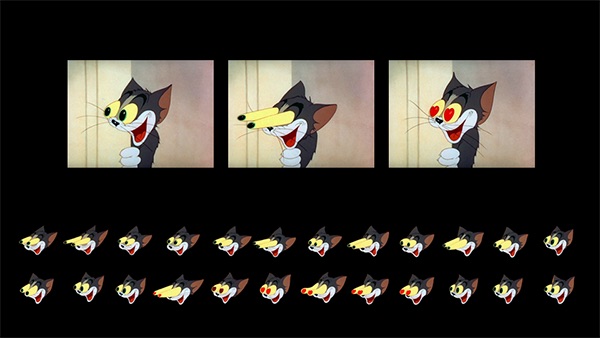
Jonas Holmer. LOVE, 2013 (study); video animation with sound; 5:55. Courtesy of the Artist.
On the challenges of using the tools of computer programming in his production process, Holmer speaks of the overriding tendency to think as a programmer even when acting as an artist. Describing programming as a “complex process burdened with constraints,” the artist is conscious of the limitations (such as flatness and lack of tactility) that come with using the computer as a primary medium for production. Holmer chooses to view these restrictions in a positive light, a way of pushing the boundaries of what can and cannot be done with computing. In Almost There (2014), Holmer uses hand-drawn feathers as the single input for his program, then duplicates and rearranges them in endless hypnotic formations using a video-editing program to the backdrop of a pensive rumble.

Jonas Holmer. Almost There, 2014 (video still); video animation with sound; 10:20. Courtesy of the Artist.
One thread that connects Holmer’s work is his curiosity for systems and frameworks. In Self-Harnessing Harness (2015), the artist reveals this knack in its most tactile form. A sound installation consisting of myriad musical instruments, a fan, and clippings of Holmer’s voice, the work is an experiment in simple methods of creating sound. The different components in this piece act independently, yet are all connected to each other through a series of wires and placements. This seemingly haphazard assembly delivers a symphony that gradually changes in rhythm according to the subtle fluctuations in the arrangement’s various components. Holmer, while having actively selected and composed the parts of this installation, also intended for the piece to take a life of its own. Its odds and ends—held together by a thread, or in this case, a wire—collectively perform a composition that the artist could not have entirely planned. For Holmer, whether in creating art, music, or computer programs, true stimulation lies in the engineering of processes rather than the manufacturing of products.
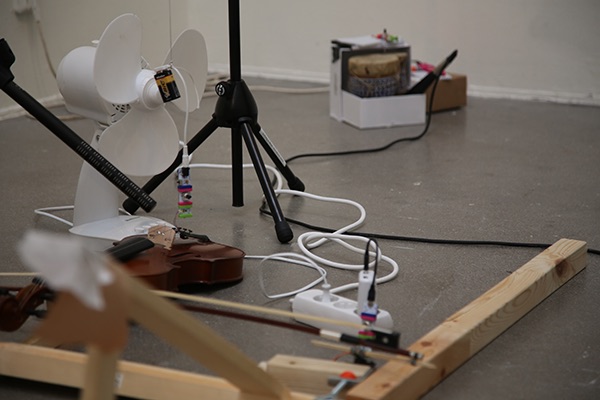
Jonas Holmer. Self-Harnessing Harness, 2015 (installation shot); violin, drums, motors, mp3 player shuffling clips of the artist’s voice, oscillating fan, mics, guitar pedals, mixer, speakers. Courtesy of the Artist.
Jonas Holmer is an artist, musician, and software developer. He is currently finishing his MFA at Konstfack, Stockholm (University College of Arts, Crafts and Design). His main output in the last years has been in the form of animations, sound art, tapes, computer games, and installations.





