







San Francisco
Paul Graham: The Whiteness of the Whale
From our partners at Art Practical, today we bring you a review of Paul Graham: The Whiteness of the Whale at Pier 24 Photography. Author Forrest McGarvey states, “Graham uses the controlled process of photography, from aiming through the viewfinder to the adjustment of color on the final prints, to depict his vision of American life.” This article was originally published on November 19, 2015.
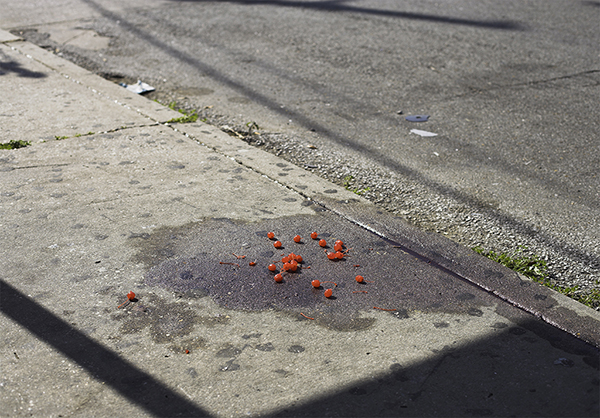
Paul Graham. New Orleans (Cherries), 2005. Courtesy of the Artist and Pier 24 Photography, San Francisco.
With almost sixty works from three series spanning thirteen years, Paul Graham: The Whiteness of the Whale is the first single-artist show installed at Pier 24 Photography. In the work, British artist Paul Graham has taken America as his subject of interest, traveling to various states and documenting people, places, and objects. American Night (1998–2002) presents large 4-by-5 prints of waiting, wandering, and isolated subjects overexposed into obscurity along with dense, colorful prints of large California houses decorated with candy-red cars and pristine blue skies. In The Present (2009–2011), Graham took to the streets of New York, producing sequential street photography–style shots that play with senses of space and time. The last series installed, A Shimmer of Possibility (2004–2006), fragments the silence and stillness found in American Night into multiple perspectives in collections of images of parked cars, empty lots, and sunsets.
As a viewer moves through the massive show, Graham’s strategies for selecting his subjects and manipulating the formal qualities of the images become more apparent, resulting in a romanticized spectacle that leaves the viewer feeling ambivalent and unfulfilled. Graham uses the controlled process of photography, from aiming through the viewfinder to the adjustment of color on the final prints, to depict his vision of American life. The combination of banal, conventional subject matter and striking visual techniques ultimately reduces the work to its formal qualities. In American Night, Graham manipulates light to build contrasts between works with nearly invisible content and others saturated with intense color. But the differences between overgrown back roads in Louisiana and opulent homes in California are obvious, and the sense of drama depends on tired tropes of the empty plasticity of wealth and the transient non-places of poverty. By further playing up these perspectives through the massive scale of the photographs, Graham leaves a viewer feeling uncomfortable about accepting these imposing yet generic visualizations of economic standing.





