







San Francisco
Raiders and Empires
Today from our partners at Art Practical, we bring you the latest iteration of Genevieve Quick’s “Locating Technology” column, which “[…] explore[s] the evolution of technology and its effects on artists’ processes, disciplinarity, and the larger social context of media creation, dispersal, access, and interactivity.” Quick says of Stephanie Syjuco’s project, “As hybrid image/objects, the ‘ceramics’ in RAIDERS traffic in the tension with reproduction, illusion, space, and place.” This article was originally published on October 27, 2015.
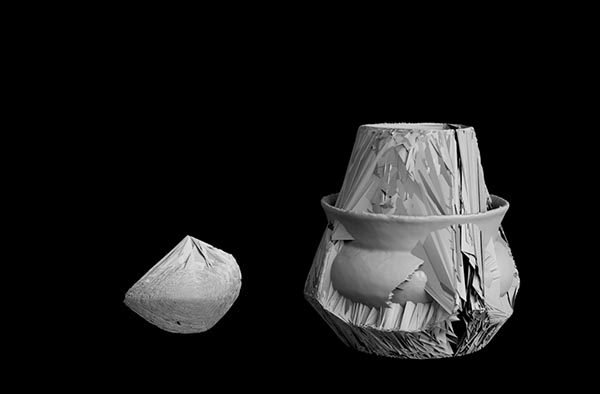
Stephanie Syjuco. Empire/Other: Morphset E, 2013 (video still); 3D animated video. Courtesy of the Artist and FLACC Workplace for Visual Artists, Belgium.
Much of the history of museum collections is related to the concentration of wealth and power of empires, and more recently corporate monopolies. While museums take great care in contextualizing the aesthetic, cultural, and historical significance of their artworks, they often omit most of their objects’ acquisition histories. These backgrounds, extending from antiquity to present, would most likely include emperors and profiteers, along with their contemporary counterparts: the business tycoons that museums name as donors. In RAIDERS: International Booty, Bountiful Harvest (Selections from the Collection of the A____ A__ M_____) (2011) and Empire/Other (2013–ongoing), Stephanie Syjuco alludes to the questionable acquisition of museum artifacts. In these projects Syjuco harnesses technologies of distribution and reproduction—the web, photography, and 3D scanning and printing—to create objects that reveal the tangled history of colonization and cultural hybridization. Syjuco’s web-sourced imagery and 3D manipulations create imperfect objects that declare their simulation while entering into the same economic exchange system as the artifacts that they reference.





