







Seattle
Franz Erhard Walther and Pae White at the Henry Art Gallery
The Henry Art Gallery in Seattle opens two exhibitions, Franz Erhard Walther: The Body Draws and Pae White: Command-Shift-4. The featured artists—albeit separated by 24 years and 5,600 miles—create a compelling juxtaposition, revealing shared interests in graphic art, architecture, and fiber as mediums that shift between sculpture and performance. Both artists produce works that are liminal and in flux—forever making and remaking themselves through direct interaction.

Franz Erhard Walther. The New Alphabet; installation view, Franz Erhard Walther: The Body Decides at WIELS, Brussels. Courtesy WIELS & the Franz Erhard Walther Foundation. Photo © 2014 Sven Laurent.
As the first major U.S. retrospective of works by German artist Franz Erhard Walther (b. 1939), The Body Draws presents nearly 300 artworks spanning 1957 to 2015. The exhibition delves into the artist’s process, displaying sketches and renderings alongside finished works to emphasize the significance of drawing within his practice. The notion of drawing, however, is further expanded in performance-based works to include the ethereal marks made by the body as it travels through space.
The exhibition begins with a selection of Walther’s youthful creative exploits, and includes Wortbilder (1957–58), a series of typographic experiments produced while the artist was enrolled at Werkkunstschule Offenbach, a school of design and applied arts. The influence of design—as a process, set of materials, and a way of conceiving of the relationship between humans and things—resounds throughout the trajectory of Walther’s career. Wortbilder is explicitly tied to the Bauhaus legacy, which challenged designers to see and leverage image, text, color, and form as communicative tools for creating meaning.
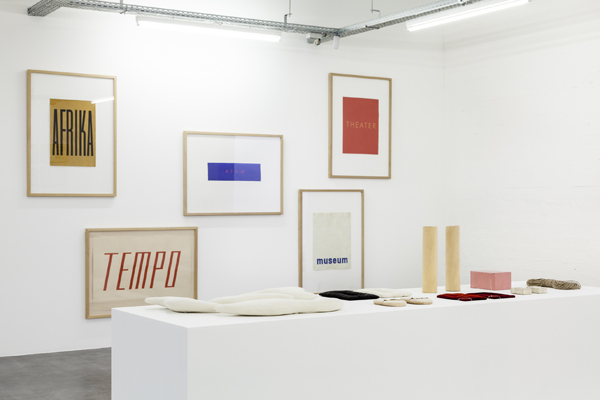
Franz Erhard Walther. Selection of Handpieces and Word Pictures; installation view, Franz Erhard Walther: The Body Decides at WIELS, Brussels. Courtesy WIELS & the Franz Erhard Walther Foundation. Photo © 2014 Sven Laurent.
In the 1960s, Walther began experimenting with the material and conceptual potential of art. As with many of his Minimalist contemporaries, Walther cultivated an interest in performance, regarding the gesture as a central component of his practice. Lufteinschlüsse (1968) is a series of eighteen air enclosures—two sheets of paper fused together with glue that, before being entirely sealed, were inflated with a pocket of air. Walther, who was accustomed to assembling layered desserts in his parents’ bakery, formed these paper sculptures that, like the crackled surfaces of puff pastry, represent a gesture enshrined in material form.
Werksatz (First Work Set) (1963–69) comprises fifty-eight objects, in addition to thousands of instructional sketches, to support specific choreographed interactions. The objects are crafted in lightweight undyed canvas, and are tied in bundles like ready-for-issue military kits. Unfurled, each element becomes a series of sheets and oddly designed garments for collective use. Activations consist of participants wearing, holding, and being covered by the cloth. Executed in silence, the works often veer from pleasantly meditative to uncomfortably prolonged. In this age, the snaps of cellphone shutters divert attention away from the pieces as living, breathing, and ephemeral objects, taking the performances to a wholly other dimension online—an interesting social turn that is a far cry from Walther’s 1960s intent.
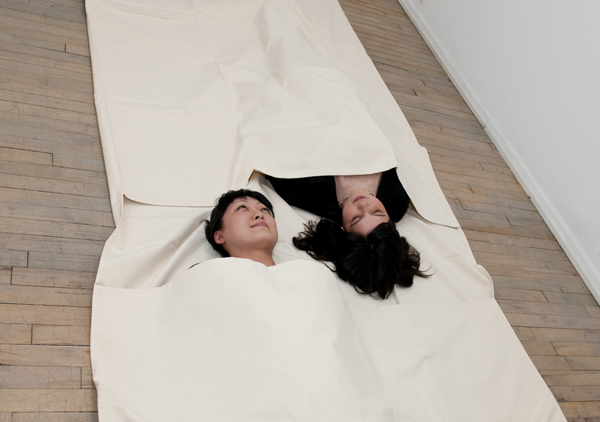
Franz Erhard Walther. Kopf zu Kopf ueber Kopf (Nr. 24, 1.Werksatz), 1967; sewn canvas; 166 1/8 x 58 1/2 in.; activation in Franz Erhard Walther, Peter Freeman, Inc., New York, March 11-May 1, 2010. Courtesy of Peter Freeman, Inc. Photo: James Dee.
Referred to as “instruments of process,” the objects demand a type of performative interaction that continues to frame more recent works. 55 Handlungsbahnen (Action Paths) (2003–2009) is a contemporary and much more colorful iteration of the Werksatz project. Made from rolls of industrial canvas dyed in burgundy, cobalt, sage, and orange tones, the pieces abandon the garment-like aesthetic of the earlier set in favor of designs that are more architectural—a vocabulary that is somewhere in the realm of midcentury modern meets 1970s athletic and outdoor.
In the 1980s and ’90s, Walther drew inspiration from architecture, designing various Configurations composed of geometric fiber sculptures that are installed as clusters on walls or human-scale obstructions protruding from gallery floors. Das Neue Alphabet (1991–1994) expands the two-dimensional practice of typography into three-dimensional sculptural forms. Monumental G, W, and Z, on view at the Henry, operate as whimsical interlocutors amid Walther’s very stoic, conceptual forms.
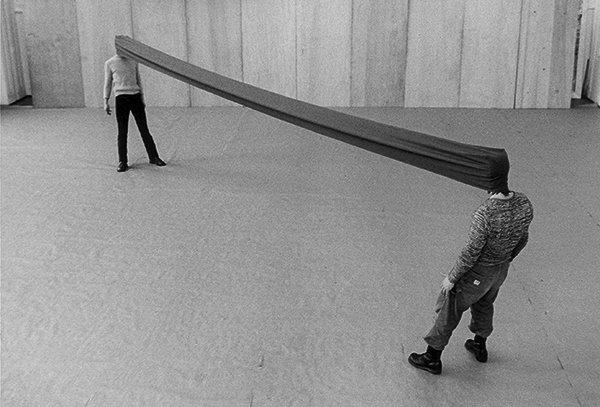
Franz Erhard Walther. Sehkanal (with body weight and exertion exposing one’s opposite number to one’s gaze – sight channel) Single Element n°46 of 1.Werksatz, 1968; green fabric; 30 x 740 x 20 cm. Courtesy of Galerie Jocelyn Wolff. Photo credit: Timm Rautert. Copyright Franz Erhard Walther Foundation, Timm Rautert.
In 1971, Robert Morris claimed to “want to provide a situation where people can become more aware of themselves and their own experience rather than more aware of some version of [his] experience,” a statement that articulately and succinctly illustrates two approaches to involving the audience within performance art. Minimalists, like Walther, stipulate that participation is elicited when a work invites completion through its physical interaction. Walther’s actions are scripted, eliminating the possibility for surprise in the performance of his works.
In contrast, Pae White’s Command-Shift-4 operates in the trajectory of Fluxus and Allan Kaprow, eliminating any separation between art and viewer. For White, the individual embodied experience of the work is the true subject of art, produced through physical and social performance. Command-Shift-4 is composed of graphic forms, mirrors, and cheery craft yarn stretched and overlaid like intersecting warps of a room-sized loom. It is a dynamic sensory experience, evoking the visual play of Op Art, combined with the commercially driven message making of graphic design. Inspired by a photograph taken of Sea Ranch, a visionary 1960s housing development on the coast of northern California, the installation intends to reflect the experience of walking into a screen grab, shifting, pixelating, and diffusing as visitors make their way through the gallery space.
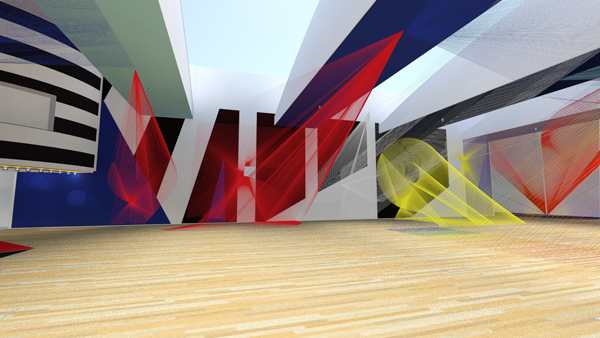
Pae White. Digital sketch for the installation Command-Shift-4. Courtesy of the Artist.
The Body Draws and Command-Shift-4 both explore experience as a medium for the production of art. Walther’s series of action-based works require the artist to lurk in the margins, overseeing the production of meaning as the pieces are remade through the decades. White removes her authorial agency, relinquishing control over making and meaning to allow surprise and delight to creep in. In tandem, the two projects illustrate the range of performance art and sculpture, creating intriguing investigations into the embodied experience of contemporary art.
Franz Erhard Walther: The Body Draws is on view at the Henry Art Gallery in Seattle through March 6, 2016; Pae White: Command-Shift-4 is on view through January 24, 2016.





