







Fan Mail
Fan Mail: Ashley Pastore
Ashley Pastore has a thing for old science and life magazines. Poring over dated issues of National Geographic, Pastore has come to appreciate the visual aesthetic and color palette of print from the ’50s to ’80s, which she describes as being rich, deep, and full-bodied. After scouring Craigslist and rummaging through random thrift stores, the artist now has a sizable collection of vintage magazines that have effectively become her medium of choice in her ongoing collage print series.
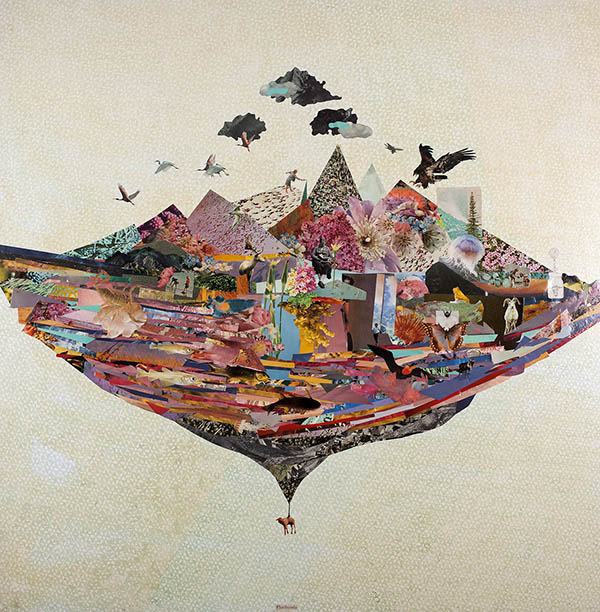
Ashley Pastore. Floribunda; lino-block print, cut magazine on board; 48 x 48 in. Courtesy of the Artist.
Hailing from Erie, Pennsylvania, where she currently lives and works, Pastore studied material studies and printmaking at the Cleveland Institute of Arts, indicating an appreciation for tactility that she incorporates into her practice. Floribunda is a piece that demonstrates Pastore’s knack for the material. Using a combination of lino-block print and collage, Pastore has layered magazine cutouts of flora and fauna onto a flat, patterned background to create an intricate, textured canvas of colors and forms.
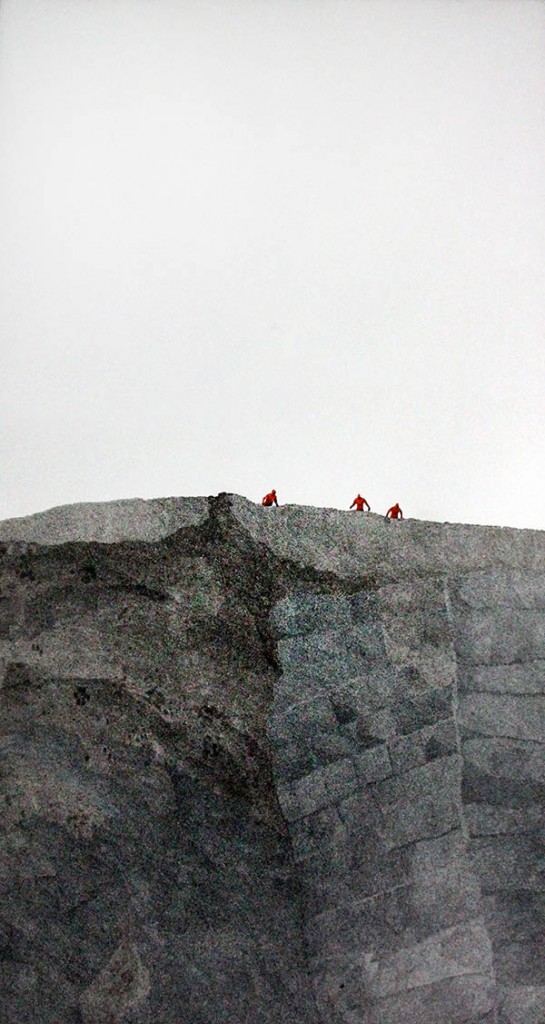
Ashley Pastore. Can’t See a Thing; pen, cut magazine; 50 x 28 in. Courtesy of the Artist.
To produce a sense of depth in her paper compositions, Pastore performs the manual process of pattern repetition. At first glance, Can’t See a Thing looks like an image of rocky terrain—perhaps a cut out from a geology magazine—but in reality, the boulder-like effect is created through an infinite number of hand-drawn circles that are so small they appear to be more like specks. For Pastore, this technique serves practical and conceptual dimensions, which both connect to the notion of time. In the reverie-inducing process of creating countless circles, a sense of presence is conjured. The attempt to memorialize a collective conscience is reflected in the tiny circles producing a larger whole. The very act of Pastore’s creation and the time it entails is, in a sense, a tribute to the seemingly insignificant ways in which people choose to spend their time, that yet ultimately adds to the “vastness of the human experience.”
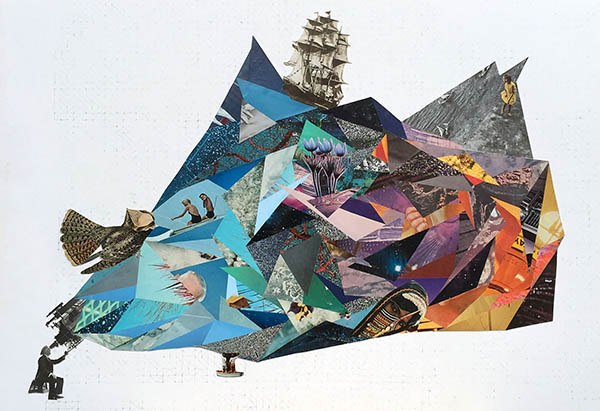
Ashley Pastore. The Divine Difference; acetone transfer, cut magazine; 31 x 21 in. Courtesy of the Artist.
The notion of the individual within the collective is a running theme throughout Pastore’s body of work. In The Divine Difference, for example, the contrast in scale between the male figure and the amalgamation of world imagery branching out across the canvas is a testament to the dichotomy in the human condition—of being at once distinct and connected. In Yolo, Pastore inverts the scale, making the human figure the centerpiece of the work amid a dual pattern of lines and geometric forms. In this work, the atom-like composition surrounding the human face becomes symbolic of the single unifying unit that lies at the core of all matter, thereby emphasizing the interconnectedness of the universe.
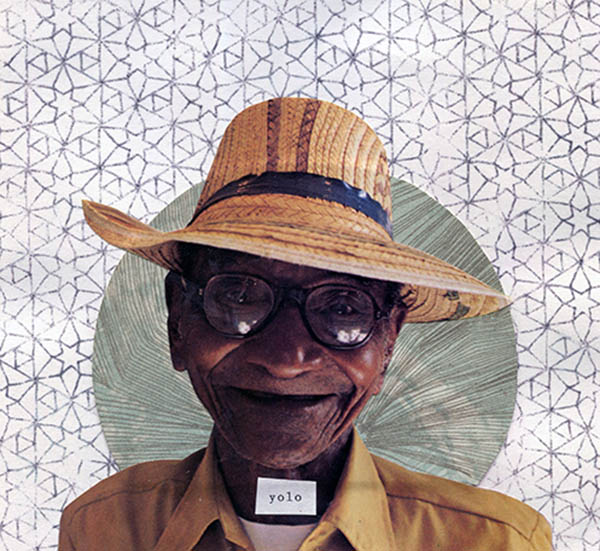
Ashley Pastore. YOLO; lino-block print, acetone transfer, cut magazine; 23 x 26 in. Courtesy of the Artist.
While there is a discernible humor in Pastore’s work (in Real Women Make Their Mark, for example), a more salient feature of her pieces might be instead a sense of the post-apocalyptic in the space of human consciousness. By collapsing a multitude of faces, objects, and terrains onto a backdrop of spiraling motifs, Pastore has established an otherworldliness—an alternative space where the micro and the macro exist in unlikely conjunction with one another, yet appear harmonious nonetheless. In some ways, Pastore’s work is similar to that of Egyptian artist Basim Magdy, whose photographs and works on paper depict landscapes that are nameless and timeless, and are meant to call upon the viewer’s subconscious to imagine a realm without borders or temporal mandates. In the same vein, Pastore’s collages are an invitation to spend time in the space of the past, present, and future, all at once. Her use of antiquated magazines that evoke the aesthetic of another era offers an opportunity for nostalgia, while the involved layering of her canvases calls upon the present act of looking. Between memory and recognition, Pastore’s polychromatic compositions inspire an openness toward the improbable made probable, through an appreciation for the power of imagination.

Ashley Pastore. Real Women Make Their Mark; pen, tea, cut magazine; 40 x 32 in. Courtesy of the Artist.
Ashley Pastore is an American artist who lives and works in Erie, Pennsylvania. She completed her BFA at the Cleveland Institute of Art and has since shown her work in exhibitions in Texas, New Mexico, and Ohio. Some of Pastore’s residencies include one at the Austin Museum of Art in Texas and another at the Redmoon Theater in Chicago.





