







San Francisco
Davina Semo: APPROACH OR ENTER at CAPITAL
Shotgun Reviews are an open forum where we invite the international art community to contribute timely, short-format responses to an exhibition or event. If you are interested in submitting a Shotgun Review, please click this link for more information. In this Shotgun Review, Colin Fernandes reviews Davina Semo: APPROACH OR ENTER at CAPITAL in San Francisco.
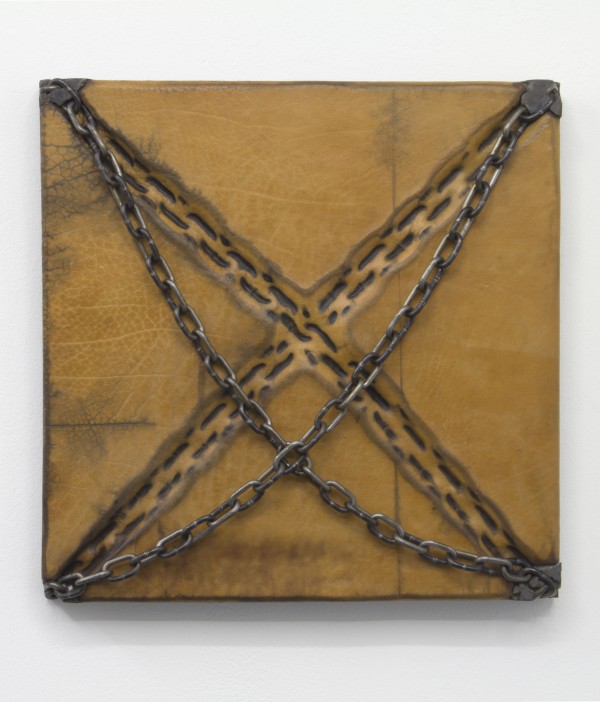
Davina Semo. SHE FOUGHT WITH THE KID WHO THREW ROCKS AT HER DOG, 2015; leather, pigmented reinforced concrete, waxed steel chain; 18 x 18 x 2 1/2 in. Courtesy of the Artist and CAPITAL, San Francisco.
APPROACH OR ENTER, the title of Davina Semo’s solo show at Capital Gallery, is both a taunt and a caution. Five Brutalist sculptures rendered in industrial materials compose the show. Their hard, sharp surfaces evince a sinister feel.
At seven feet tall, the largest sculpture is a concrete slab propped up against the wall. Brightly colored glass spikes puncture its surface, creating the appearance of a “bed of nails,” albeit one with the sharp points oriented away from the viewer. A smaller slab with spikes rests on the gallery floor. A pair of sizable concrete-and-leather squares are hung at about torso height; both incorporate waxed steel chains arranged in a cruciform manner to form harnesses of sorts. The final piece is a sliver of blackened cast bronze, 21 by 1/2 by 1 and 1/8 inches in dimension. I could imagine its use as a striking weapon, or as a “sound” with which to examine a bodily orifice.
The use of force is most explicitly embodied in the quadrate wall sculpture titled SHE FOUGHT WITH THE KID WHO THREW ROCKS AT HER DOG (2015). Its tan leather surface bears imprints of the overlying chains, as well as dark blemishes. If this were an autopsy, I might conclude the victim had sustained blunt trauma injuries.
The muscular, minacious quality of the artworks coupled with their formal installation in the clinical gallery space evoked an interrogation chamber, the sort of institutionalized power structure that employs pain, or the threat of pain, as a means of coercion and control. The suffering body is implied but conspicuous in its absence. It is as if Semo is calling attention to that which is unseen and unspeakable. To borrow the words of Elaine Scarry, the artist “bestows visibility on the structure and enormity of what is usually private and incommunicable, contained within the boundaries of the sufferer’s body.”[1]
An added interpretive layer is the manner in which Semo titles her works. Phrases are gleaned from text messages, emails, literature, sports commentary, and overheard conversation.[2] I struggled to find easy connections between these often-long phrases and the respective artworks. In the context of this show, however, this “mismatched” method of titling functions as an allusion to pain’s inexpressibility via language, and to the incomprehensible, meaning-destroying nature of the pain experience itself.
Standing beneath the white lights at Capital Gallery, surrounded by these (potential) instruments of pain, I imagined my own body in violent relationship to the art: head slammed against concrete, chest shackled by chains, flesh impaled on glass spikes, orifices violated by the metal rod. It has been a week since I visited this show, and I can still feel the might of its impact.
Approach or enter, she said, at your own risk.
Davina Semo: APPROACH OR ENTER is on view through October 17, 2015, at Capital Gallery, San Francisco.
Colin L. Fernandes is a pain medicine physician, writer, and collector. His writing has appeared in the New York Times, the Contra Costa Times, a Penguin anthology, the San Francisco Arts Quarterly, and the online magazines Art Practical and Daily Serving.
[1] Elaine Scarry, The Body in Pain: The Making and Unmaking of the World (New York: Oxford University Press, 1985)
[2] http://www.interviewmagazine.com/art/davina-semo-ruder-forms-survive#_





