







San Francisco
Mechanized Bodies: Anxiety and Healing in a Global Economy
Today from our partners at Art Practical, we bring you an essay on art, manufacturing, and workers’ bodies. Author Genevieve Quick explains, “Whether in the U.S., Mexico, or India, workers endure the same cycle: becoming part of a larger network of production that can be disassembled and relocated, rendering them redundant. Assembly-line production has taken its toll on workers’ bodies since the beginning of industrialization, and its absence is also felt as a traumatic experience.” This article was originally published on August 18, 2015.
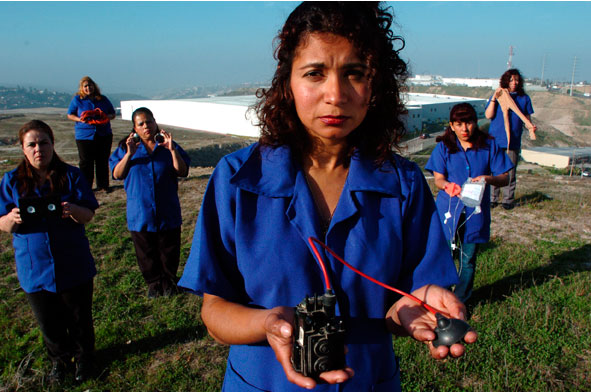
Vicky Funari and Sergio De La Torre. Maquilapolis (City of Factories) (still by David Maung), 2006; film; 68:00. Courtesy of the Artists.
We tend to consider how technology and machines alter our bodies from the consumer’s end, as with our daily use of wearable or smart devices (watches, fitness trackers, phones, and more) and the more fantastic, cutting-edge neuroprosthetics and artificial organs. Our products and technologies, however, are made by individuals on assembly lines whose bodies are also imprinted by the manufacturing process. During the rise of industrialization in the U.S., Charlie Chaplin’s Modern Times (1936) presciently satirized the way in which assembly-line work automates the body, such that the body is disoriented when removed from work. As our economies globalize, manufacturing not only expands to different regions, but also migrates from one region to another. When manufacturing exits an area, it leaves its trace on workers’ bodies. Jesse Sugarmann’s We Build Excitement (2013) and Vicky Funari and Sergio De La Torre’s Maquilapolis (City of Factories) (2006) explore the plight of unemployed American autoworkers and struggling Mexican factory workers. As their video and film projects feature collaborators miming their assembly-line jobs, they reveal the automation of the body and the void left in the global migration of manufacturing. While Surabhi Saraf’s Remedies: Capsules and Remedies: Tablets (both 2014) also use the physical gesture of assembly-line production, she transforms the manufacturing process into a ritual process of healing.





