







Fan Mail
Fan Mail: Tavis Lochhead
Toronto-based artist Tavis Lochhead has a knack for the surreal. In his photo collage series Habitat, large sections of industrial sites are digitally manipulated into semi-abstract compositions that disrupt the mundane aesthetics of manufacturing zones. In each work, the central figure—what the artist describes as “a sculptural element floating in space”—is an assemblage produced by an elaborate process of merging, mirroring, and stitching.
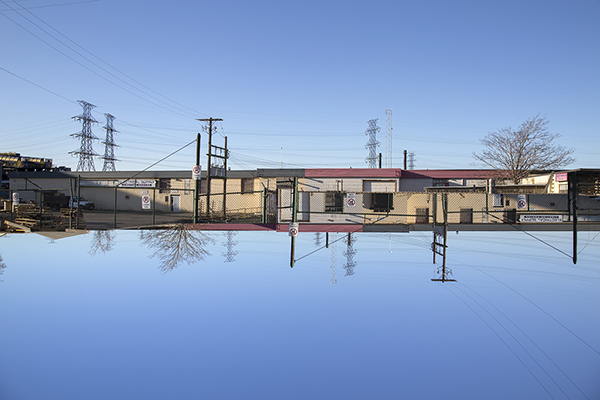
Tavis Lochhead. Habitat 1, 2015; digital image. Courtesy of the Artist.
Initially trained in architecture, Lochhead describes his interest in reimagining industrial landscapes as an exploration of perspectives that emerges from playing with the laws of physics. What would nondescript structures look like if they were turned upside down? What happens when the elements of everyday life are subjected to new parameters that serve to accentuate their normally muted presence? In Habitat 1 (2015), the boxy quality of the building is contrasted by a series of perpendicular protrusions both artificial and natural. Between electric towers, telephone poles, and barren trees (upright and inverted), the composition offers a glimpse into an alternative realm of vantage points and perspectives that defy logic and create a compelling space for experimenting with the mundane. The particular construction of this image lends itself to a subtle enunciation of the various lines and planes that exist in overlooked environments, ranging from the multicolored corrugated rooftops to the diagonal wiring that breaks the symmetry of the scene.
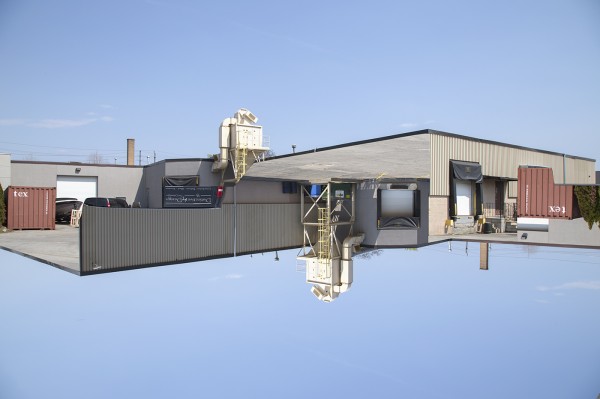
Tavis Lochhead. Habitat 10, 2015; digital image. Courtesy of the Artist.
Lochhead’s fascination with industrial sites may be attributed to their pervasiveness in our modern era. Though they are formally and conceptually different from Lochhead’s work, Bernd and Hilla Becher’s famous industrial typologies serve as one precedent to the act of isolating and organizing manufacturing structures as a method of examining their formal qualities, as well as a commentary on the advent of the industrial age. Another more contemporary example would be Jenny Odell’s borderline obsessive survey of elements such as water tanks and nuclear cooling towers as seen on Google Maps. Like Lochhead, Odell uses Photoshop to cut up and reconfigure these structures into patterns that reveal the sheer ubiquity of industrialized landscapes today.
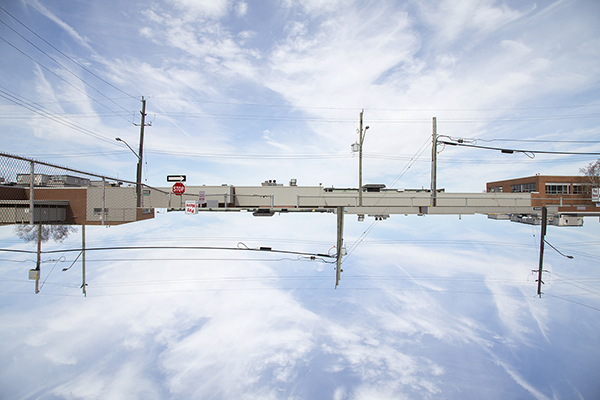
Tavis Lochhead. Habitat 7, 2015; digital image. Courtesy of the Artist.
In Habitat 10 (2015), the mirroring and juxtaposition of structures against the clear stillness of a pale blue sky can be seen as a disorienting exercise in visual gymnastics. Where does one building end and another begin? Additionally, the seamlessness of the artist’s technique and the matte-like quality of the sky create an element of flatness that confuses the figure–ground relationship between the structure and its environment. In Habitat 7 (2015), Lochhead confounds the minimal quality of his chosen building; the anti-gravitational effect he evokes in the suspension of the horizontal building, telephone poles, and wires against the sprawling backdrop of clouds is simultaneously unsettling and quasi-ethereal.
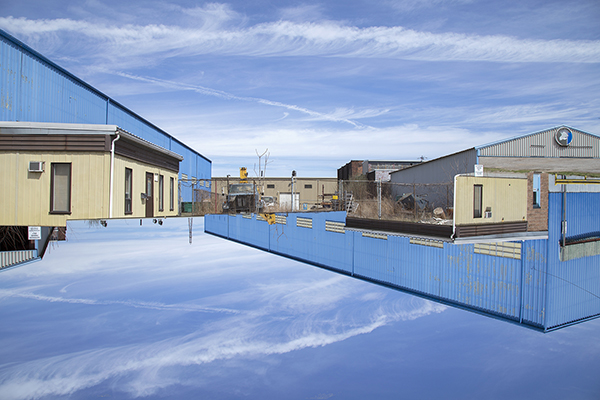
Tavis Lochhead. Habitat 9, 2015; digital image. Courtesy of the Artist.
Another disorienting factor in Lochhead’s series is the deliberate omission of basic contextual information, such as the specific function of the buildings or the location of their sites. They could be taken anywhere—and maybe that is precisely the point. In looking at these structures, stripped completely of identifying factors or bearings, viewers are forced to examine the formal typology of these spaces strictly from a visual and aesthetic standpoint that speaks to their materiality and compositional substance.
As Lochhead continues to evolve his practice and exploration of landscapes, it is possible to look at his semi-fantastical assemblages as a reflection of the rapidly growing industrial ecology, its visual manifestations, and the thin line often separating the mundane from the extraordinary.
Tavis Lochhead is a Toronto-based visual artist who uses his photography as a medium to create surreal visuals of architecture and landscapes. He holds a BSc in architecture from McGill University and has exhibited his work in solo and group exhibitions at Papeterie Nota Bene in Montreal, and online at Saatchi Art.





