







New York
Zoe Beloff: A World Redrawn at the James Gallery, CUNY
It is a strange fact that Theodor Adorno, Max Horkheimer, Arnold Schoenberg, Thomas Mann, and Bertolt Brecht all resided in Los Angeles, California, in the 1940s. Unsurprisingly, few of them found their wartime haven a particularly sympathetic milieu. Brecht’s stay was especially ill-fated, ending with his interrogation by the House Un-American Activities Committee (HUAC) and consequent return to Berlin. A decade earlier, the Latvia-born film director Sergei Eisenstein had found himself similarly blacklisted by the Hollywood establishment and left North America without having realized the major film that Paramount Pictures had contracted him to execute.
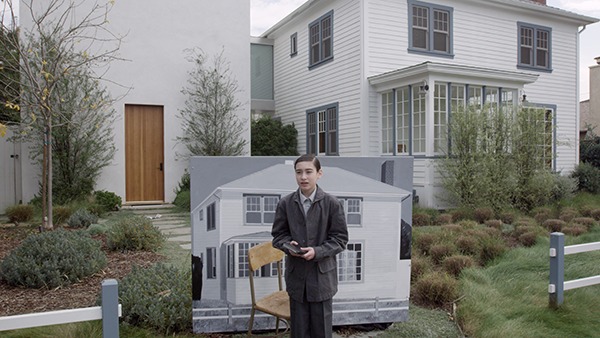
Zoe Beloff. Two Marxists in Hollywood, 2015 (film still). Courtesy of the James Gallery, Graduate Center, CUNY.
Zoe Beloff’s current exhibition at the James Gallery of the Graduate Center, City University of New York (CUNY), A World Redrawn: Eisenstein and Brecht in Hollywood, assembles materials from the Russian State Archive of Literature and Art and the Bertolt Brecht Archive in Berlin to explore Brecht’s and Eisenstein’s exceptionally unproductive years in the City of Angels and the embittered flights of fancy to which they gave rise. Specifically, Beloff takes up two unrealized projects, Brecht’s sketch for a film called A Model Family in a Model Home and Eisenstein’s idea for a film called The Glass House, both thinly veiled allegorical attacks on the state of American culture, set in a rapidly changing domestic sphere.
Through three mock-documentary films (the most memorable of which includes interviews with a fictional Brecht and Eisenstein, played by young boys before the backdrop of present-day L.A.) and associated ephemera, including props, architectural models, and promotional-style posters in pencil and watercolor, Beloff departs from her archival source material to creatively give voice to her subjects, often speaking through them to lament the inhumane speculative capitalism of today. In large part, the result hews closely to well-worn hagiographies of Brecht and Eisenstein as heroic avatars of leftist opposition. To this extent, the exhibition is something of a plod, frequently calling into question its reason for existence, and Beloff’s didactic, recurring references to the 2008 subprime mortgage crisis make for a less than satisfying answer. The show’s better moments, in contrast, are the ones when Beloff allows the idiosyncrasies and contradictions of her subjects to shine through, adumbrating the potential of a more revisionist approach.
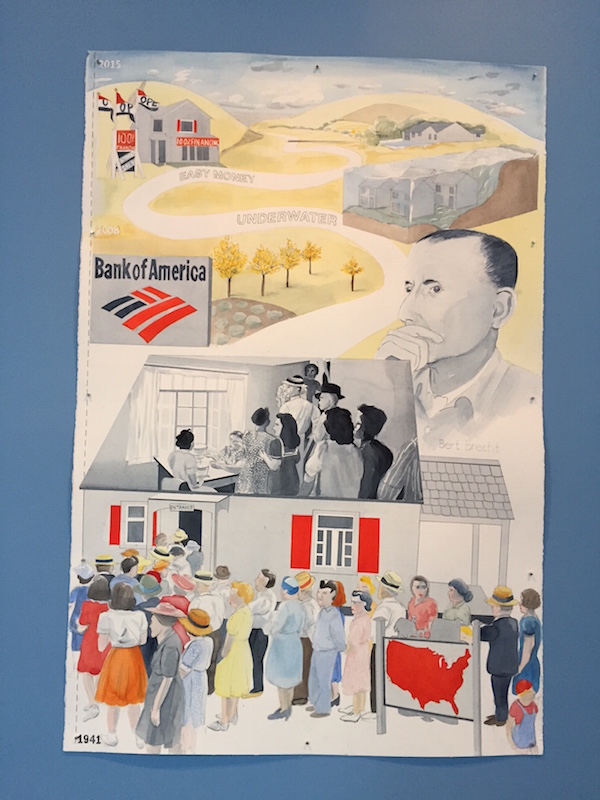
Zoe Beloff. American Home Ownership, 2015; watercolor on paper; 40 in. x 60 in. Photo: Alex Bigman.
A Model Family in a Model Home was Brecht’s idea for a film inspired by a Life magazine story about the Engels, “Ohio’s most typical farm family,” who for ten days during the 1941 State Fair lived in a model home before an audience of war-weary fair-goers eager to consume such a theater of normalcy. In Brecht’s story, the spectacularly commodified family publicly implodes, ending in divorce and dissolution.
Naturally, Hollywood had little interest in Brecht’s anti-ideological brand of epic theater, of which A Model Family was an especially brazen example. In one particularly insightful statement unearthed by Beloff, Brecht observes that Hollywood’s concept of realism demands characters who seem preternaturally disposed to maneuver though the existing social system, as opposed to ones who chafe at or reject it—gangster films being one counterexample of which Brecht approved. Beloff generally depicts Brecht as the latter type, and yet she allows one compelling contradiction to emerge: Though Brecht steadfastly refused to compromise his work to suit the demands of the Hollywood dream machine, he never ceased trying to make inroads there. Endeavoring day in and day out to sell his agitational wares, he soon found himself an embittered pauper. “Almost nowhere has my life ever been harder than here in this mausoleum of easy going,” he said.[1] Yet even as late as his humiliating testimony before HUAC, reproduced by Beloff in her film A Model Family in a Model Home, we hear the Marxist author attempting to construe his work as revolutionary only in the antifascist sense, the one most aligned with American patriotism. It sounds like the voice of someone still ardently hoping for acceptance.
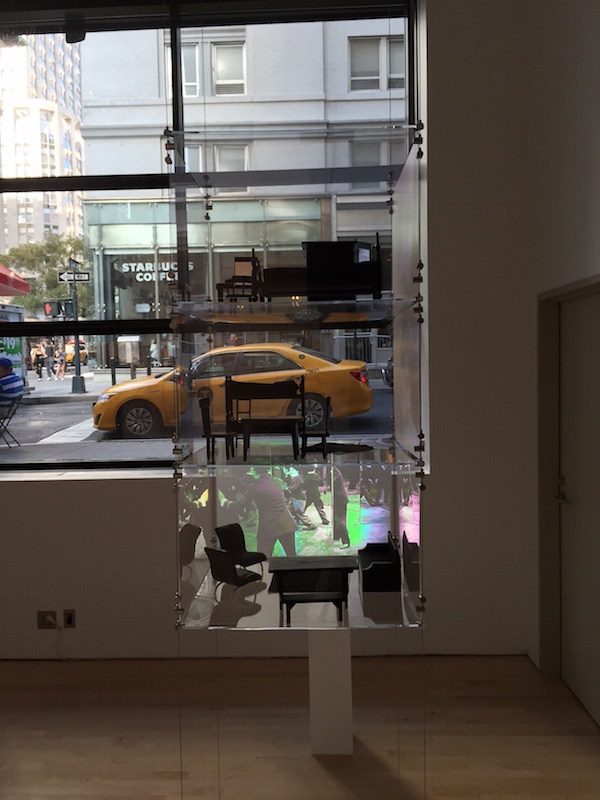
Zoe Beloff. Glass House, 2015; Plexiglas, three video projections, miniature furniture, metal fasteners; 24 x 24 x 48 in. Photo: Alex Bigman.
Beloff offers a picture of Eisenstein as someone who arrived in California with comparably greater social advantages. A gallery vitrine of archival material contains photographs of him palling around with Walt Disney, playing tennis with Charlie Chaplin, and working alongside his assistant, Gregori Aleksandrov, on the sun-dappled terrace of their enviable Coldwater Canyon home. Similar to Brecht, however, Eisenstein possessed what would prove to be an utterly unrealistic yet equally uncompromising desire to marshal Hollywood’s resources for his radical experiments in filmmaking. Among these, for example, was a desire to film in a vertical format—Beloff quotes him hailing this as a “virile, masculine” alternative to the standard horizontality—which would have required a complete revolution in cinema infrastructure in order to be profitable.
Eisenstein’s outsized ambitions are emblematized by his idea for The Glass House, a film about the dehumanizing effects of an abode in which every surface is transparent—a result of architectural modernism gone mad. The Glass House never received the green light from producers, not least because of the tremendous expense entailed by Eisenstein’s proposed set design. Thus rebuffed, the youthful Eisenstein of Beloff’s film ambles through Los Angeles grumbling about a film industry in which art is “dominated by the dollar” and artists are subservient to the “money men” upstairs.[2]
As if to further illustrate Eisenstein’s film idea, Beloff presents a model of the director’s proposed set. Projected onto two of its Plexiglas surfaces, however, are films of Mickey Mouse and Chaplin’s tramp, respectively. Thus, the two Hollywood fixtures with whom Eisenstein cavorted, as seen in the archival display, reappear through the intrusive, even threatening form of their realized productions. No longer just a citadel of uncompromising vanguardism and leftist opposition, The Glass House also becomes the screen for a clash of egos, in which Eisenstein’s emerges the loser. Thus, Beloff’s model renders palpable several of the contradictions about Eisenstein’s tenure in Los Angeles that her research brings to the surface. In declining to resolve them, it demonstrates the capabilities of art as a complexifying complement to archival work. One wishes the exhibition as a whole did the same.
Zoe Beloff: A World Redrawn: Eisenstein and Brecht in Hollywood is on view at the James Gallery of the Graduate Center, City University of New York (CUNY), through November 21, 2015.
[1] Stephen Parker, Bertolt Brecht: A Literary Life (Bloomsbury, 2014), 433.
[2] From Zoe Beloff’s video Two Marxists in Hollywood (2015).





