







Seattle
Martin Creed: Work No. 360 at the Henry Art Gallery
Let’s just state the obvious: Martin Creed’s Work No. 360: Half the Air in a Given Space, on view at Henry Art Gallery, is insanely fun to experience. Pushing your way through a space filled (true to the installation’s title, only halfway) with over 37,000 pearly gray balloons is like being in a mosh pit, surrounded by marshmallows. It’s a ridiculous image, to be sure, but one that gets at how exhilarating, disorienting, and at times suffocating the piece feels on the inside.
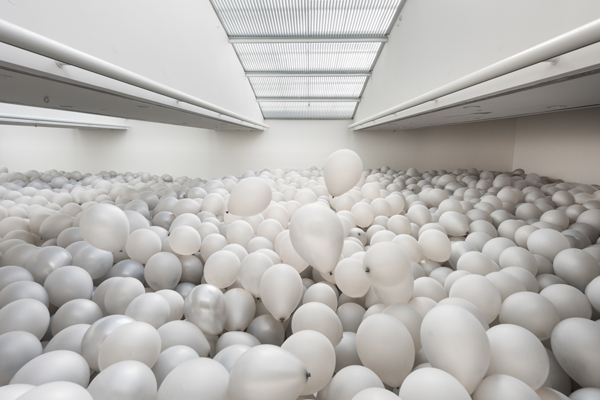
Martin Creed. Work No. 360: Half the Air in a Given Space, 2015; installation view. Courtesy of Henry Art Gallery, University of Washington, Seattle, Washington. Photo: RJ Sánchez, Solstream Studios.
Over the past decade, Creed has made about a dozen pieces involving colored latex balloons of various dimensions. The exact number of balloons for each installation is calculated via a mathematical calculation; the volume of the gallery is halved and then divided by the equivalent volume of a sixteen-inch balloon in cubic feet. Work No. 360 turns the Henry’s lower-level gallery into a space of play that simultaneously, thanks to the sheer density of the balloons, makes one self-conscious of the volume that one’s body takes up while masking the true dimensions of the surrounding white cube.
First viewed from above, the installation swells and moves, recalling a wave pool, although the source of the balloons’ undulations isn’t entirely clear. It’s only as you descend a gradually sloping ramp to the gallery’s glass entrance below that you realize people inside are causing the bursts and ripples seen on the surface. Once you have been given a green wristband (to track attendance), squeezed in through the glass door, and let the initial wave of shock wear off, it’s hard not to start reaching for metaphor: the aforementioned mosh pit, a snowstorm, a fog bank, or, to expand on Sylvia Plath’s remarkably prescient phrasing, a herd of “oval-soul animals/taking up half the space.”
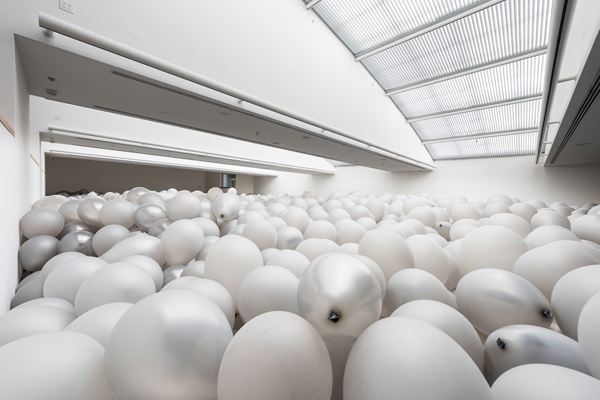
Martin Creed. Work No. 360: Half the Air in a Given Space, 2015; installation view. Courtesy of Henry Art Gallery, University of Washington, Seattle, Washington. Photo: RJ Sánchez, Solstream Studios.
Whatever your choice, nothing quite encapsulates the physical experience of the space. The balloons both impede and warp one’s range of motion and field of vision, making the bounded space they’re contained in feel infinite and decidedly more viscous. That initial endorphin-fueled sense of fun is tempered by unease (and for the truly claustrophobic, panic would immediately ensue). Getting separated from someone is easy, whereas—as attested to by the anxious fidgeting and fruitless calls of the parents lined up outside the gallery, still waiting for their children to emerge—finding each other is far more challenging. Bumping into another person frequently came as an unexpected surprise, despite the sounds of the balloons squeaking and rubbing together (or popping underfoot), which offered a kind of echolocation for sensing other people’s trajectories.

Martin Creed. Work No. 360: Half the Air in a Given Space, 2015; installation view. Courtesy of Henry Art Gallery, University of Washington, Seattle, Washington. Photo: RJ Sánchez, Solstream Studios.
Through the piece’s accompanying wall text, the Henry dutifully posits Andy Warhol’s bespoke, pillow-like silver clouds as an art-historical precedent and counterpoint to Creed’s denser massing of commercially produced gray orbs. Given the range of feelings triggered by the piece, a more instructive comparison might be to the large-scale, participatory amusements of Creed’s contemporary, Carsten Holler. Broadly speaking, both artists are interested in setting into place conditions that heighten, trigger, or play off of sensory-based affective states such as excitement, surprise, and wonder. However, unlike Holler’s giant corkscrew slides or flight-simulating harnesses, Work No. 360 achieves these thrilling ends through simpler means: It makes solid the volume that is already present within the space, by using a readily available object. Creed refrains from couching his work in the aura of pseudoscience that, in Holler’s case, often feels pretentious and condescending. If both Holler and Creed invite us to reappraise institutional space as a site for play, Creed goes further. He asks those who step inside Work No. 360 to reencounter play as a kind of viscerally felt negotiation of boundaries, emotions, and interpersonal recognition. Perhaps it’s all much simpler than that, and Work No. 360 boils down to one question that it leaves unanswered: What’s more fun—running through a room full of balloons or running through a room full of balloons in an art museum?
Martin Creed: Work No. 360: Half the Air in a Given Space is on view at Henry Art Gallery in Seattle through September 27, 2015.





