







Shotgun Reviews
Graffiti and Pictorial Actions for Ricardo Cadena
Shotgun Reviews are an open forum where we invite the international art community to contribute timely, short-format responses to an exhibition or event. If you are interested in submitting a Shotgun Review, please click this link for more information. For the next three Sundays, our Shotgun Reviews will come from the finalists for the Daily Serving/Kadist Art Foundation Writing Fellowship in Mexico City. In today’s edition, author Jorge Gomez del Campo reviews the Graffiti and Pictorial Actions for Ricardo Cadena on June 9, 2015, in Mexico City.
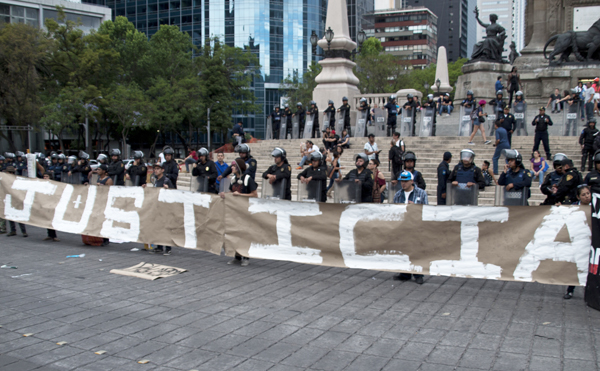
Acciones Pictóricas Grafiteras por Ricardo Cadena, May 9th, 2015; Mexico City.
The sun in the center of Mexico City was unbearable; an assorted gathering of rappers, artists, hip-hoppers, and activists crowded into the shade in front of Metro Sevilla. They were there for an event called “Acciones Pictóricas Grafiteras por Ricardo Cadena.” A few people were tagging on butcher paper taped to the walls. Curious commuters pushed their way in between the large banners commemorating and denouncing the murder of Ricardo Cadena in the city of Puebla, Mexico, by the police. Initial reports suggested an accidental shooting. Later, eyewitness testimony said that the graffiti artist had been shot while face down on the ground, at point blank range.
Transit police in yellow vests guided traffic around gathering onlookers. A handful of other officers monitored the crowd. People took to a megaphone. Some spoke about plans for the day. Others demanded justice for Cadena. A few people rapped, including a young woman; there was grief and tension in the muscles of her thin face; there was grief and tension in her quavering voice.
From in front of the Metro, the action moved to the streets. Dozens marched on an upscale street named after the city, Puebla, where Cadena was killed. They shook rattle-cans and tagged the pavement with the name of the murdered artist. As the march progressed, so did the police presence. Soon there were trucks loaded with armed and armored officers; soon there were additional foot patrols. Inevitably, small confrontations erupted. One masked artist pushed several police out of the way so he could finish spray-painting “Ricardo Cadena” across an intersection. Afterward, he posed defiantly for photos. Eventually, when the march reached El Angel, truckloads of riot police kettled the entire group.
The artists and activists organizing the event had no way to directly control the police, and their presence and intimidation seemed expected. Some part of the aesthetic and social effect of graffiti stems from its beginnings as a temporary, transgressive art of defiance. The aesthetic strength of this action, of its statement to Cadena—no amount of repression will silence the streets that call out your name; you will not be forgotten—depended upon the confluence of the exaggerated police presence and the defiance of the artists.
Jorge Gomez del Campo is an activist, artist, and academic living in Mexico City. As part of his doctoral investigation at the UNAM, he is currently analyzing spectacular violence as an artistic practice.





